

On this page
You sit down to study for the evening with a mountain of homework. You complete a mechanics numerical, switch to reading an organic chemistry chapter for thirty minutes, and then return to a maths problem. After two hours, you feel absolutely exhausted, but your to-do list has barely moved.
The problem is not your focus, your intelligence, or your stamina; the problem is how you have ordered your work. When you bounce back and forth between completely different types of thinking, you force your brain to constantly change gears. The solution to this hidden time drain is a technique called task batching.
What is context switching in studying?
When you change from calculating friction in physics to memorising plant morphology in biology, your brain cannot adapt instantly. According to a 2001 study published by the American Psychological Association by researchers Joshua Rubinstein, David Meyer and Jeffrey Evans, task switching involves two distinct stages of "executive control".
First, your brain must undergo "goal shifting", deciding to drop the previous task and mentally committing to the new one. Second, it must perform "rule activation", which involves unloading the mental framework for maths from your working memory and loading the completely different rules for biology.
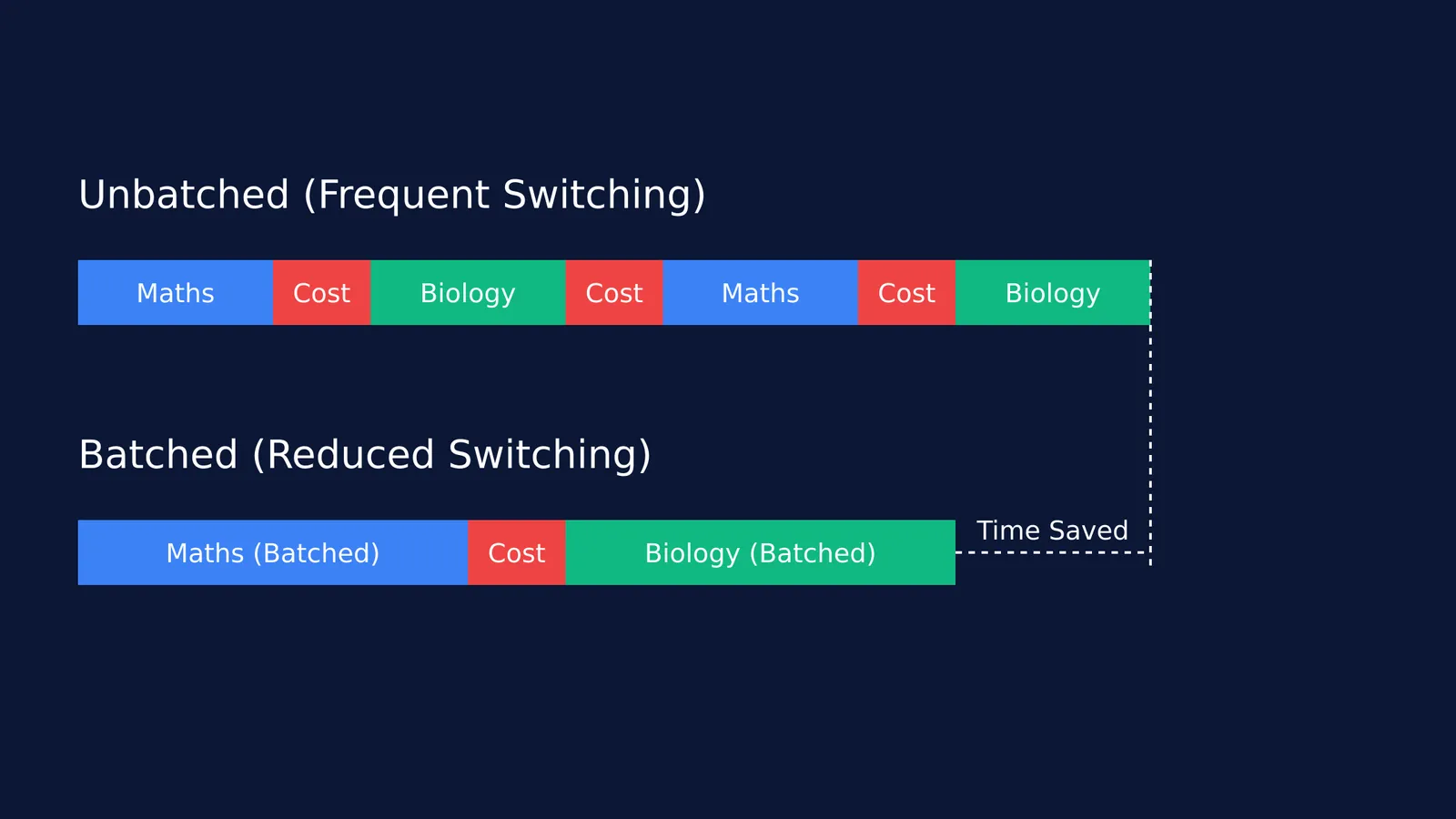
Each of these mental shifts takes only a fraction of a second, but they accumulate rapidly over a long study session. The researchers found that these mental blocks can reduce a person's productive time by up to 40%. Every time you switch between different subjects or different types of cognitive work, you pay a "switching cost." You are draining your working memory on the transition itself rather than the actual learning. This is exactly why you might stare blankly at a physics problem for five minutes after reading history, trying to remember formulas you knew perfectly well yesterday.
How long does it take to recover from an interruption?
The costs increase sharply if you break your batch to check a completely different task, like replying to a message or looking up a disconnected fact. A 2005 field study led by Gloria Mark observed that when workers are interrupted, it takes an average of 25 minutes and 26 seconds to return to the original task, as they often get side-tracked by other minor tasks along the way. While this study was conducted in office environments, the cognitive principle is identical for students: once you derail your train of thought, getting back into a state of deep focus requires significant time and mental energy.
How do you batch study tasks to save time?
The solution is to group your tasks by the *type of thinking* they require, rather than just by subject. For example, instead of doing five different subjects' homework assignments sequentially in whatever order you received them, you should batch them by the cognitive activity involved:
The problem-solving batch: Do all your physics numericals, maths exercises, and chemistry calculations together. Your brain is already in "calculation mode", making the transition between these subjects much easier and highly efficient.
The reading and note-taking batch: Read your history chapters, literature assignments, and your biology textbook back-to-back. You can stay in a narrative, comprehension-focused mindset.
The active recall batch: Review flashcards for chemistry, geography, and vocabulary in one single sitting.
By batching, you pay the cognitive switching cost only once per large block of time, rather than dozens of times throughout the evening.
How do you plan your batches effectively?
Start your day by identifying the "heavy lifting" tasks that require the most unbroken focus, such as learning a completely new mathematical concept or writing an essay draft. Schedule these intensive batches for when you naturally have the most energy. Leave passive tasks, like sorting notes or reviewing familiar flashcards, for the end of the day when your cognitive reserves are lower.
If you struggle to stick to a long batch block without getting distracted, you might want to look into whether the Pomodoro technique works for your personal focus span, or try to build a study routine that lasts longer than a week.
How does Fermi keep you in the batching zone?
One of the biggest reasons students break their batches and lose focus is getting stuck on a hard problem. Instead of abandoning your maths batch in frustration to read a biology textbook, the Fermi Problem Library provides worked problems with a step-by-step solver that explains the reasoning rather than just printing an answer.
If you are still struggling to grasp the underlying concept, Fermi's AI tutor can work out what you already know and build a plan for the session. By holding a continuous line of reasoning across a session, the tutor helps you push through the mental block without switching contexts, keeping your study batches efficient and intact.


