On this page
JEE Advanced registration opens for candidates who qualify through JEE Main, and the window is short. When we checked in October 2026, the official JEE Advanced website had not yet announced the 2027 dates. This guide follows the JEE (Advanced) 2026 Information Brochure, published by IIT Roorkee. Dates and cut-offs change, so check each detail against the 2027 brochure. Our guide to reading an information bulletin shows where the key rules usually sit.
Who is eligible to register for JEE Advanced?
The JEE (Advanced) 2026 eligibility page sets five criteria. You must meet all five.
JEE Main rank: you must be among the top 2,50,000 successful candidates, across all categories, in the B.E./B.Tech. paper of JEE Main.
Age: for 2026, you had to be born on or after 1 October 2001. SC, ST and PwD candidates get five extra years.
Attempts: you can take JEE Advanced at most twice, in two consecutive years.
Class XII: for 2026, you must have appeared in Class XII for the first time in 2025 or 2026, with Physics, Chemistry and Mathematics as compulsory subjects.
No earlier IIT admission: if an IIT has already admitted you, you cannot apply again, with narrow exceptions such as the preparatory course.
What documents do you need for JEE Advanced registration?
You upload scanned copies during registration. The 2026 brochure (Clause 15) lists the following:
Your Class X certificate if it shows your date of birth; otherwise, your birth certificate.
Your Class XII certificate, plus the marksheet if it is out.
A gazette notification if your name differs from your Class X certificate.
GEN-EWS or OBC-NCL: a certificate issued on or after 1 April of the exam year, or the brochure's declaration if you don't have it yet.
SC or ST: a caste or tribe certificate, or the declaration.
PwD: a UDID certificate or the brochure's PwD form. A dyslexia certificate must say "SEVERE" for you to get the PwD benefit.
Scribe or compensatory time: the request form addressed to the Chairperson of the nearest zonal coordinating IIT.
A Class XII board outside India or not on the brochure's list: an equivalence certificate from the Association of Indian Universities.
How much is the JEE Advanced fee?
These are the 2026 fees for exam centres in India, from the brochure's fee table:
Female candidates (all categories): ₹1,600.
SC, ST and PwD candidates: ₹1,600.
All other Indian candidates: ₹3,200.
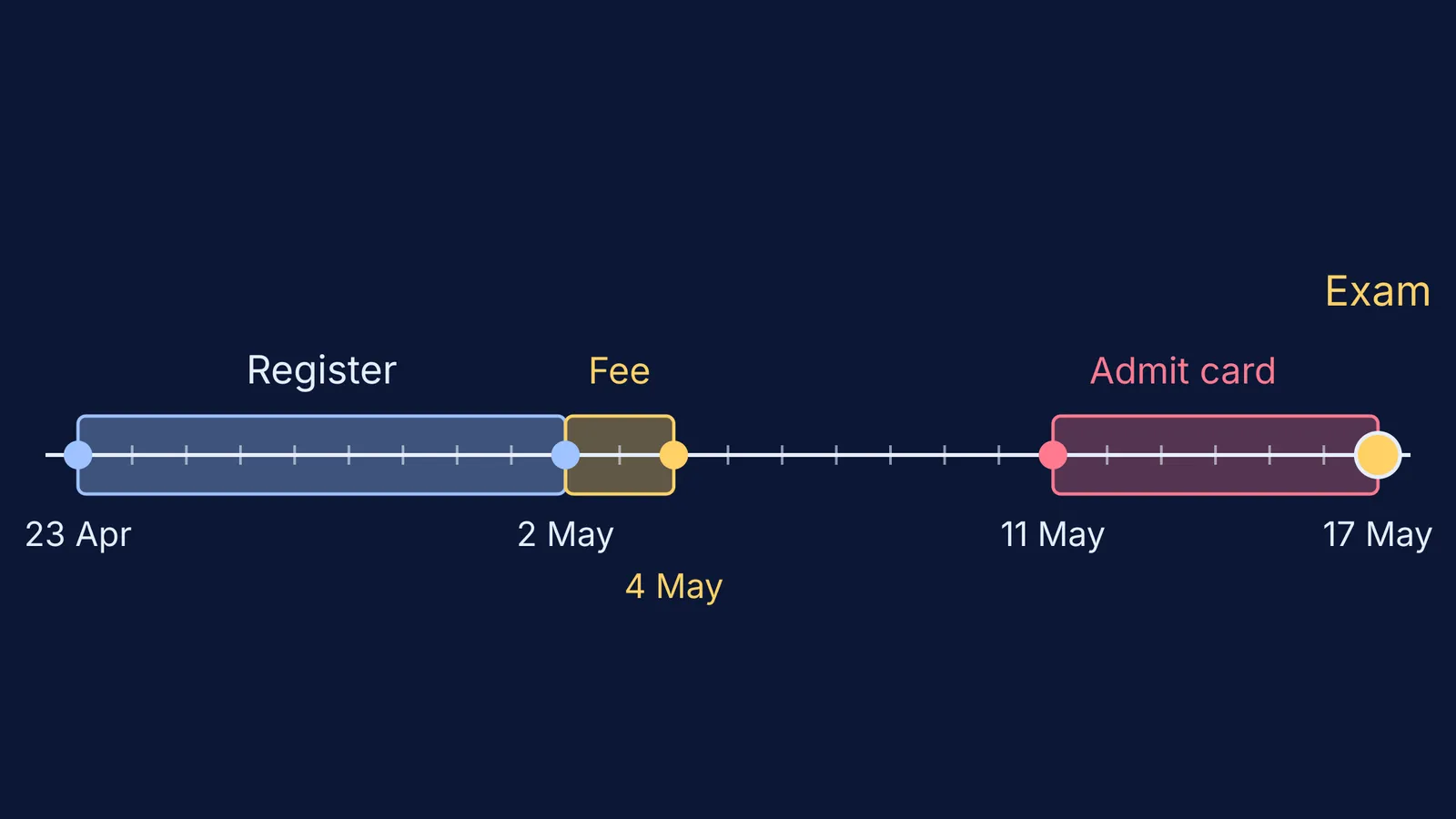
The fee excludes bank charges and is non-refundable. The brochure set 4 May 2026 as the last date to pay. On 4 May, the official website extended the registration deadline to 5 May and warned that registration is incomplete until the fee is paid.
What are the steps, day by day?
This plan follows the 2026 schedule. Shift the dates once the 2027 brochure is published.
Before the JEE Main result: scan your documents. Apply for a fresh EWS or OBC-NCL certificate dated after 1 April.
On result day: save your JEE Main scorecard and check your rank against the eligibility page.
Days 1 to 3 of the window: register at jeeadv.ac.in, upload your documents and choose your ten cities.
The same sitting: pay the fee and save the receipt.
Two days later: log in again and check that the fee shows as paid.
Admit card day: in 2026, admit cards could be downloaded from 11 May. Check your name, photograph, date of birth and category. If anything is wrong, contact the Chairperson at your zonal coordinating IIT. Our guide covers what to do about an admit card photo or signature mismatch.
What are the most common registration slip-ups?
Each of these comes from a rule in the 2026 brochure:
An old category certificate. An EWS or OBC-NCL certificate issued before 1 April does not meet the rule.
Picking cities in a hurry. You must list ten cities, and requests to change your city are not accepted under any circumstances.
Paying on the last night. Registration is not complete until the fee is paid, and a failed payment may leave little time to retry.
Forgetting the Class XII marks rule. To be admitted to an IIT, you need at least 75% aggregate marks in Class XII (65% for SC, ST and PwD candidates), or a place in the category-wise top 20 percentile of your board.
Not asking for a scribe or compensatory time. You must opt in during registration, not afterwards.
Once the form is in, the weeks before the exam are for revision. Our explainer on partial marking in JEE Advanced multiple-correct questions covers one rule worth knowing. If mock tests show you losing marks to the wrong method, the Fermi Problem Library has worked problems with a step-by-step solver that explains the reasoning rather than printing an answer.
If exam stress gets heavy, talk to someone you trust, or call Tele MANAS on 14416.