

On this page
The information bulletin is the official rulebook that the National Testing Agency (NTA) publishes for each exam, every year. The JEE Main 2027 information bulletin runs to more than 90 pages, and NTA's public notice of 24 October 2026 says candidates not complying with its instructions "shall be summarily disqualified". You do not need every page. Read five parts carefully and keep the rest for reference.
What is an information bulletin, and where do you find it?
It sets out who can apply, the fee, the paper pattern, the syllabus, exam-day rules and results. Download it only from the official site: jeemain.nta.nic.in for JEE Main and neet.nta.nic.in for NEET-UG. Check the exam name and year on the cover first; a PDF forwarded on WhatsApp may be last year's.
Which sections of the JEE Main bulletin should you read first?
The page numbers below are the printed ones in the JEE Main 2027 bulletin.
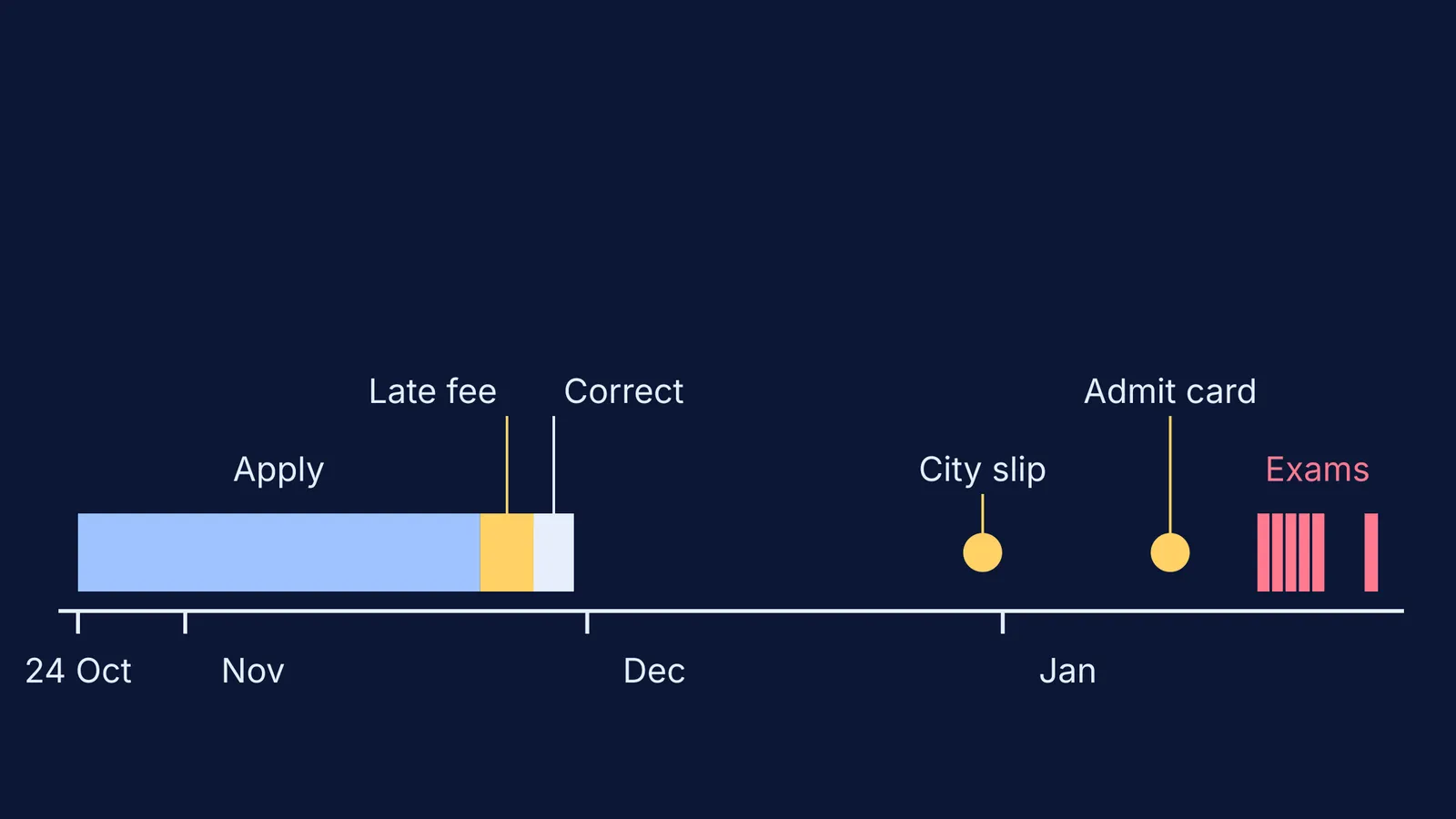
Important dates (pages 5 and 6). Session 1 applications run from 24 October to 22 November 2026, then a late-fee window (23 to 26 November) and corrections (27 to 29 November). The city slip is due on 30 December 2026, admit cards on 13 January 2027, and the exam is on 20, 21, 22, 23, 24 and 28 January 2027. Session 2 applications run from 5 January to 3 February 2027, with exams from 2 to 7 April 2027.
Eligibility (Chapter 3). There is no age limit, but you must have passed Class 12 in 2025 or 2026, or be appearing in 2027. Your state code of eligibility is the state where you passed Class 12, not where you live.
Documents and uploads (pages 8 and 9). Besides a live photograph, you upload a scanned photo of 10 to 200 kB showing 80% of your face, ears visible and no mask; a 10 to 100 kB signature; and your Class 10 certificate as a 50 to 300 kB PDF. The bulletin asks for your own email and mobile number; the public notice also allows a parent's or guardian's.
Rules (Chapters 8 to 10). Only one application is allowed, and NTA will not hold a re-test for anyone who misses their scheduled date. The barred list includes geometry boxes, any paper, calculators, phones and all watches.
Exam-day instructions (Chapters 6 to 8). Report two hours early; gates close 30 minutes before the exam starts. Carry a printed admit card with the self-declaration filled in, two passport-size photos matching your upload, and one original, valid photo ID. Print at least four copies of the admit card. A transparent water bottle is allowed; rough sheets and a pen are provided.
See also who can sit JEE Main and our guide to the JEE Main computer-based test screen.
How is the NEET-UG bulletin different?
The skeleton is similar; the details are not. The NEET-UG 2026 bulletin has its own chapter on barred items and dress code, and its barred list included pens, watches, belts and water bottles, some of which JEE Main allows or provides. Entry closed at 1:30 PM for a 2 PM paper, a parent's mobile number and email were mandatory, and a chapter for parents suggests visiting the centre a day early.
That bulletin opened applications on 8 February 2026, and on 25 October 2026 the NEET-UG website still listed it as current. When the 2027 edition appears, reread the same five parts. Our explainer on NEET UG eligibility rules covers age, subjects and qualifying marks.
How should you and a parent read it together?
Sit down with the PDF, one sheet of paper (your fact sheet) and a 30-minute timer.
Minutes 0 to 5: confirm the file. Exam name, year and NTA web address on the cover.
Minutes 5 to 10: dates. Copy every date onto the sheet and into a phone calendar, with a reminder two days before each deadline.
Minutes 10 to 15: eligibility. Check your Class 12 year and work out your state code.
Minutes 15 to 22: uploads. Resize your photo, signature and Class 10 certificate now, not on the last night.
Minutes 22 to 30: rules and exam day. Read the barred-items list aloud and write the documents to carry at the top of the sheet.
A worked example from the JEE Main 2027 bulletin: a student lives in Noida, Uttar Pradesh, but takes Class 12 at a school in New Delhi. Their state code of eligibility is Delhi. An improvement exam taken later from another state would not change it.
Then a check the parent can run: "Tell me the last date to pay the fee, the admit card date, and what you must carry." If the answers match the fact sheet, you are done.
After the paperwork, the syllabus chapter is the next thing to plan around. Fermi's AI tutor can work out what you already know and build a plan for the session, and the Fermi Concept Library gives each concept in physics, chemistry, biology and mathematics its own lesson.
Download the bulletin today and fill in your fact sheet before the first deadline.


