

On this page
If you are aiming for DTU, NSUT or IIIT-Delhi, your JEE Main rank is only half the story. Where you passed Class 12 decides which pool of seats you compete in. Here is how it works under the 2026 rules.
What is JAC Delhi counselling?
JAC Delhi is the joint online counselling for undergraduate admission to Delhi Government-funded universities, started in 2014, according to the About JAC Delhi page. Five universities take part: DTU, NSUT, IGDTUW, IIIT-Delhi and DSEU.
The JAC Delhi 2026 admission brochure puts this year's intake at 7,765 engineering seats and 90 B.Arch seats, and sets the rules:
NSUT, DTU, IGDTUW and DSEU allot B.Tech seats by your Common Rank List rank in JEE Main Paper 1.
IIIT-Delhi uses its own merit list: your JEE Main Paper 1 percentile plus up to 2 bonus points for achievements such as olympiads.
For general candidates, NSUT, DTU, IGDTUW and DSEU need 60% in Physics, Chemistry and Mathematics combined; IIIT-Delhi needs 70% in your best five subjects and 70% in Mathematics. Reserved categories get some relaxation.
Registration costs a non-refundable ₹1,500 plus transaction charges.
Who counts as a Delhi region candidate?
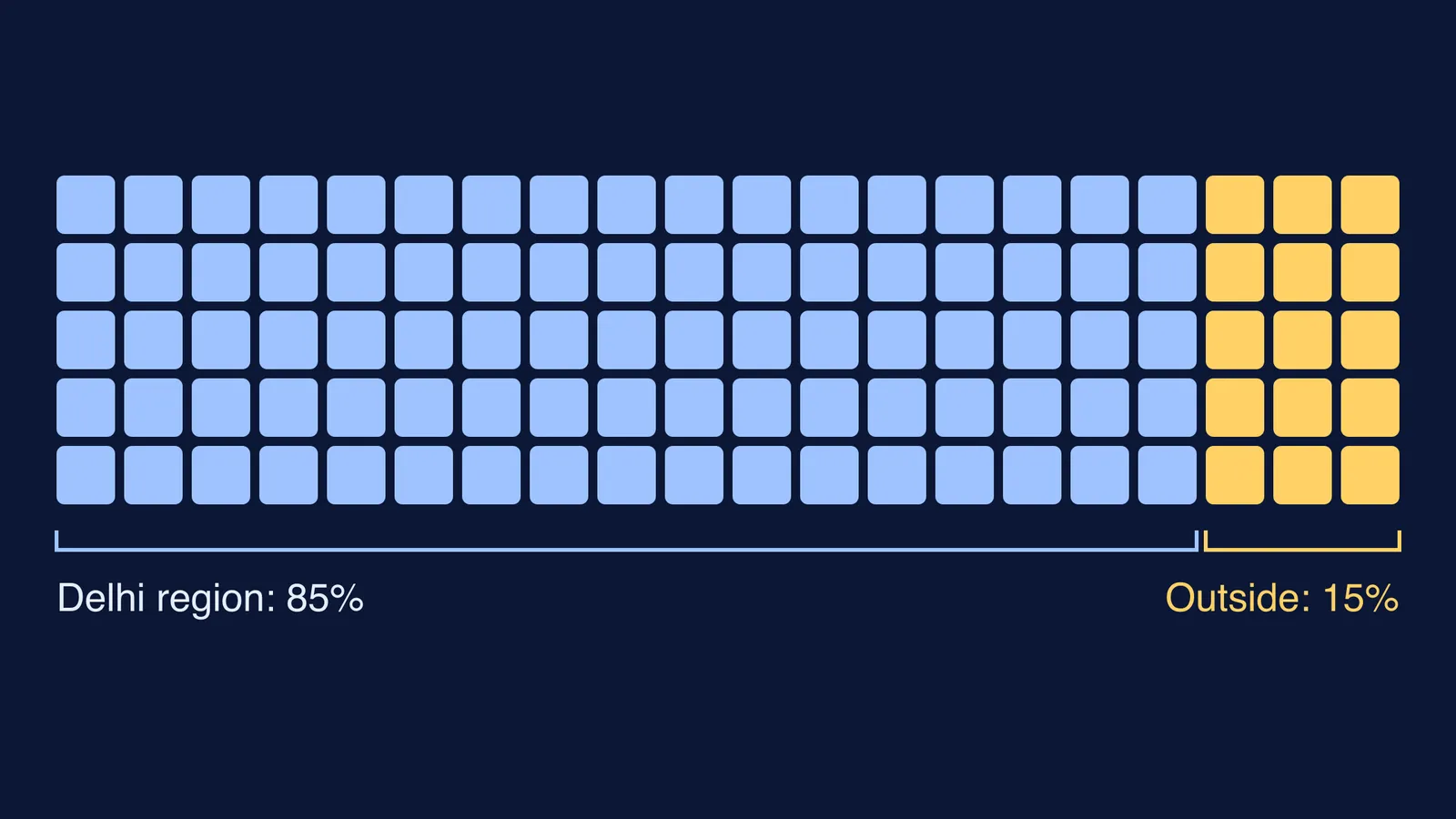
The 2026 brochure earmarks 85% of seats in every participating institution for Delhi region candidates and 15% for outside Delhi region candidates (JAC Delhi 2026 brochure, section 2.1). What counts is where your school is, not where your family lives. For NIOS or Patrachar Vidyalaya students, the location of the exam centre decides.
The brochure also reserves 15% of seats for SC, 7.5% for ST, 27% for OBC (non-creamy layer) and 10% for EWS. To claim a Delhi region SC, ST or OBC seat, your certificate must be issued by the Government of NCT of Delhi.
How does choice filling work in JAC Delhi?
You fill choices in the candidate login during registration, adding university and branch pairs and reordering them. When registration ends, your list locks automatically and, under the 2026 brochure (section 4.2), stays valid for the whole counselling. Later edits are limited to short scheduled windows, such as a single-day window after round 1, so treat your first list as the real one and fill as many choices as you can.
For a way to sort your list into dream, target and safe options, see our guide to ordering dream, target and safe choices, and use past opening and closing ranks to judge where each choice sits.
A simple way to build your list:
On paper, write every branch you would actually attend.
Cross out anything you would refuse even as your only offer.
Rank the rest by what you want, not what you expect; a higher choice you miss costs nothing.
Enter the list, check it against your paper copy, and print it after registration closes; you need the printout at document verification.
What happens after you get a seat?
The 2026 brochure runs 4 regular rounds and 1 online spot round, with an extra upgradation round after round 4 (JAC Delhi 2026 brochure, chapter 5). When you are first allotted a seat, you must pay a ₹95,000 seat acceptance fee on time. If you do not pay, the seat is cancelled and you drop out of the later online rounds. You then report in person for document verification.
Once your admission is confirmed, you are on float unless you ask to freeze:
Freeze: keep this seat and leave the upgrade queue. A frozen branch cannot be reverted.
Float: keep this seat but stay in line for a higher choice in later rounds. If you are upgraded, you do not report again at the new university.
An example: Riya lists NSUT CSE first, DTU IT second and IGDTUW ECE third. In round 1 she gets IGDTUW, pays ₹95,000, clears verification and stays on float. In round 2 she moves to DTU IT automatically, with no second acceptance fee and no second visit; the balance fee is then DTU's. Had she frozen, she would have stayed at IGDTUW.
If you change your mind, you can withdraw online before the last withdrawal date and get the ₹95,000 back minus ₹1,000 processing. After that date, the whole fee is forfeited. Running JoSAA and JAC Delhi side by side? Our guide to managing multiple counselling rounds without losing fees shows how to line up the deadlines.
A checklist before you register
Download the current brochure and schedule from the JAC Delhi information bulletin; dates and fees can change from year to year.
Keep certificates ready, scanned for upload and in original.
Register a bank account in your or an immediate family member's name; refunds go only there.
Ignore anyone promising a seat for money; the JAC website warns against touts.
If you want to use the weeks between rounds to firm up maths and physics before first-year B.Tech, Fermi's AI tutor can work out what you already know and build a plan for the session.


