On this page
Every counselling portal asks for the same thing: the programmes you want, in order. Most families spend their energy on which colleges go on the list. Fewer think hard about the order, and the order is where the decision is actually made.
This guide uses JoSAA, which allots seats at the IITs, NITs, IIITs and other government-funded institutes. For MCC or state counselling, read that body's own bulletin first.
How does counselling use the order of your choices?
JoSAA's allocation runs on a version of the Deferred Acceptance algorithm, according to the researchers who designed it (Baswana et al., INFORMS Journal on Applied Analytics, 2019). In plain terms, the system reads your list from the top and gives you the highest choice your rank can hold against everyone else's ranks and lists.
The JoSAA Business Rules 2026 spell out three things that matter here:
Only one seat from among the choices you fill is made available to you.
You will not be considered for any programme that is not on your list.
After the choice-filling deadline you cannot reorder, add or delete choices.
So a programme you leave off can never be allotted, and a programme you place too high can stop the system from ever reaching one you wanted more.
Does putting a safe college first improve your chances?
No. Economist Alvin Roth proved in 1982 that some matching procedures always give everyone on one side the incentive to report their true preferences (Roth, Mathematics of Operations Research, 1982). Deferred Acceptance is one of them: in the standard model, the side that applies, here the students, cannot get a better result by misreporting its order (Gale-Shapley algorithm, with sources).
In practice, a dream choice placed above your safe choice does not cost you the safe seat. If your rank cannot hold the dream, the system simply moves down to the next line.
JoSAA also runs several rounds. When you accept a seat you choose Freeze, Float or Slide, which decides whether you are still considered for choices above it in later rounds (JoSAA Business Rules 2026). We explain each option in JoSAA Freeze, Float and Slide: what each option means.
How do you split choices into dream, target and safe?
Start with last year's closing ranks for your category and quota; if the terms are new, read what opening and closing ranks mean in JoSAA and NEET. Then tag each programme you would genuinely join. This is a working rule of thumb from us, not an official cut-off:
Dream: last year it closed at a rank clearly better than yours, about a fifth better or more.
Target: it closed within about a fifth of your rank, either side.
Safe: it closed at a rank well beyond yours, about a third beyond or more.
Closing ranks shift every year, so treat the bands as rough.
A worked example: a rank of 12,000
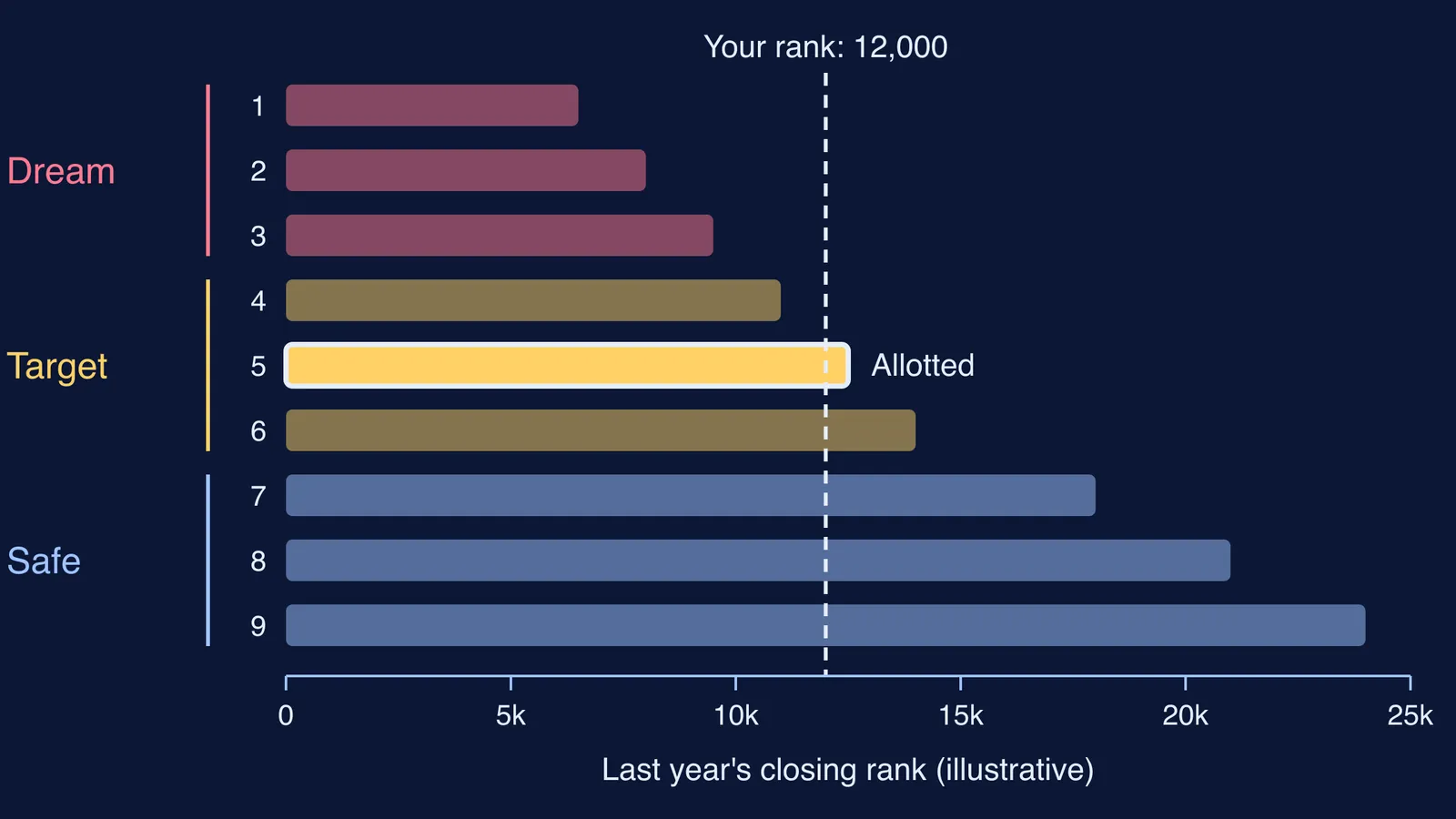
The numbers here are made up to show the mechanics. Asha has a rank of 12,000. Her nine choices, with last year's closing ranks, are:
Dream: 6,500
Dream: 8,000
Dream: 9,500
Target: 11,000
Target: 12,500
Target: 14,000
Safe: 18,000
Safe: 21,000
Safe: 24,000
If this year looks like last year, the system checks choices 1 to 4, finds her rank cannot hold them, and allots choice 5. Choices 6 to 9 were her insurance if ranks had moved against her.
Now suppose a worried relative persuades her to put the 18,000 safe choice at number 1 "just to be sure". She is allotted it straight away. Nothing sits above it on her list, so no later round can move her up to the 12,500 target she could have had.
What should you check before locking your list?
List only programmes you would actually join, as the JoSAA Business Rules 2026 advise.
Order them by preference alone, then tag each as dream, target or safe.
Make sure you have several safe choices you would be content to attend.
Use the mock seat allocations: the 2026 rules included two within the choice-filling window. Our guide on how to read your JoSAA mock seat allotment result shows what to look for.
Save often and lock before the deadline. The rules say unsaved choices are not recognised, and the last saved list is locked automatically.
If counselling is still a year away and most of your list sits in the dream band, the work that shifts bands happens in physics, chemistry and maths. Fermi's AI tutor works out what you already know and builds a plan for the session, so each study hour starts from your actual gaps.
Write your list on paper first, in pure preference order, and only then open the portal.