

On this page
The Joint Seat Allocation Authority (JoSAA) handles admissions for IITs, NITs, IIITs, and GFTIs. Before the actual rounds begin, the system runs two mock allotments. In 2024, for instance, these rounds were held on June 15 and June 17, drawing on a seat matrix of 59,937 available seats.
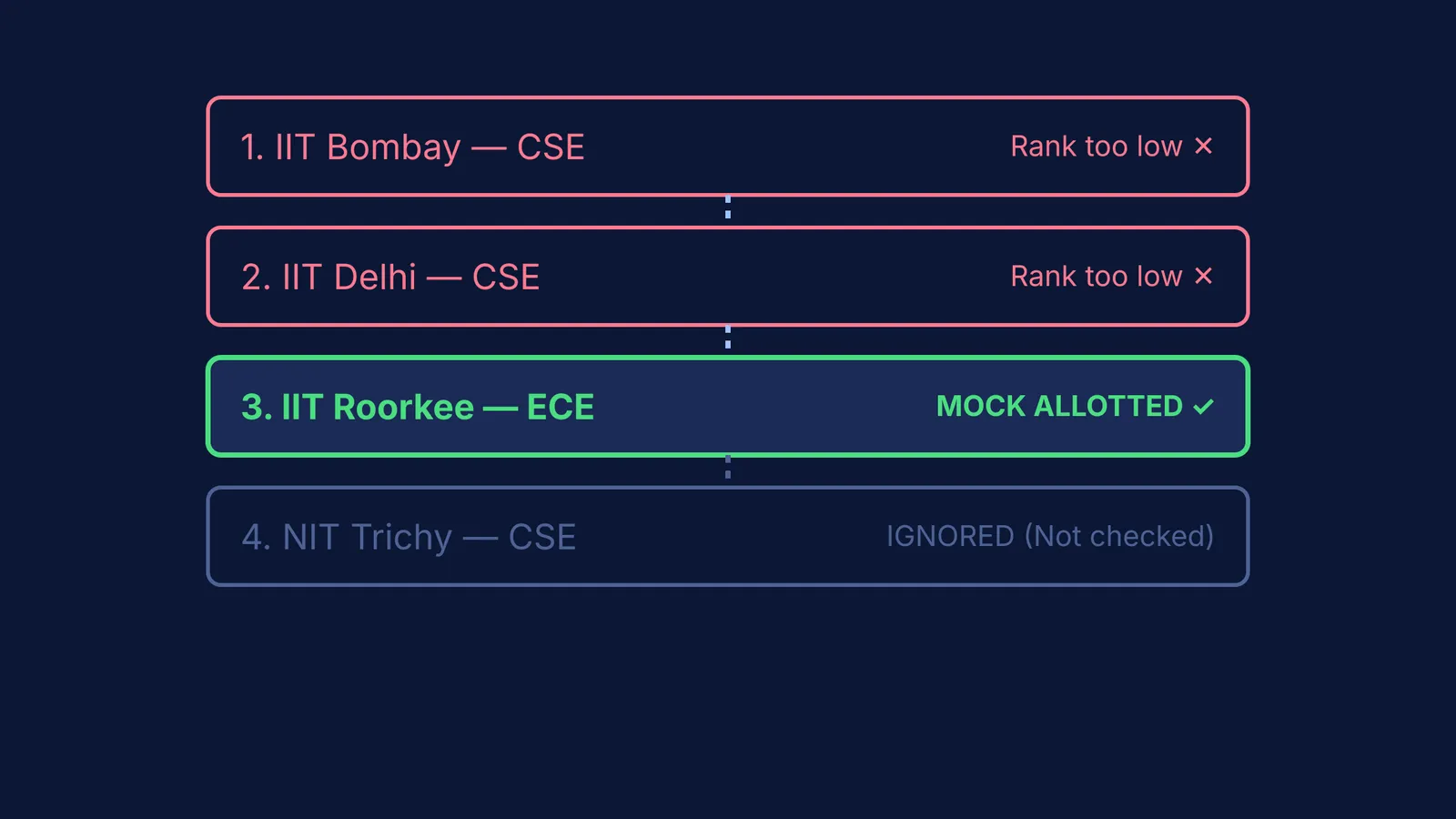
The mock result acts as a trial run. It reads your list from top to bottom, checking your JEE Main or JEE Advanced rank against the previous year's cut-offs and the current applicant pool. The first choice where your rank makes the cut is shown as your mock allotment.
How to read your JoSAA mock seat allotment result?
To check your result, log in to the official JoSAA portal using your JEE Main application number and password. On the candidate dashboard, click the "View Mock Seat Allotment Result" tab.
When the page loads, you will see one of two outcomes.
An allotted seat: The system will list a specific institute and branch, such as NIT Warangal for Chemical Engineering. This means that if the final round were conducted at that exact moment, you would likely be placed in that seat based on the choices you have saved so far.
"No seat allotted": This indicates that your rank is currently too low for the choices you have listed. The closing ranks for the colleges you selected are higher than your position.
If you are allotted a seat, pay close attention to its position on your preference list. Any choice listed below this allotted seat is effectively invisible to the system. The algorithm stops reading your list the moment it finds a match. This is exactly how the real allocation works, which is why your true preferences must sit at the top of the list.
How to change choices after a JoSAA mock allotment?
The mock allotment is not a final offer; it is a strategic tool designed to help you reorder your list before the choice-locking deadline. You can add, remove, or rearrange colleges based on what the mock result tells you.
If you received a "No seat allotted" message, your list is too ambitious. You need to expand your preferences. Add more options at the bottom of your list where your rank safely clears the historical cut-offs.
If you were allotted a seat, you now have a solid baseline. You can safely remove any choices below this allotted seat that you do not actually want to attend, because the system will never reach them anyway. For the choices above your mock allotment, arrange them strictly by what you want most, following the "Dream, Reach, Safe" framework:
Dream choices (Top): Place the institutes and branches that are slightly above your rank at the very top. You might get lucky if cut-offs drop or if other students shift their preferences.
Reach choices (Middle): These are the courses where your rank closely matches the previous year's closing ranks. This is where your mock allotment seat usually lands.
Safe choices (Bottom): These are colleges where your rank is well ahead of the cut-off, ensuring you have a backup plan if the cut-offs spike.
Why is the mock allotment not your final seat?
Your mock result is a snapshot of the choices filled up to that specific day. However, many candidates will change their lists after seeing their own mock results, which changes the mathematical landscape for everyone.
If a candidate ranked higher than you adds the same seat to their list after the mock round, they might take that seat in the real Round 1. Conversely, if students ahead of you decide to drop a choice, a better seat might open up for you, pushing you higher up your preference list. Because of these shifts, the real cut-offs always move.
The most important rule is to fill your choices in the exact order you want to study them. Do not place a college higher just because its historical cut-off is higher; place it higher because you want to go there more.
If you are preparing for your next attempt, the Fermi Problem Library has worked problems with a step-by-step solver that explains the reasoning rather than printing an answer, helping you build the right approach for the exams that decide these ranks. If your rank requires you to sit for further counselling, keep an eye out for the CSAB special rounds after JoSAA, which fill the remaining NIT and IIIT seats after JoSAA concludes.
For more details on how your percentile was calculated before counselling, read How JEE Main percentile scores and shift normalisation work. If you are considering state engineering admissions, review the KEA counselling after KCET process.


