On this page
If a counsellor, an online quiz or a relative has handed your child an IQ number, it is easy to treat it as a verdict. It is better read as a measurement with error bars, taken on one day, against norms that age. Here is what the test covers, why the number moves, and how to read a report.
What does an IQ test actually measure?
A modern IQ test is a set of short tasks. The Wechsler Intelligence Scale for Children (WISC-V), used for ages 6 to 16, groups them into five areas: verbal comprehension, visual spatial skill, fluid reasoning, working memory and processing speed, according to Pearson's sample WISC-V UK report.
The Full Scale IQ is scaled so that the average child of the same age scores 100, with a standard deviation of 15, and Pearson describes 90 to 109 as the average range (WISC-V UK sample report).
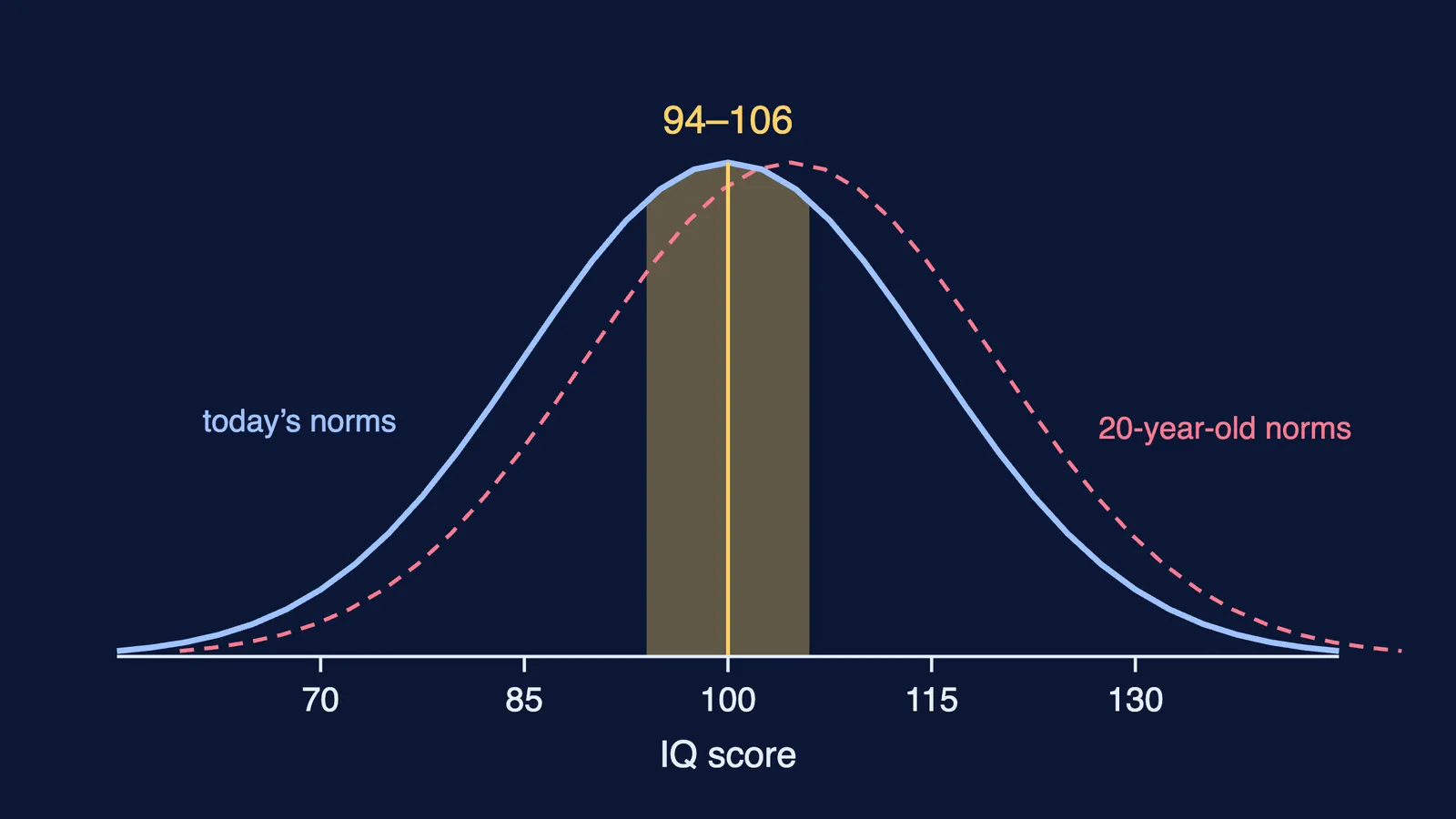
Every score is true ability plus some measurement error, so the same report gives each one as a 95% confidence interval: its sample child's Full Scale IQ of 100 is reported as 94 to 106 (Pearson). That is a 12-point window around one number.
Notice what is not on the list: curiosity, persistence, creativity, how clearly you explain an idea, or how much physics you know.
Why do IQ scores change over time?
The Flynn effect. IQ scores have risen across generations, so a test's norms go stale. A meta-analysis of 285 studies found scores rise by about 2.31 points per decade against older norms (Trahan and colleagues, Psychological Bulletin, 2014). A separate review of almost 4 million people from 31 countries found gains from 1909 to 2013, smaller in recent decades (Pietschnig and Voracek, 2015). So a child scored on 20-year-old norms can look several points higher than on current ones.
Practice effects. Taking a test again raises the score. A meta-analysis of 50 studies and 134,436 people taking cognitive ability tests found an average retest gain of 0.26 standard deviations, larger with coaching and identical test forms (Hausknecht and colleagues, 2007). On the IQ scale, where one standard deviation is 15 points (Pearson), a gain of that size would be roughly 4 points. A later meta-analysis of 153,185 people found gains up to the third sitting and none after (Scharfen, Peters and Holling, 2018).
Schooling moves scores too. Across more than 600,000 participants, each extra year of education raised cognitive scores by about 1 to 5 IQ points (Ritchie and Tucker-Drob, 2018).
Does IQ predict marks in school?
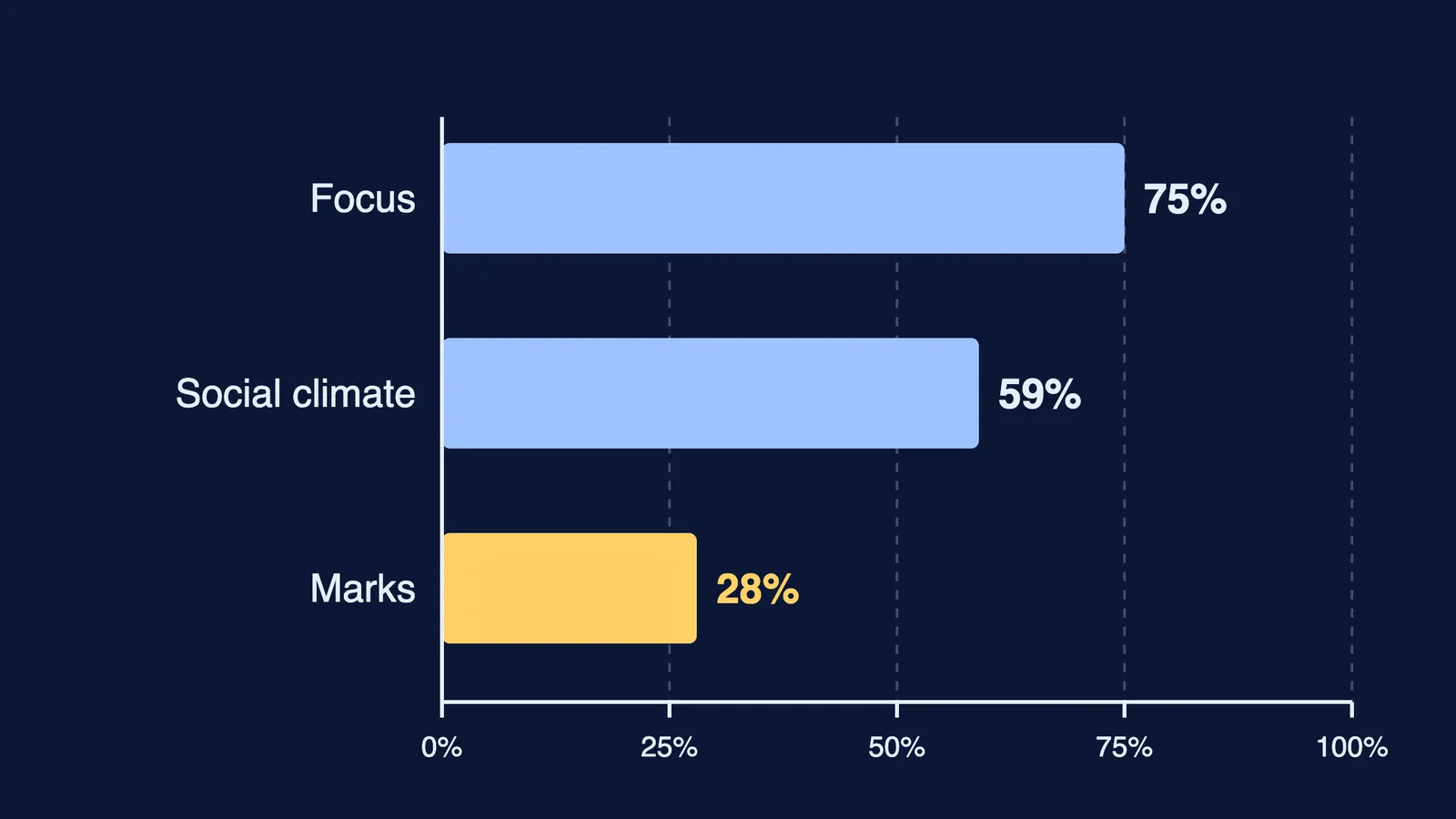
Strongly, but not completely. In a study of more than 70,000 English children, general intelligence measured at 11 and GCSE results at 16 correlated 0.81 (Deary and colleagues, 2007). The share of variation in subject results explained by intelligence ranged from 58.6% in mathematics to 18.1% in art and design, so even in maths a large part of the result came from something else.
Habits are part of that something else. In a study of 164 eighth graders, self-discipline measured in autumn accounted for more than twice as much variance in final grades as IQ did (Duckworth and Seligman, 2005). The words adults use matter as well; Carol Dweck's research on growth mindset and praise explains why praising effort and strategy beats praising being clever.
How should you read a child's IQ report?
Before a number becomes a label, ask five questions:
Which test, and how old are its norms? Older norms inflate scores.
What is the confidence interval? Read "94 to 106", not "100".
Has the child taken this or a similar test recently? Practice adds points.
Do the five area scores differ? A gap tells you more about what help to give than the total does.
Who interpreted it? A qualified psychologist reads it alongside schoolwork, health and context. A free online quiz does none of this.
Then choose your words. Instead of "You have an IQ of 112, so maths should be easy for you", try "This test says your reasoning was strong on that day. What you practise next is what changes your marks." The second is accurate, and points at something your child controls.
For students: if you are preparing for a reasoning paper, practice will raise your score, and that is expected; our guide on how to prepare for a mental ability test in Class 10 sets out a plan.
If a low score has left you unsure where to start with a subject, Fermi's AI tutor works out what you already know and builds a plan for the session, so the next step is about the topic, not the number. The Fermi Concept Library has a lesson for every concept in physics, chemistry, biology, mathematics and computing when you want to fill one gap at a time.
If a test result or exam pressure is weighing on your child, talk to a school counsellor or a qualified psychologist. Tele MANAS, the government's free mental health helpline, is on 14416 (National Mental Health Programme).
One score is one day's reading; what your child does next deserves more attention.