

On this page
If the exam is tomorrow and you have barely started, you can still help yourself tonight. The aim is not to cover everything. It is to pull the important material out of your memory several times, fix the gaps, and still sleep.
Can you really study for an exam in one night?
You can learn some of it, with a catch. In Roediger and Karpicke's 2006 study in Psychological Science, students either reread prose passages or took recall tests on them. On a final test 5 minutes later, rereading did better. On tests 2 days or 1 week later, the students who had tested themselves remembered substantially more, even though rereading had made students feel more confident.
Your exam is not 5 minutes away; it is tomorrow, after a night's sleep. So build tonight around testing yourself, not rereading. A 2013 review of 10 study techniques by Dunlosky and colleagues reached the same verdict: practice testing and distributed practice were rated high utility, while rereading and highlighting were rated low, and the authors suggest practice testing in place of rereading.
What should you cover when you only have one night?
Spend the first half hour sorting. With the portion list and last year's paper beside you, put every topic in one of three piles:
A: likely to be asked, and you half-know it. Most of tonight goes here.
B: likely to be asked, and new to you. Learn the core only: definitions, standard formulas or diagrams, and one worked example of each question type.
C: unlikely, or already solid. A quick skim at the end, or nothing.
How should you test yourself tonight?
Work in 25-minute cycles with 5-minute breaks, built on the testing effect above:
Close the book. Write down everything you remember about one topic, or attempt two or three questions from a past paper.
Open the book and mark what you missed or got wrong, in a different colour.
Redo only the misses, book closed.
Copy each miss in one line onto a single sheet: your morning page.
For each topic, ask yourself out loud: what is the definition, what is the formula, when does it apply, and what does a typical question look like? A parent can help by reading out questions and only checking your answers.
If a numerical keeps going wrong because you picked the wrong method, the Fermi Problem Library has worked problems with a step-by-step solver that explains the reasoning rather than printing an answer.
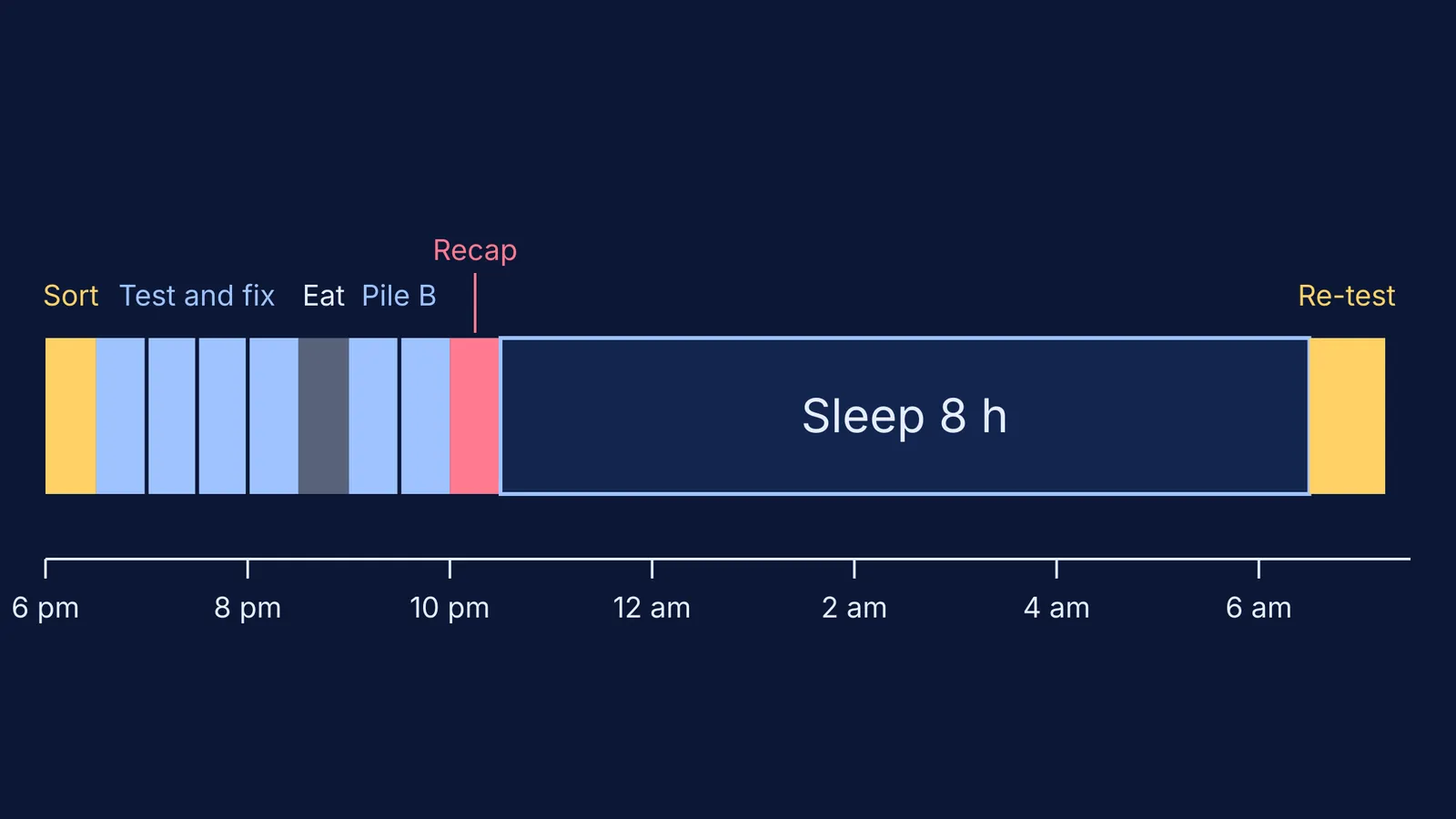
The evening, for a 6:30 am alarm:
6:00 to 6:30 pm: sort topics.
6:30 to 8:30 pm: four cycles on pile A.
8:30 to 9:00 pm: dinner, away from your desk.
9:00 to 10:00 pm: pile B, then a short mixed set of questions.
10:00 to 10:30 pm: read your morning page once; screens away.
10:30 pm to 6:30 am: sleep.
6:30 to 7:15 am: test yourself on the morning page. No new topics.
When should you stop studying and sleep?
Set the stop time before you start. The US Centers for Disease Control and Prevention recommends 8 to 10 hours of sleep a day for teenagers aged 13 to 17, which is why the plan above keeps 8 hours.
In a diary study of 535 high school students published in Child Development, students recorded their study and sleep for 14 days in each of three school years; on days after they gave up sleep to study more than usual, they had more trouble understanding lessons and were more likely to struggle on a test or assignment. A 2007 brain imaging study by Yoo and colleagues in Nature Neuroscience found that after a single night without sleep, activity in the hippocampus, a region central to forming new memories, was lower while people learned new material, and they remembered less of it later.
If worry keeps you awake night after night, talk to a parent, teacher or doctor, or call Tele MANAS on 14416, India's free national mental health helpline. Our posts on how to stop feeling sleepy while studying and the night before a school exam: a checklist for parents cover the practical side.
How do you avoid cramming next time?
Use the same cycles, spread out. The Dunlosky review rated distributed practice, studying in sessions spread over time, as high utility for learners of different ages and abilities. With a week, you could test the same topics a week before, three days before and the day before, so each round catches what has slipped. Keep tonight's morning page: it is a ready-made list of what to test first.
A simple way to start is a weekly quiz that mixes old and new topics, as in our guide to how a weekly cumulative quiz stops forgetting. If you don't know where to begin, Fermi's AI tutor can work out what you already know and build a plan for the session, so you sit down to a clear next step.
Tonight, sort, test, sleep. Next time, start a week early and do the same thing three times.


