

On this page
It’s the evening before the board exam. The syllabus is covered (or mostly covered), the house is quiet, and the nerves are starting to build. As a parent, this is the time to shift from academic coach to practical support. The goal of the final evening is not to cram new equations, but to organize the morning and protect your teenager's confidence and memory.
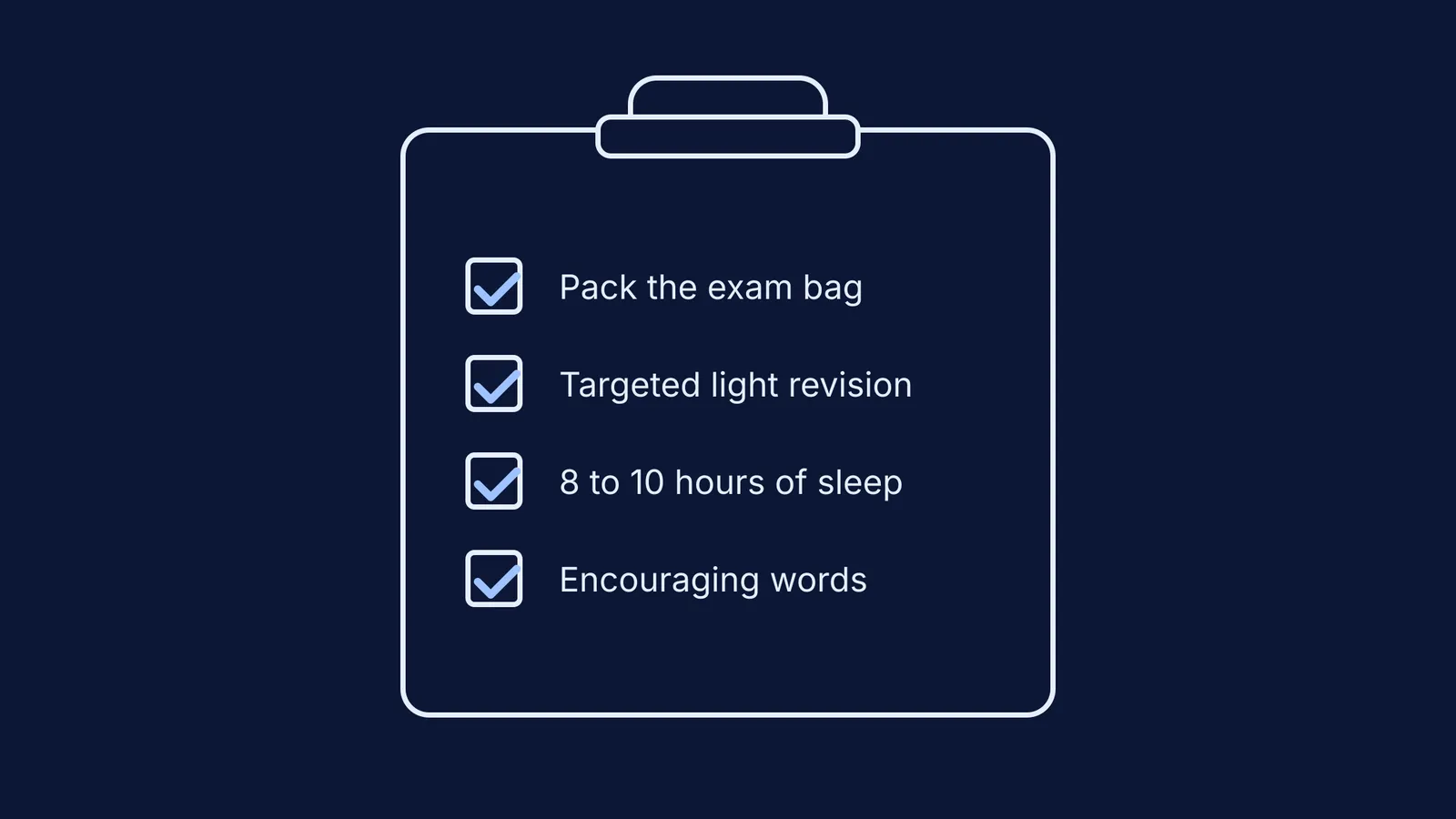
What should they pack in their exam bag?
The first step to a calm morning is packing the night before. If your teenager is taking a board exam, the entry rules are strict. Packing their bag together ensures they will not be turned away at the gate.
Admit card and ID: The physical, original admit card and their school identity card are mandatory. It is helpful to keep a photocopy at home just in case.
Stationery: Keep everything in a transparent pouch. They will need blue or royal blue ballpoint or gel pens, pencils, an eraser, and a scale.
Personal items: Only a transparent water bottle and a simple analogue watch are permitted. Digital watches, smartwatches, and opaque bottles are barred.
Travel essentials: Make sure their metro card, bus pass, or a small amount of money for travel is ready in their pocket.
By gathering these items before dinner, you remove the panicked morning search for a working pen. It signals a hard stop to the day's practical worries.
How to structure a light revision?
In the late afternoon, keep revision targeted. This is not the time to read a textbook cover to cover or start a completely new topic. Instead, have them review a few key concepts or practice one or two familiar problems to build momentum.
For example, if they are reviewing tracing a ray through a glass slab or naming carbon compounds in Class 10, keep the session short and targeted. If they are stuck on a specific concept, the Fermi Concept Library holds a lesson for every concept in physics, chemistry, biology, mathematics and computing.
If they need to walk through a final problem to reassure themselves, Fermi's AI tutor works out what they already know and builds a plan for the session. By writing on a board and checking their understanding as it goes, it helps them finish their revision early. Once that focused session is done, close the books. The rest of the evening should be for an early dinner and winding down.
How much sleep do they really need?
It is tempting for a student to stay up until 2 AM revising, but this harms their performance. The US Centers for Disease Control and Prevention recommends 8 to 10 hours of sleep per night for teenagers aged 13 to 17 (Source).
Sleep is not just rest; it is when the brain does the work of studying. A landmark 2006 study published in *Current Biology* demonstrated that sleep actively protects declarative memories—such as historical dates or biology definitions—from being disrupted by competing information (Source). When participants in similar tests were faced with interfering information, those who had slept retained significantly more of the original material compared to those who stayed awake.
To help them wind down, encourage a screen-free hour before bed. The blue light from phones delays the release of melatonin, making it harder to fall asleep. Suggest reading a non-academic book or listening to quiet music instead.
What are the right words to say?
The words a parent uses on the eve of an exam can either buffer against stress or act as a catalyst for anxiety. A 2022 meta-analysis published in the *Psychological Bulletin* found that young people's perceptions of their parents' expectations increased by 40% between 1989 and 2019, driving a rise in perfectionism and anxiety (Source).
What to avoid:
"You must get an A."
"Your cousin already finished their revision."
"Don't let us down."
These phrases tie their self-worth to a score and create a transactional view of learning. Children often look to parents for cues on how to interpret stressful situations. If a parent uses catastrophizing language, the child learns to perceive the exam as a threat rather than a challenge.
What to say:
"I am proud of how hard you have worked."
"An exam is just one way to show what you know."
"We are here for you regardless of the result."
These statements satisfy their psychological need for support without adding pressure. A low-key environment where parents manage their own stress allows the student to approach the exam with hope rather than fear. If anxiety is overwhelming, remind them that help is available; in India, professional support can be reached through helplines like Tele MANAS (14416).


