

On this page
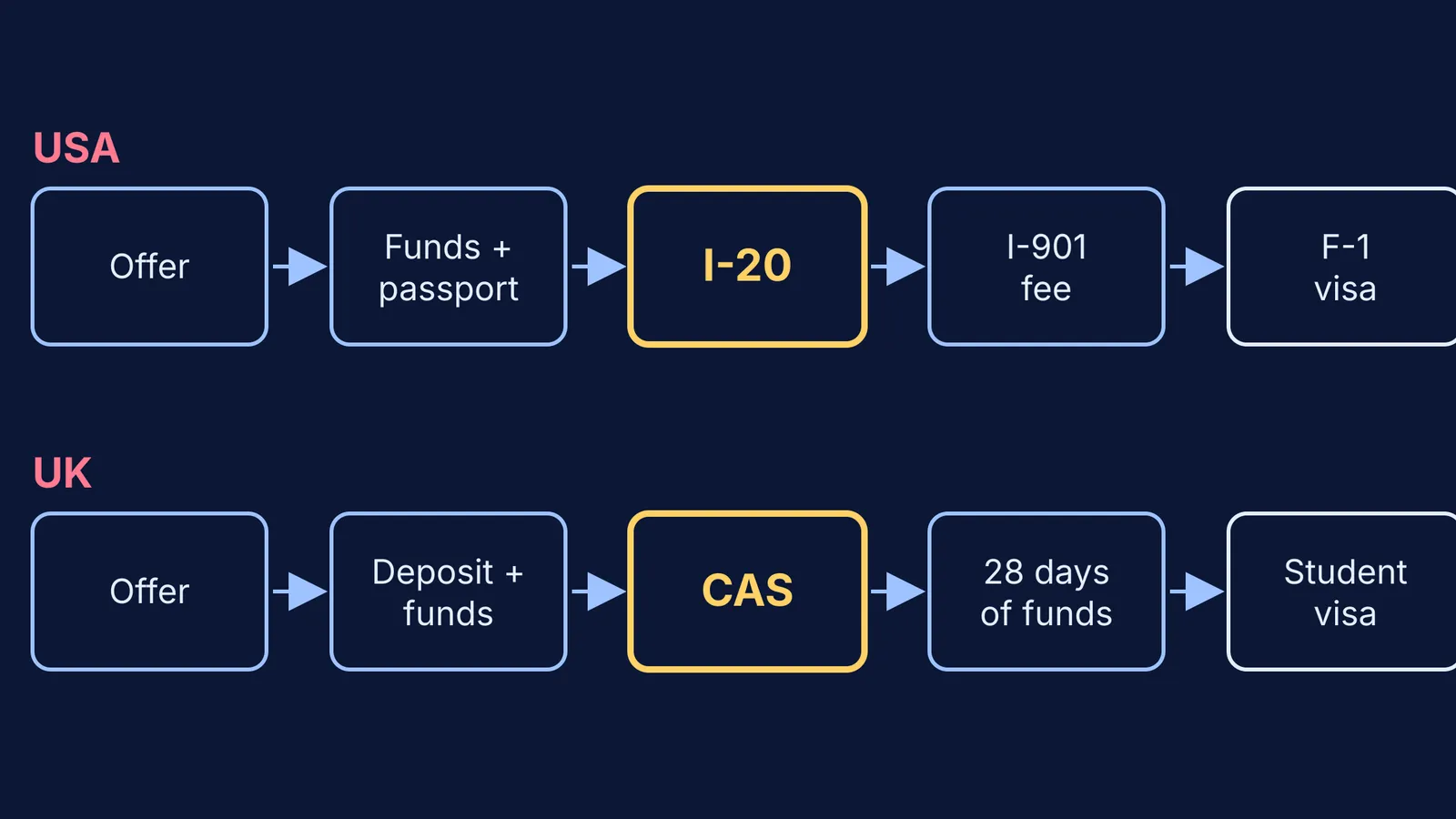
An offer letter is not a visa. Between the two sits one more document from your university: the Form I-20 for the US, or the CAS for the UK. The university usually needs proof of money, a valid passport and, often, a deposit from you first.
What is an I-20 for US universities?
The Form I-20 is the "Certificate of Eligibility for Nonimmigrant Student Status", and every F or M student needs one (Study in the States, US Department of Homeland Security). After you are accepted, a designated school official at a government-certified school issues it. It shows your programme start date, the school code and your SEVIS identification number. Both you and the school official sign it, and if you are under 18, your parents sign it too.
To issue it, the school checks that you can pay. At Cal Poly Pomona, for example, the international office asks for a passport and financial documents showing adequate funding to meet the estimated tuition and living expenses for the first year of study. Documents cannot be more than 3 months old, and a letter from a private sponsor, such as a parent, must come with that sponsor's bank statement.
What is a CAS letter for UK universities?
A CAS (Confirmation of Acceptance for Studies) is a statement with your personal and course details and a unique reference number that you need for your Student visa application (University of Liverpool). At Liverpool, a master's student gets one after accepting the offer, meeting its conditions, sending their qualifications and paying the deposit, or providing a formal financial guarantee if a sponsor is paying the fees. Undergraduates there do not need to pay a deposit first.
A CAS reference number is valid for six months and can only be used once, according to the same Liverpool page. If any detail is wrong, tell the university so it can update the CAS, because the CAS and the visa form must match.
How do the I-20 and CAS lead to the visa?
For the US, your I-20 details let you pay the I-901 SEVIS fee, which must be paid before the Department of State issues you a visa. The fee for F and M applicants is $350. Take the original I-20 to your visa interview, and you may arrive in the US up to 30 days before the start date on it (Study in the States).
For the UK, the CAS number goes into your Student visa application. You can apply from outside the UK up to 6 months before your course starts, the fee is £558 plus the healthcare surcharge, and you will usually get a decision within 3 weeks (GOV.UK Student visa). Students from India also need a tuberculosis test from a Home Office-approved clinic. If you are under 18, both parents or legal guardians must give written consent, or one parent if they have sole responsibility.
How much money must you show for a UK Student visa?
GOV.UK sets the living-cost amount at £1,529 a month in London or £1,171 a month elsewhere, for up to 9 months, on top of the course fees shown on your CAS. You must hold the money for at least 28 days in a row, and the 28-day period must end within 31 days of the date you apply. India is not on the list of countries exempt from this.
A worked example: Priya is going to a university outside London, and her CAS shows £17,000 of first-year fees still to pay.
Living costs: £1,171 × 9 months = £10,539.
Total to show: £17,000 + £10,539 = £27,539.
She plans to apply on 15 August, so the money sits untouched in the account from 1 July to 28 July (28 days).
28 July is 18 days before 15 August, inside the 31-day limit, so her statement works.
If the balance dips below the total mid-window, the 28 days restart. For other costs, see our guides on estimating the cost of living abroad and what applying to foreign universities costs.
What should you do in the week your offer arrives?
Do this with a parent, since bank paperwork is often in their name.
Check your passport is valid well beyond your course start date, and renew it now if not.
Find your university's I-20 or CAS page and list its exact documents and deadlines.
Ask the bank for a statement or loan sanction letter in the format the university asks for.
Pay any deposit only through the university's official payment page.
When the I-20 or CAS arrives, check every detail against your passport the same day.
Put the visa fee, I-901 fee or healthcare surcharge and any TB test into your budget.
Unsure whether to do this alone? Read hiring a counsellor or doing abroad applications yourself. And if the wait leaves you free months, Fermi Courses offers university-level courses from working scientists, with the AI tutor available on every lecture, so you can start on first-year material before you fly.


