

On this page
Before tuition, flights, or accommodation appear on a family's radar, applying to universities abroad requires significant upfront capital. For Indian students, the pre-admission phase covers entrance exams, language tests, application portals, academic evaluations, and visa processing. Without structured planning, these administrative outlays can create unexpected financial pressure right when students are focusing on their final school examinations. Understanding where each cost arises helps families plan ahead and take full advantage of fee reduction policies.
What is the true cost of an application cycle?
Applying abroad is an iterative process where discrete administrative charges compound rapidly. For students applying to undergraduate programs in the United Kingdom, the UCAS application fee is a flat £34.50 for up to five university course choices in the 2027 entry cycle (up from £28.50 in previous years). In contrast, applications to colleges in the United States operate largely through individual campus fees. On the Common Application portal, where applicants submit an average of 6 to 7 applications, institutional charges typically range from USD 40 to USD 90 per university. Applying to seven selective American campuses can therefore cost upwards of USD 450 in portal submission fees alone.
Which standardised testing and reporting fees are unavoidable?
Standardised testing represents the largest upfront investment prior to university deadlines, demanding months of disciplined preparation alongside studying science in English. For undergraduate admissions in the United States, the College Board SAT registration fee is USD 68, alongside an international regional fee of USD 43 for candidates in South Asia, totalling USD 111. Each SAT registration includes four free score reports sent to universities if designated within 9 days of testing; subsequent reports cost USD 14 each.
Demonstrating English proficiency adds another test expense: the ETS TOEFL iBT registration fee in India is USD 205 (approximately ₹17,200), while the IDP IELTS Academic fee is ₹17,000 depending on test format. Many institutions alternatively accept the Duolingo English Test, which costs USD 65 (around ₹5,500) with free unlimited score reporting.
If you need to strengthen underlying STEM principles before sitting for standardised quantitative reasoning sections, the Fermi Concept Library maps every concept in physics, chemistry, biology, mathematics and computing to help diagnose foundational gaps, while the Fermi Problem Library provides worked problems with a step-by-step solver that explains the reasoning rather than printing an answer.
How much do transcripts, evaluations, and visa registrations cost?
Beyond testing and portals, universities require authenticated academic records and financial disclosures. An evaluation from World Education Services (WES) costs USD 107 to USD 160 for a basic document report and up to USD 239 for a course-by-course assessment package. Furthermore, private universities requiring financial aid documentation often mandate the College Board CSS Profile, which charges USD 25 for the initial submission and USD 16 for each additional institution.
Once admitted, international students face mandatory visa compliance costs: for the United States, the U.S. Department of Homeland Security SEVIS I-901 fee is USD 350, while the Machine Readable Visa (MRV) fee collected by the U.S. Department of State is USD 185, totalling USD 535 (approximately ₹45,000).
How can students reduce application expenses by over 60%?
The published sticker price of an application cycle is rarely what informed students actually pay. Proactive fee reduction strategies can eliminate most portal and testing charges:
Counselor waivers: Through the Common Application, students facing financial hardship can request an application fee waiver. When confirmed by a school counselor or headmaster, this removes portal fees across participating institutions.
The India Scholars Program: Eligible Class 11 and 12 students can obtain vouchers via the Buddy4Study College Board program, providing a 90% SAT fee reduction for family incomes under ₹8 lakh and 50% for incomes between ₹8 lakh and ₹15 lakh.
Institutional aid forms: Instead of paying USD 16 per college on the CSS Profile, ask admissions offices whether they accept the free International Student Financial Aid Application (ISFAA).
Direct waiver codes: Admissions offices frequently share fee waiver codes during virtual webinars or upon receiving a direct hardship inquiry.
Juggling multiple deadlines and high expenses can easily cause strain at home; breaking these hurdles into clear steps helps with managing application and exam stress.
What does a realistic abroad application budget look like?
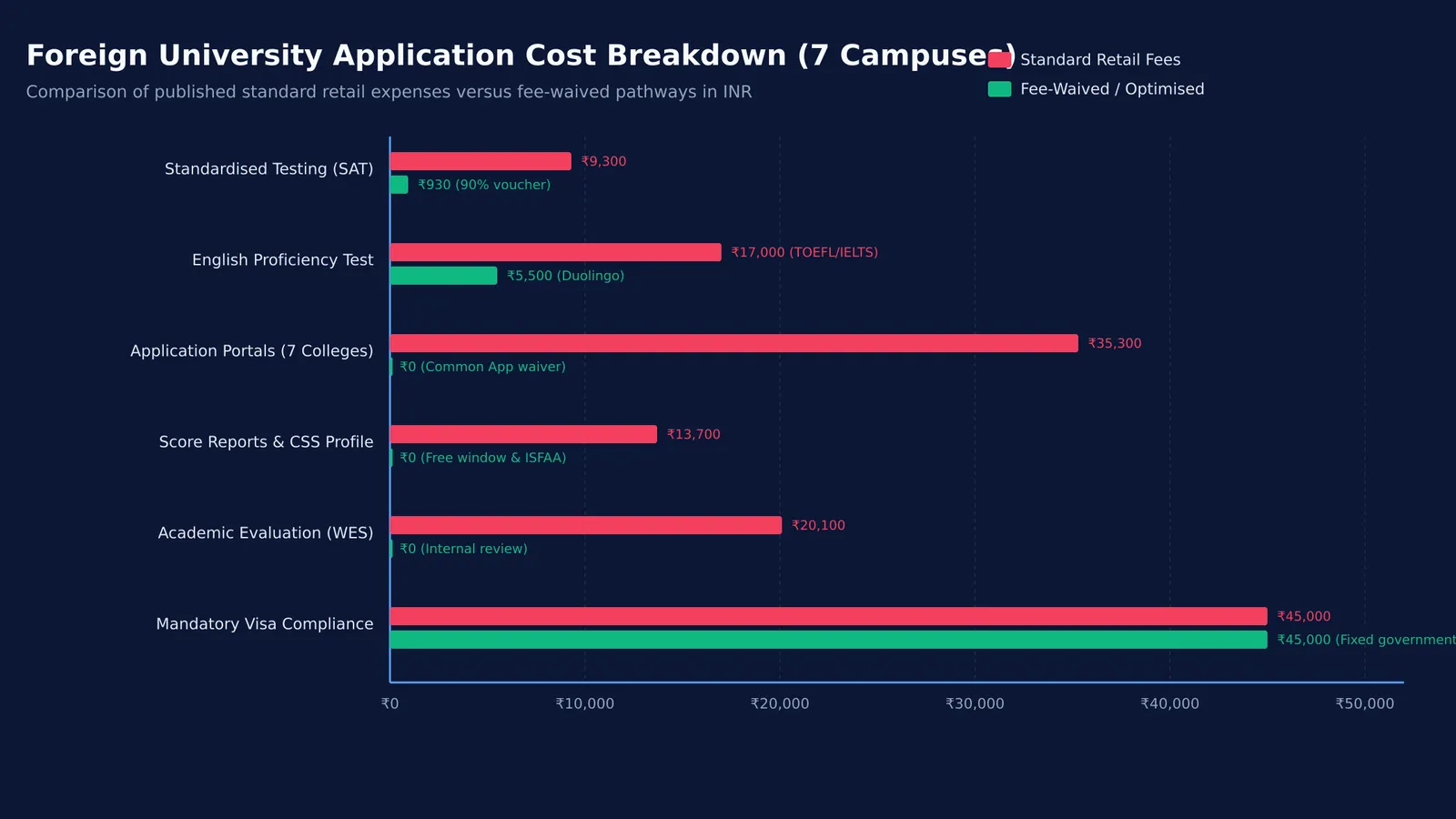
To turn these variables into a concrete financial plan, families can compare two trajectories for applying to seven overseas universities based on published rates from the College Board, ETS, and the U.S. Department of State. Following the habit of setting structured milestones with if-then plans keeps expenses visible well before deadlines hit.
Standard unassisted budget (7 universities):
Standardised test (SAT base and regional fee): ₹9,300
English language test (TOEFL or IELTS): ₹17,000
Application portal fees (7 campuses at USD 60 average): ₹35,300
Score reports and CSS Profile filings: ₹13,700
Credential evaluation (WES course-by-course package): ₹20,100
Mandatory visa fees (SEVIS I-901 and MRV fee): ₹45,000
Total unassisted outlay: ₹1,40,400
Fee-waived and optimised budget (7 universities):
Standardised test (90% SAT fee reduction voucher): ₹930
English language test (Duolingo English Test): ₹5,500
Application portal fees (Common App counselor waiver): ₹0
Score reports and CSS Profile (free window and ISFAA): ₹0
Credential evaluation (institutions accepting internal review): ₹0
Mandatory visa fees (SEVIS I-901 and MRV fee): ₹45,000
Total optimised outlay: ₹51,430
By preparing documentation early and requesting waivers directly, families can save nearly ₹89,000—reducing non-visa application expenses by more than 85%. That relief allows students to concentrate their energy on academic performance and compelling personal essays.


