

On this page
Green chemistry asks a question most textbooks skip: how much mess does making this molecule leave behind? If you like chemistry but don't want to spend your career cleaning up spills, this is the job of designing the waste out before it exists. Here is what the work looks like, which degrees lead to it, and a plan you can start in Class 11.
What is green chemistry, in plain words?
The US Environmental Protection Agency puts it this way: "Green chemistry is the design of chemical products and processes that reduce or eliminate the use or generation of hazardous substances" (US EPA). The same page says this is different from remediation, which treats waste after it has been made. A green chemist works upstream, picking a different reaction, solvent or catalyst so the hazardous material never appears.
The field has a set of design rules, the 12 principles. We walk through them with an example in our explainer on the 12 principles of green chemistry.
How do green chemists measure waste?
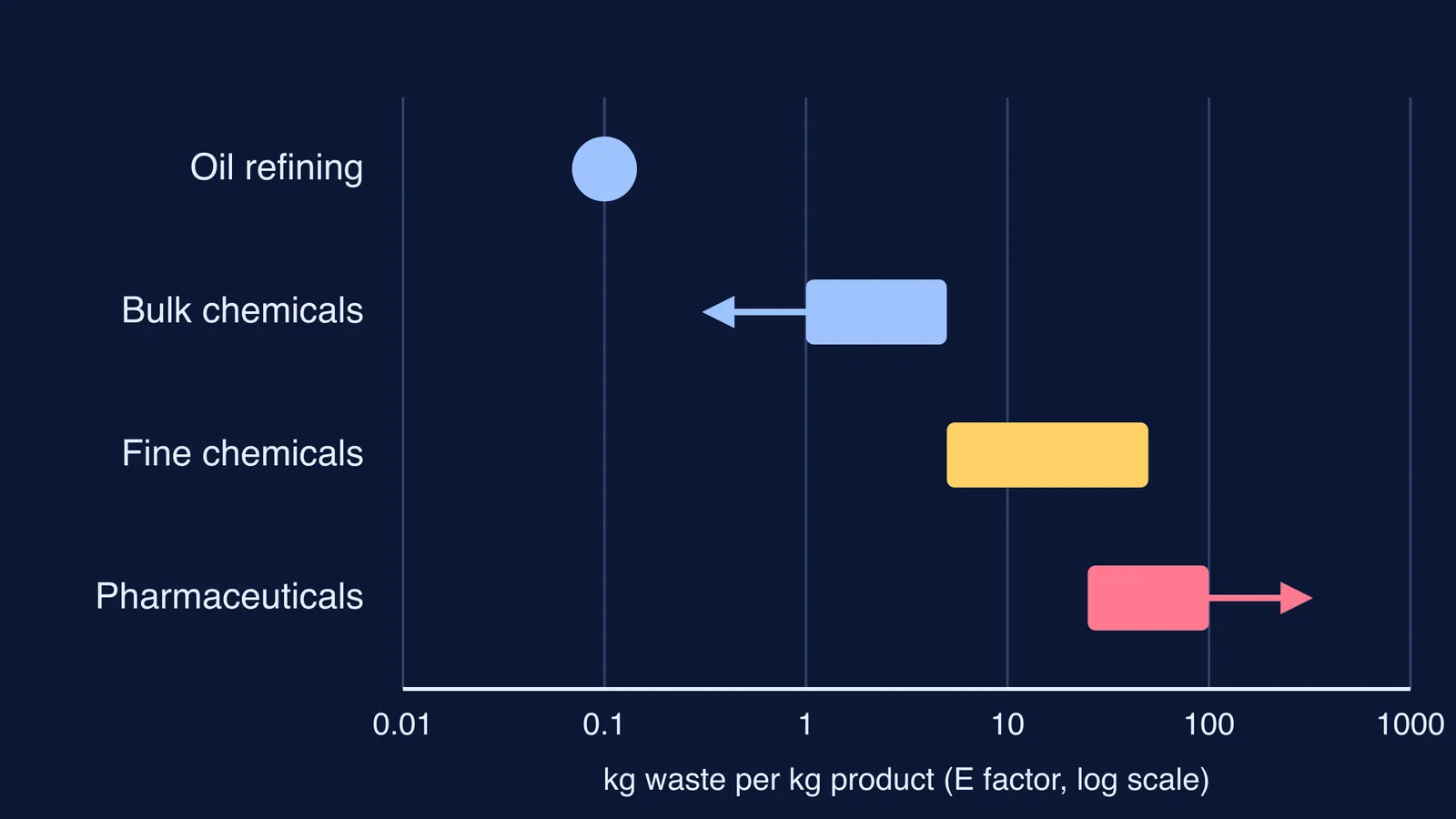
The most common yardstick is the E factor: the mass of waste divided by the mass of product, introduced by the chemist Roger Sheldon in the late 1980s (Sheldon's E factor page). Lower is better; a process that made no waste at all would score zero.
Typical E factors rise steeply as products get more complex: about 0.1 kg of waste per kg of product for oil refining, under 1 to 5 for bulk chemicals, 5 to 50 for fine chemicals, and 25 to more than 100 for pharmaceuticals (CHEManager, citing Sheldon's table). Per kilogram, medicine-making leaves the most waste, although refineries and bulk plants make far larger tonnages, so both are targets for cleaner processes. Sheldon looked back on 25 years of the idea in the journal Green Chemistry (Sheldon, 2017).
What does the work actually look like?
One well-documented case: Merck and Codexis replaced a high-pressure hydrogenation step in making the diabetes drug sitagliptin with an engineered enzyme. The US EPA, which gave the work a 2010 Green Chemistry Challenge award, reports a 10 to 13 percent rise in overall yield, a 56 percent gain in productivity and a 19 percent cut in total waste, with all metals (rhodium and iron) removed from the process (US EPA award page). The research was published in Science (Savile and colleagues, 2010).
A project like this draws on several skills at once: organic chemistry, enzyme engineering and process engineering. Green chemistry is a way of working more than a job title. The 2005 Nobel Prize in Chemistry, for the metathesis method, was described in the Nobel press release as "a great step forward for 'green chemistry'" (Nobel Prize press release).
Which degree leads to a career in green chemistry?
There are three common doors.
BSc then MSc in chemistry, if you love reactions and mechanisms. Research-led roles often expect a PhD, and analytical chemistry is a related job that measures the purity and waste green chemists care about.
BTech in chemical engineering, if you like the idea of scaling a reaction from a flask to a plant. Our guide to what you study in chemical engineering covers the subjects.
Biotechnology or biochemistry, if enzymes and fermentation interest you, as in the sitagliptin story.
For a master's or PhD in India, GATE has separate papers for Chemistry (CY) and Chemical Engineering (CH); check the current syllabus on the GATE 2027 official site, run by IIT Madras.
A worked example you can do with Class 11 chemistry
Say a lab preparation uses 10 g of reactants and 200 g of solvent, and gives 8 g of pure product. Everything that is not product counts as waste.
Mass in: 10 + 200 = 210 g.
Waste: 210 − 8 = 202 g.
E factor: 202 ÷ 8 ≈ 25.
Now suppose you redesign the step so that 180 g of the solvent is recovered and reused. Waste falls to 210 − 180 − 8 = 22 g, and the E factor to about 2.8. The reaction never changed; the solvent did most of the damage. Spotting that is a core skill of the job.
This arithmetic rests on the mole concept and stoichiometry. If those feel shaky, the Fermi Concept Library has a lesson for each chemistry concept and shows where it sits in the map, and the Fermi Problem Library works through problems step by step, explaining the reasoning rather than printing an answer.
How can you start moving towards it now?
Class 11 and 12: make physical and organic chemistry solid. Yield, limiting reagent and equilibrium are everyday tools in this work.
First year of college: read the 12 principles and apply one of them to an experiment in each lab course.
Second and third year: ask a professor working on catalysis, solvents or enzymes whether you can join a summer project.
Final year: choose between a master's route, a process-development job in industry, or a PhD, and check the current GATE syllabus well before the exam.
Start with one number this week: the E factor of your next school practical.


