On this page
In 1998, the chemists Paul Anastas and John Warner set out twelve principles for designing chemicals and processes that make less waste and do less harm, in their book Green Chemistry: Theory and Practice (Yale Center for Green Chemistry and Green Engineering). The core idea: stopping pollution at the design stage beats cleaning it up afterwards.
The US Environmental Protection Agency defines green chemistry as "the design of chemical products and processes that reduce or eliminate the use or generation of hazardous substances" (US EPA).
What are the twelve principles of green chemistry?
Here are Anastas and Warner's titles, from page 30 of their book as reproduced by Yale's green chemistry centre, each in plain words:
Prevention: prevent waste rather than clean it up later.
Atom economy: get as much of the starting materials as possible into the product.
Less hazardous chemical syntheses: use and make substances with little or no toxicity.
Designing safer chemicals: keep the product working while cutting its toxicity.
Safer solvents and auxiliaries: avoid solvents and separation agents where possible, and use harmless ones otherwise.
Design for energy efficiency: keep the energy a process needs low, working at room temperature and pressure where possible.
Use of renewable feedstocks: prefer renewable raw materials to depleting ones.
Reduce derivatives: skip unnecessary temporary modification steps, which need extra reagents and make waste.
Catalysis: use selective catalysts rather than reagents that get used up.
Design for degradation: products should break down harmlessly after use, not persist.
Real-time analysis for pollution prevention: monitor reactions as they run, before hazardous substances form.
Inherently safer chemistry for accident prevention: choose substances that cut the risk of releases, explosions and fires.
Principle 9 rests on something you already study: a catalyst speeds up a reaction without being used up. Our explainer on how catalysts change reaction rates covers the collision theory behind it.
Who are Paul Anastas and John Warner?
Anastas trained as a synthetic organic chemist, with a PhD from Brandeis University, and is credited with establishing the field of green chemistry. At the EPA he directed the US Green Chemistry Program (Yale School of Public Health profile). He was the EPA's Assistant Administrator and Science Advisor from 2009 to 2012 and is now Yale's Teresa and H. John Heinz III Professor in the Practice of Chemistry for the Environment. Warner is his co-author on the 1998 book.
How do you calculate atom economy?
Atom economy turns principle 2 into a number. B. M. Trost argued for reactions that waste as few atoms as possible in a 1991 Science paper, The Atom Economy: A Search for Synthetic Efficiency (Trost, Science, 1991).
Atom economy (%) = molar mass of the desired product ÷ total molar mass of all reactants × 100.
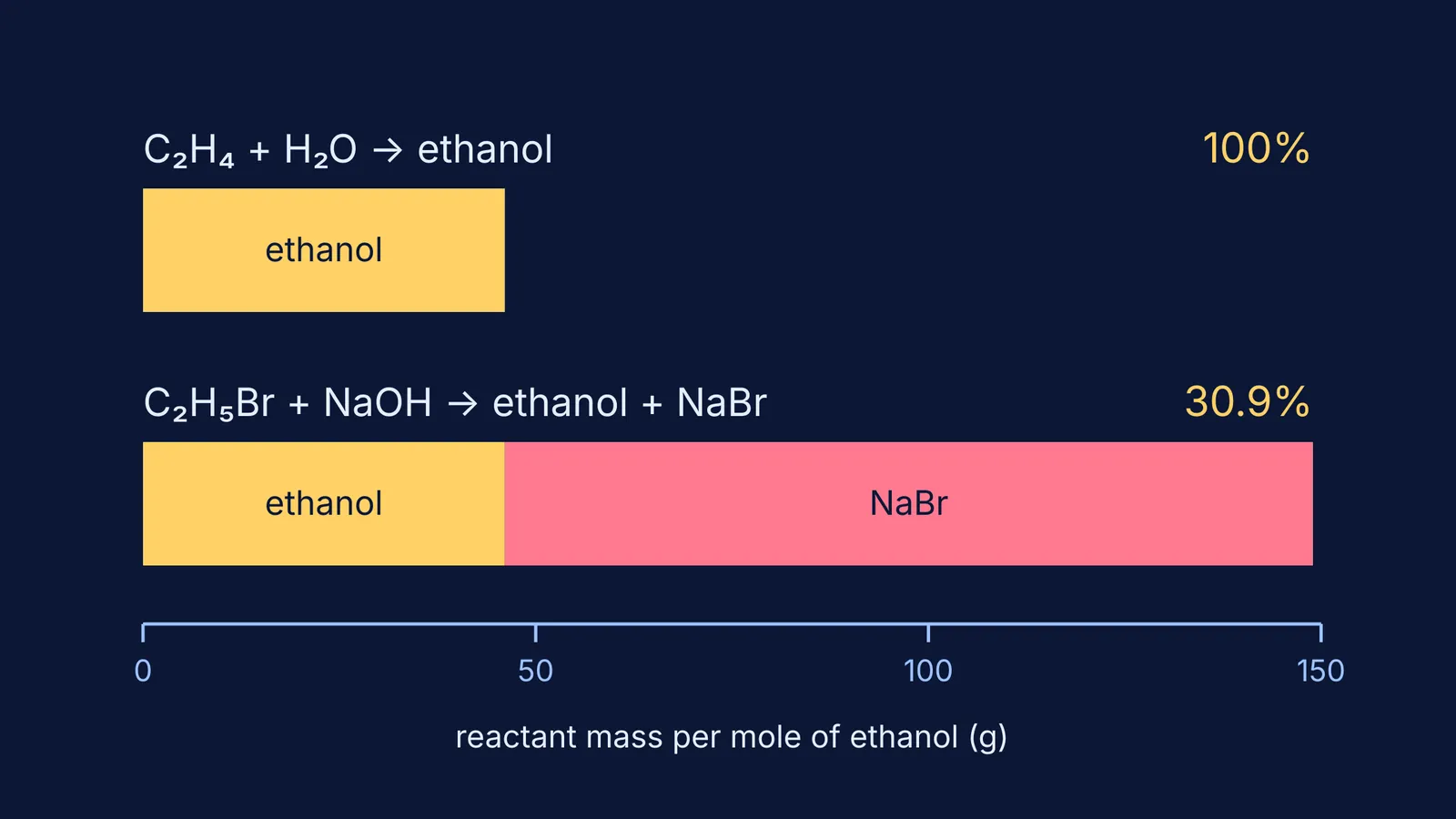
Here are two routes to ethanol from school organic chemistry.
Route A: adding water to ethene
C₂H₄ (28.05 g/mol) + H₂O (18.02 g/mol) → C₂H₅OH (46.07 g/mol)
Atom economy = 46.07 ÷ 46.07 × 100 = 100%
Route B: bromoethane with sodium hydroxide
C₂H₅Br (108.97 g/mol) + NaOH (40.00 g/mol) → C₂H₅OH (46.07 g/mol) + NaBr (102.89 g/mol)
Atom economy = 46.07 ÷ 148.96 × 100 = 30.9%
Even at 100% yield, route B makes about 2.2 kg of sodium bromide per kilogram of ethanol (102.89 ÷ 46.07 = 2.23). That ratio is the idea behind Roger Sheldon's E factor, kilograms of waste per kilogram of product, which he introduced in the late 1980s (Sheldon, The E Factor). Real yields below 100% only make it worse.
It is the same molar-mass arithmetic you use for finding the limiting reagent in stoichiometry problems, so you practise both at once.
Is green chemistry part of the school syllabus?
Yes, by name. The rationale of CBSE's Class XI-XII chemistry curriculum for 2025-26 says "many new areas like green chemistry, material science, biomolecules, and industrial chemistry deserve to be an integral part of the chemistry syllabus at this stage" (CBSE Chemistry curriculum 2025-26). The same document says micro-chemical methods should be used in practicals wherever possible, which fits the spirit of principle 1: smaller amounts, less waste.
How can you use the twelve principles when you study?
Run this six-question check on any reaction in your textbook. It takes a few minutes.
What else forms besides the product you want? (Prevention)
What is the atom economy, from molar masses? (Atom economy)
Is a reagent used up where a catalyst could do the job? (Catalysis)
Which solvent is used, and is it needed at all? (Safer solvents)
Does it need high temperature or pressure? (Energy efficiency)
Where does the product end up after use? (Design for degradation)
If the percentage step trips you up, the Fermi Problem Library has worked problems with a step-by-step solver that explains the reasoning rather than printing an answer.
Next time a textbook reaction leaves a by-product, do the atom economy sum: one line of arithmetic tells you how much of the reactants could ever end up in the product.