

On this page
Graph questions in maths and economics, and map questions in social science and geography, often come with a separate sheet. The rules on what to write on that sheet are not the same for every board, which is where most of the confusion starts.
Should you write your roll number on graph paper and maps?
For CBSE, no. The Board's centre guidelines for the 2023-24 board examinations, the latest full set we could check, tell superintendents to make sure the roll number and name are not written on the graph paper or map, but that the roll number is written on any supplementary answer book. The same guidelines say students must not write their name, roll number or any distinguishing mark anywhere inside the answer book, and should write their roll number in the space given on the OMR sheet.
For CISCE (ICSE and ISC), yes. CISCE's directions to ISC candidates say your Unique ID, Index Number and subject go on the main booklet, on each continuation booklet, and on any loose maps or graph papers you use. A summary of the 2026 ICSE and ISC guidelines repeats the same rule.
State boards vary. The Nagaland Board's 2026 answer booklet, for example, tells candidates not to write their name, school or any distinguishing mark on additional sheets, graph paper or maps, and to staple them to the main answer book.
Slipped up already? See what to do after writing the wrong roll number.
How do you tie graph paper and maps to the answer book?
On CBSE papers, supplementary answer books, maps and graphs must be securely tied with white tags or white twine only, never coloured ones, according to the same CBSE centre guidelines. Those guidelines also list a 48-page answer book with graph paper for Mathematics, with loose graph sheets given when such books are not available, and an 8-page supplementary answer book for all subjects. You fill in how many supplementary books you used on the OMR sheet.
There is one more change to know about. CBSE moved Class XII answer books to on-screen marking from the 2026 examinations, while Class X books are still marked on paper. The circular does not say how loose sheets are handled, so follow whatever your centre tells you on the day.
CISCE asks you to arrange your scripts in order with the first page on top, fasten them at the left-hand top corner and hand them over unfolded, according to its directions to candidates.
How should you label a graph so the examiner can mark it?
A graph earns marks only if the examiner can tell which question it answers and read it without guessing. Before you hand it in, check:
The question number is written clearly at the top of the graph sheet or map.
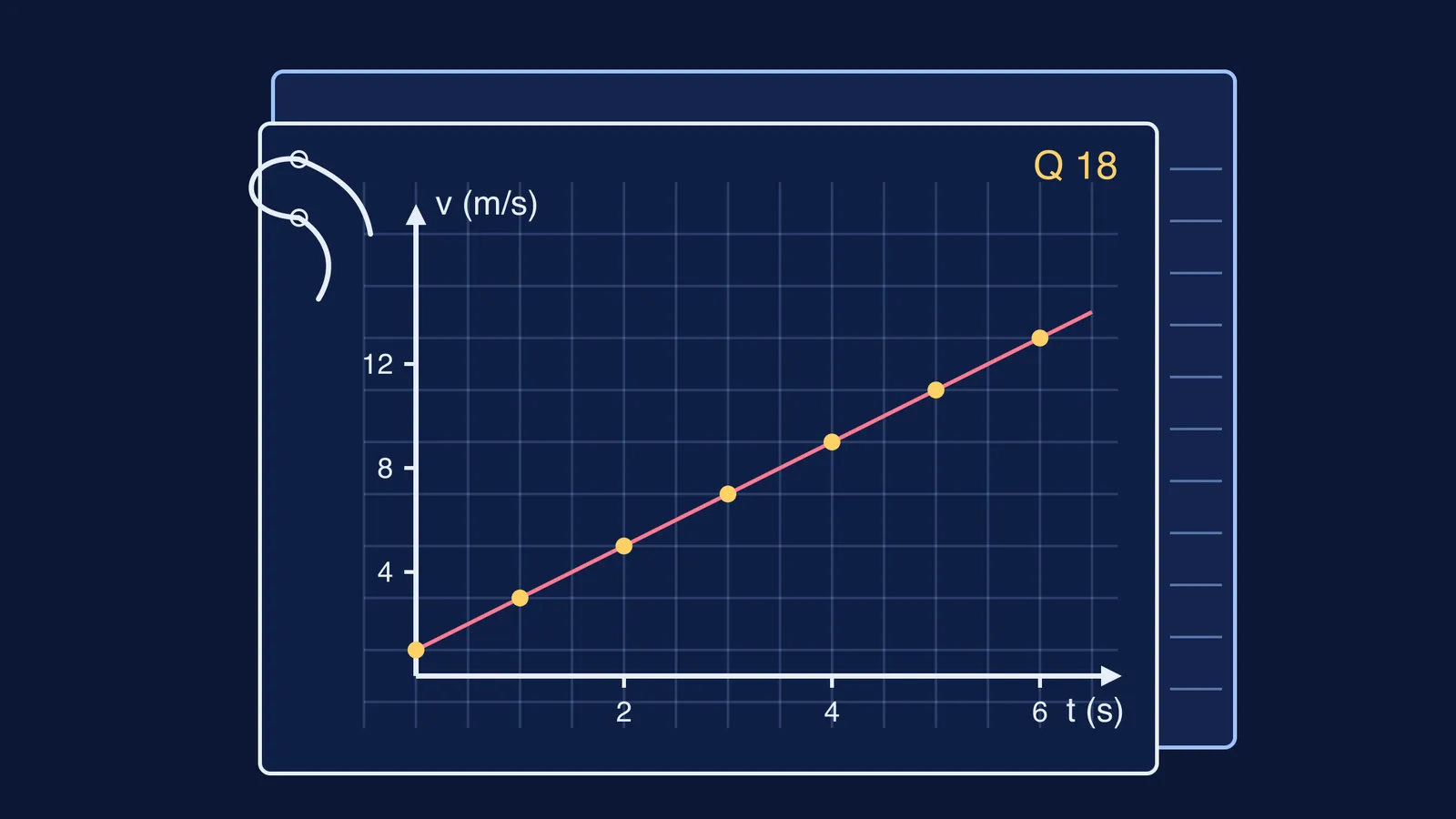
Both axes are named with the quantity and its unit, for example t (s) and v (m/s).
The scale is written in one corner, such as 1 cm = 1 s on the x-axis.
Points are marked with small dots or crosses and joined with a smooth line or a ruler.
In your answer book, at the place of the answer, you write a line like "Graph for Q 18 is on the attached graph sheet."
On a map, each place carries the number or letter the question asked for, and its name if the question asks for it.
For the drawing itself, see whether to draw diagrams in pencil or pen and how to number answers so none get missed.
If you can plot the points but cannot say what the slope or the area under the graph means, the Fermi Concept Library has a lesson for every concept in physics, chemistry, biology and mathematics. For shapes that are easier to see than to read, the Fermi Simulation Lab has interactive simulations.
What should you do before handing in extra sheets?
Say you are a CBSE Class 10 student in the social science paper. You used one supplementary answer book and one outline map. Here is the order:
On the OMR sheet, write 1 in the box for supplementary answer books used.
Write your roll number on the supplementary answer book, in the space given.
On the map, check every place has its question number. Write no roll number or name.
Stack them neatly: main answer book on top, then the supplementary book, then the map.
Make sure the bundle is tied securely with a white tag or white twine, not a coloured one.
An ICSE student would follow the same idea, except step 3 changes: write your Unique ID, Index Number and subject on the map, then fasten the bundle at the top-left corner and hand it over unfolded.
Check your own board's printed instructions this week, and try the five steps in your next mock.


