On this page
If Germany is on your list, the language question decides which courses you can apply to, whether you need a foundation year, and when to start learning. German is required for most bachelor's degrees there, but not all.
Do you need German to study in Germany?
It depends on the language your degree is taught in. The DAAD's official portal says that "the language of instruction in most degree courses at German higher education institutions is German", so for those you must prove your German to be admitted (Study in Germany). The same page says German may not be a prerequisite if you enrol in an international programme.
The catch is that English-taught options are rare at bachelor's level. In summer 2025, state-recognised German universities offered around 420 English-language bachelor's programmes, only about 4% of bachelor's programmes, compared with a good 18% at master's level, according to a DAAD and DZHW report (DAAD and DZHW, via idw).
What level of German do German-taught degrees ask for?
Universities usually want proof at about C1, the second-highest level on the Common European Framework of Reference for Languages (CEFR). The German missions in India say that for degree studies, "generally the required level of knowledge is C1, regardless if the studies are in German or English" (German Missions in India).
The usual proofs are:
TestDaF: a result of at least TDN 4 in all four parts counts as proof for unrestricted admission to all degree programmes (TestDaF).
DSH: an exam that many universities offer themselves (Study in Germany).
Certificates from the Goethe-Institut (Max Mueller Bhavan in India), ÖSD or telc, which the missions in India list as recognised (German Missions in India).
If your school-leaving certificate does not give you direct entry, you first go to a Studienkolleg, a preparatory college. The entry bar there is lower: the Studienkolleg at TU Darmstadt asks for at least B1 German and sets an entrance test in German and, for its technical course, maths (TU Darmstadt Studienkolleg). For a visa for a preparatory course in German, the missions in India also ask for at least B1 (German Missions in India).
Can you study a bachelor's in Germany in English only?
Yes, if your programme is taught in English and you meet its English requirement. The DAAD's International Programmes in Germany database can be filtered by course type and language, so you can list the English-taught bachelor's programmes in your subject.
You then need an English certificate instead of a German one. For visa applications in India, the missions list IELTS and ALTE members among accepted English certificates, and say that Duolingo, Pearson PTE and TOEFL home edition tests are not recognised (German Missions in India). Our explainer on whether you need IELTS or TOEFL after Class 12 helps with the test choice.
Even on an English programme, basic German makes rent contracts, part-time jobs and errands easier, so learn some anyway.
How long does it take to learn German to B1 or C1?
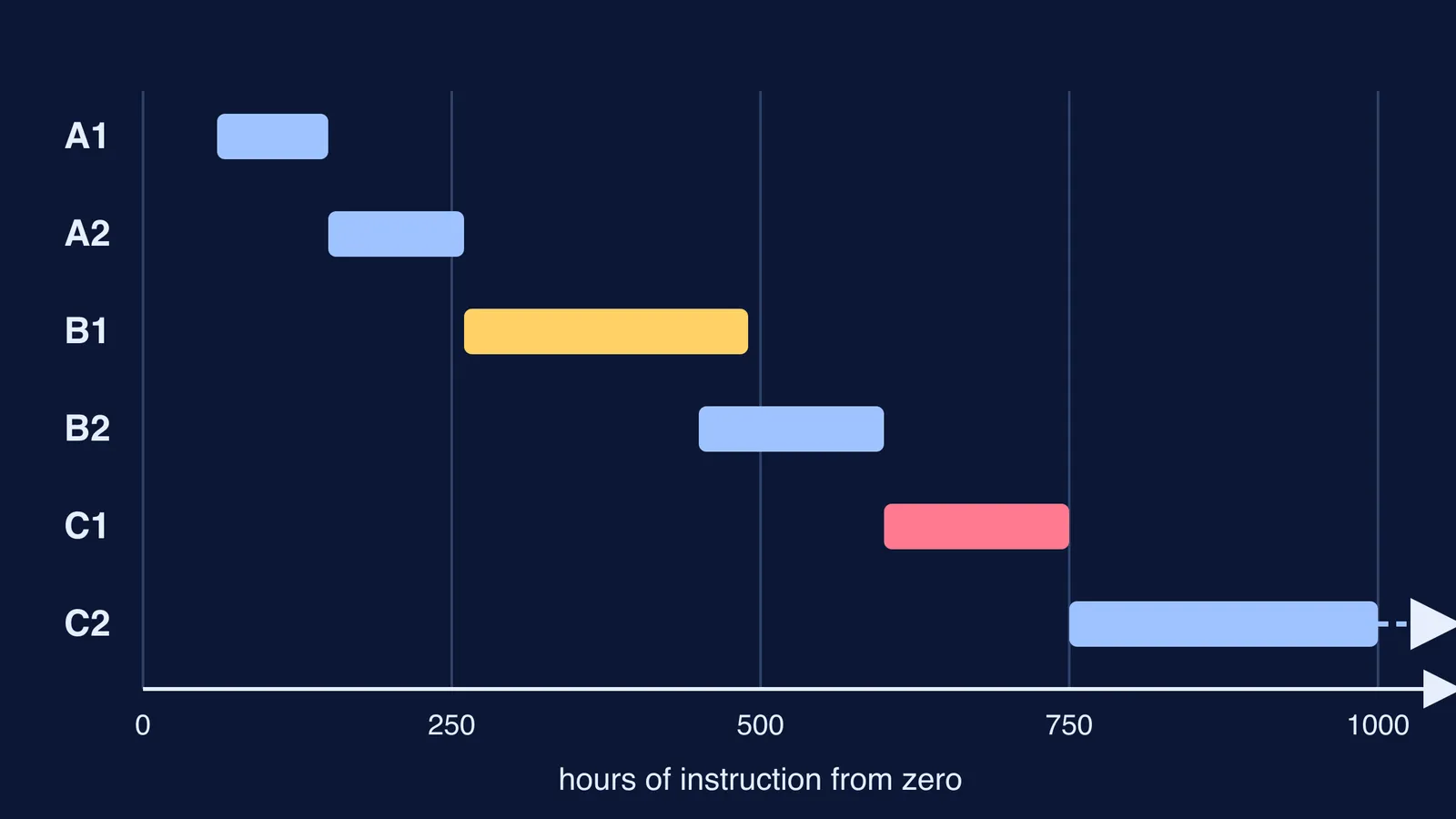
The Goethe-Institut estimates that reaching B1 takes about 260 to 490 hours of instruction (350 to 650 teaching units of 45 minutes), and C1 about 600 to 750 hours (800 to 1,000 units) (Goethe-Institut FAQ). It adds that you may learn faster if you have already studied other languages, and that a course in Germany, where you hear German outside class, makes a big difference.
On a real calendar, using those ranges:
At 5 hours a week alongside Class 11 and 12, B1 takes 52 to 98 weeks, roughly one to two years.
At the same 5 hours a week, C1 takes 120 to 150 weeks, roughly two and a quarter to three years.
At 20 hours a week in a full-time intensive course after Class 12, C1 takes about 30 to 38 weeks.
These are hours with a teacher; vocabulary and listening practice on your own come on top.
Which route fits you? A five-step plan
Shortlist five to eight programmes in the DAAD database and write down the language of instruction for each.
For each German-taught one, check whether you need a Studienkolleg first (B1 to apply at TU Darmstadt) or can enter directly (usually about C1).
Divide the hours for your target level by the hours a week you can honestly give. That is your learning time in weeks.
If that is longer than the time left before your intake, look at English-taught programmes or a later intake.
Book TestDaF, a Goethe exam or IELTS early enough that the certificate arrives before applications close.
The technical Studienkolleg entrance test includes maths, so if a Class 11 or 12 topic feels shaky, the Fermi Concept Library has a lesson for every concept in physics, chemistry, biology, mathematics and computing. If you are not sure where to begin, Fermi's AI tutor works out what you already know and builds a plan for the session.
Still choosing a school language? Read whether to learn a foreign language in school, then start your shortlist this week.