

On this page
Does learning a foreign language help your academic performance?
A meta-analysis of 63 studies by Adesope et al. (2010), analyzing data from 6,022 participants, found that bilingualism correlates with measurable gains in metalinguistic awareness, working memory, and attentional control. Learning to switch between grammar systems helps students analyze sentence structures and spot abstract patterns. Indian students who already speak two languages often find that studying a third structured language sharpens their grasp of grammar when studying science in English when you think in another language.
However, language study is not a general brain-training shortcut. A meta-analysis of 152 studies by Lehtonen et al. (2018) found no evidence that second-language learning boosts executive function in healthy adults. Studying German or Japanese will not automatically raise your marks in physics or mathematics. The genuine academic benefits are direct and practical: deeper reading comprehension, cross-linguistic vocabulary, and access to international university degrees.
How many hours does it take to reach real proficiency?
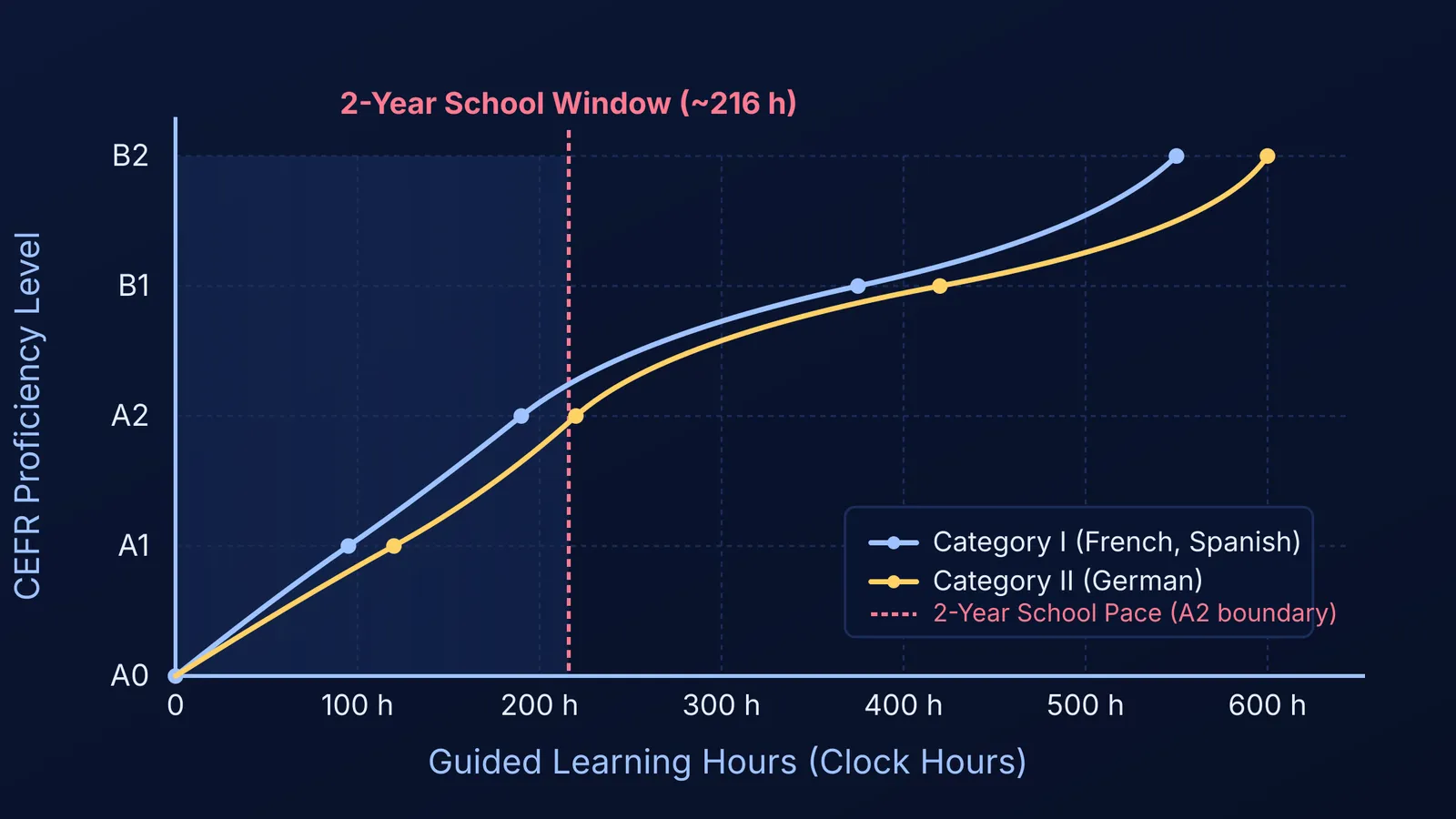
Language proficiency follows the Common European Framework of Reference for Languages (CEFR), scaling from A1 (beginner) to C2 (mastery). According to Cambridge English Support, reaching beginner A1 requires 90 to 100 guided learning hours under a teacher or structured curriculum. Progressing to conversational A2 requires a cumulative 180 to 200 hours, independent B1 takes 350 to 400 hours, and professional B2 demands 500 to 600 hours.
Classroom requirements also reflect linguistic distance. The U.S. Foreign Service Institute estimates that native English speakers need roughly 552 to 690 classroom hours (24 to 30 intensive weeks) to reach professional proficiency in Category I languages like Spanish or French. German (Category II) requires approximately 828 hours over 36 weeks due to its noun cases and grammatical genders. Category IV languages like Japanese or Mandarin demand 2,200 classroom hours over 88 weeks. For a student practising 3 hours weekly across a 36-week school year (around 108 hours annually), reaching A2 takes two academic years, making A2 an achievable secondary school milestone.
Which foreign language should you choose in school?
Under India's National Education Policy 2020 and the secondary curriculum of the Central Board of Secondary Education, schools offer foreign languages as secondary-stage electives alongside native languages, including French (Code 018), German (Code 020), Spanish (Code 096), and Japanese (Code 094). Choosing among them depends on your academic goals:
French and Spanish (Category I): These Romance languages share Latin roots with English terms, accelerating reading comprehension. Spanish offers predictable phonetic spelling that simplifies independent study, while French is widely taught across Indian boards.
German (Category II): German requires learning case tables, but offers practical advantages for science and engineering students. The Goethe-Institut provides youth certificates (Fit in Deutsch 1 and 2), and reaching B1 or B2 satisfies entry prerequisites for German foundation courses (*Studienkolleg*) or technical programs.
Japanese and Korean (Category IV): Distinct writing systems and syntax demand more time to reach basic literacy, but Japanese provides long-term value for careers in robotics and advanced engineering.
How do you balance language practice with STEM and board exams?
Treating a language elective like a weekend assignment leads to fast forgetting. In their evaluation of learning strategies, Dunlosky et al. (2013) awarded distributed practice and practice testing high-utility ratings, showing that spaced retrieval sessions dramatically outperform massed weekend cramming for retention.
To protect your schedule, build a weekly time-blocking schedule and cap language study at 30 to 45 minutes on designated days. Keeping your science revision efficient ensures language work does not cut into exam prep. With Fermi's AI tutor, the tutor works out what you already know and builds a plan for the session, keeping your STEM work on track. When difficult numericals slow you down, the Fermi Problem Library provides worked problems with a step-by-step solver that explains the reasoning rather than printing an answer.
What does a realistic weekly study routine look like?
A sustainable routine balances active retrieval with passive listening across 3 hours per week:
Monday (30 minutes): Active vocabulary recall using flashcards with a spaced revision schedule.
Tuesday (15 minutes): Passive listening during school commute to a beginner dialogue podcast.
Wednesday (30 minutes): Grammar exercises, writing six sentences using one grammatical rule.
Thursday (15 minutes): Shadowing practice, repeating audio dialogues aloud for pronunciation.
Friday (30 minutes): Reading a short graded article and noting down five new words.
Saturday (45 minutes): Review quiz and spoken conversation practice with a partner.
Sunday (Rest): Watch an episode of a foreign-language show with target-language subtitles.


