On this page
Your admit card is the map for exam day. The National Testing Agency's advisory for JEE Main 2026 Session 2 asks candidates to check five things on it: the date, the shift and timings, the venue, the reporting time and the gate closing time. Everything below builds on those five lines.
What does your admit card already tell you?
Read it the night before, with a pen. The reporting time and the gate closing time are different: the first is when you should arrive, the second is the last moment you can get in. The NTA advisory dated 31 March 2026 states that a candidate who reports after the gate closing time will not be allowed to enter the test venue.
For board exams, CBSE's advisory of 13 February 2026 said its Class 10 and 12 papers began at 10.30 am and students would be allowed to enter only up to 10.00 am.
How do you find your exam centre before exam day?
The NTA advisory says you should visit the centre in advance to learn the location and how to reach it on time, and CBSE advised its students to visit their centre in advance and plan their travel.
On that visit, note:
which gate candidates use, if it is marked
a landmark you can spot from the road
where a parent can drop you or wait
how long the trip took, at roughly the same time of day as your paper
How do you find your room and seat at the exam centre?
After entry and checks, look for a notice board or printed list that matches roll numbers to rooms.
Search for your roll number, not your name. Names repeat; roll numbers do not.
Note the room number and, if shown, the seat or system number.
Walk to the room, then check the label on the desk or computer against your admit card before you sit.
In a computer-based test, NTA asks you to check the paper on screen is in your admit card's subject and medium, and to tell the invigilator if not.
If something does not match, ask early. Short scripts help:
At the gate: “Good morning. My roll number is ___. Which building and room should I go to?”
At the chart: “I can't find my roll number on this list. Who can check it for me?”
At the desk: “This seat shows a different roll number from my admit card. Where should I sit?”
Asking at 9.20 is easy; asking at 9.58 is not.
How early should you reach the exam centre?
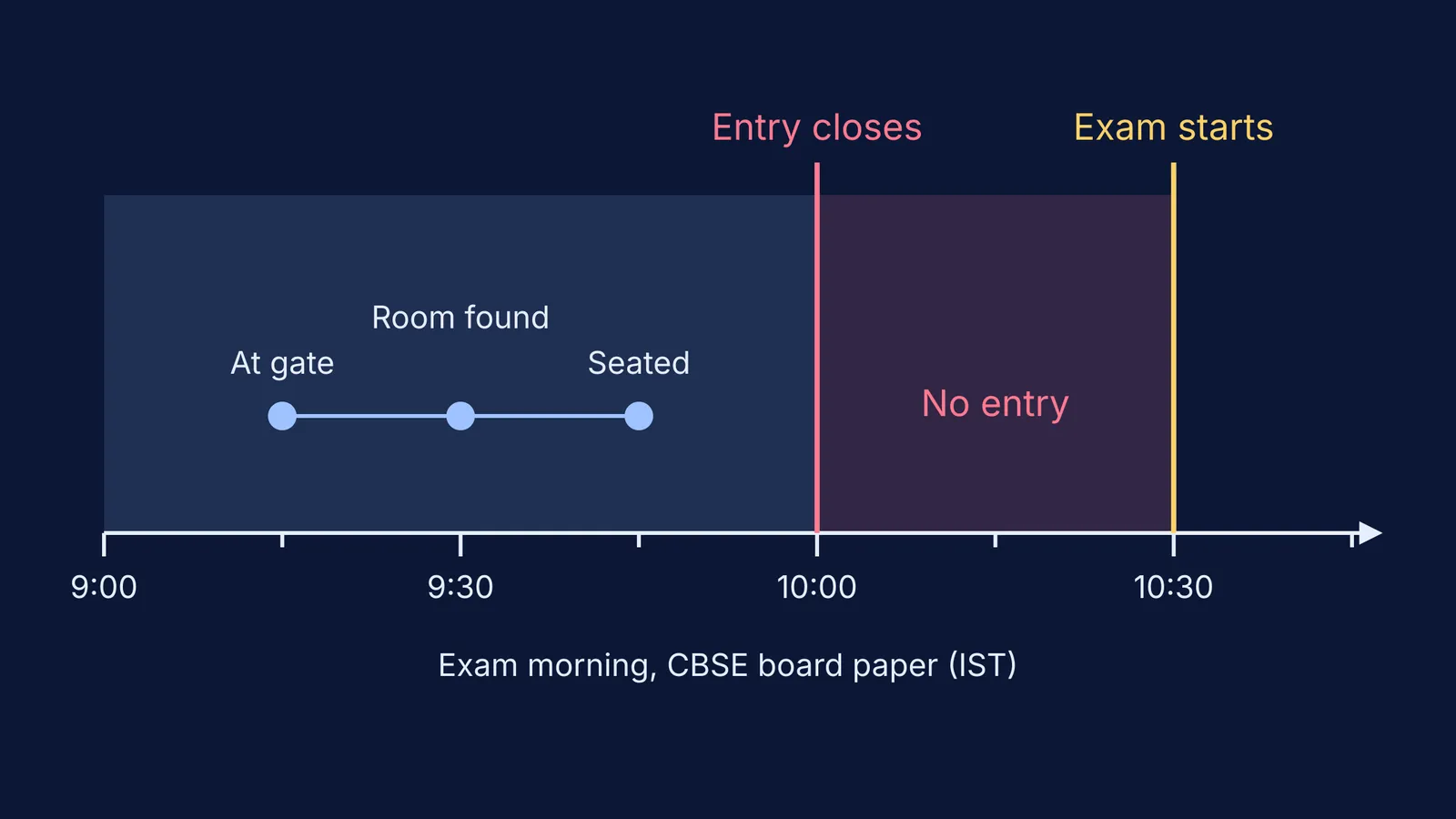
Start from the gate closing time and work backwards. A worked example for a CBSE board paper, where the 2026 advisory closed entry at 10.00 am:
Seated and settled: 9.45
Seating chart read, room found: 9.30
At the gate: 9.15
Trip timed on your visit: 40 minutes. Add half again for traffic: 60 minutes.
Leave home: 8.15
The same advisory warned that traffic arrangements for summits and other events could cause congestion, route diversions and delays on exam days, and asked students to leave home early.
For JEE Main, add the biometric step. The NTA advisory asked candidates who did not register through Aadhaar to report at least 1 hour before the gate closing time, so their biometrics could be recorded at the centre. Rules change each year, so follow the times printed on your own admit card.
What should go in the bag the night before?
From the NTA advisory for JEE Main 2026 Session 2:
Admit card, a clear printout on A4 paper, preferably in colour
At least two passport photographs, one the same as the photo you uploaded
Your original photo ID, the one given in the form; photocopies and images on a phone are not accepted
PwD certificate or UDID card, if you are claiming that relaxation
Your board or school will issue its own list, so check that too. NTA also provides A4 rough sheets in the hall; here is how to lay out a rough sheet so you can check your working.
If the night before turns into frantic re-reading, revisit problems you have already solved rather than a new chapter. The Fermi Problem Library has worked problems with a step-by-step solver that explains the reasoning rather than printing an answer.
What can parents do on exam morning?
Hold the phone and the timetable. Before exam day, watch the official site for any change of centre or timing; here is a routine for tracking exam notices without panic. On the morning, a calm “You know your room, and you have time” is enough; skip the last-minute quiz.
If the paper still feels hard once it starts, here is how to reset when a paper feels hard. And if worry about exams is affecting sleep or meals for days, talk to someone you trust; the government's Tele MANAS mental health helpline is toll-free on 14416.