On this page
If you like biology, stay steady when others panic and want to help right after an accident, an emergency medical technician (EMT) course is worth a look. Here is what the training covers in India, where EMTs work, and how it differs from nursing.
What does an emergency medical technician do?
An EMT provides emergency medical support and care to people who are critically ill or injured and transports them to a medical facility within set time limits, according to the Emergency Medical Technician-Basic entry on India's National Qualifications Register. In practice that means responding quickly to emergency calls, making the scene safe, calling in other emergency staff when needed and handling situations that range from medical emergencies to trauma and mass casualties, as the Healthcare Sector Skill Council's model curriculum sets out.
The law also names the degree-level version of this work. The National Commission for Allied and Healthcare Professions Act, 2021 lists Emergency Medical Technologist (Paramedic) under the category Trauma, Burn Care and Surgical/Anesthesia related technology. So EMT can mean a skills certificate or a paramedic degree; ask which one a course gives you.
What does an EMT course in India cover?
There are two main routes, and they differ in depth and time.
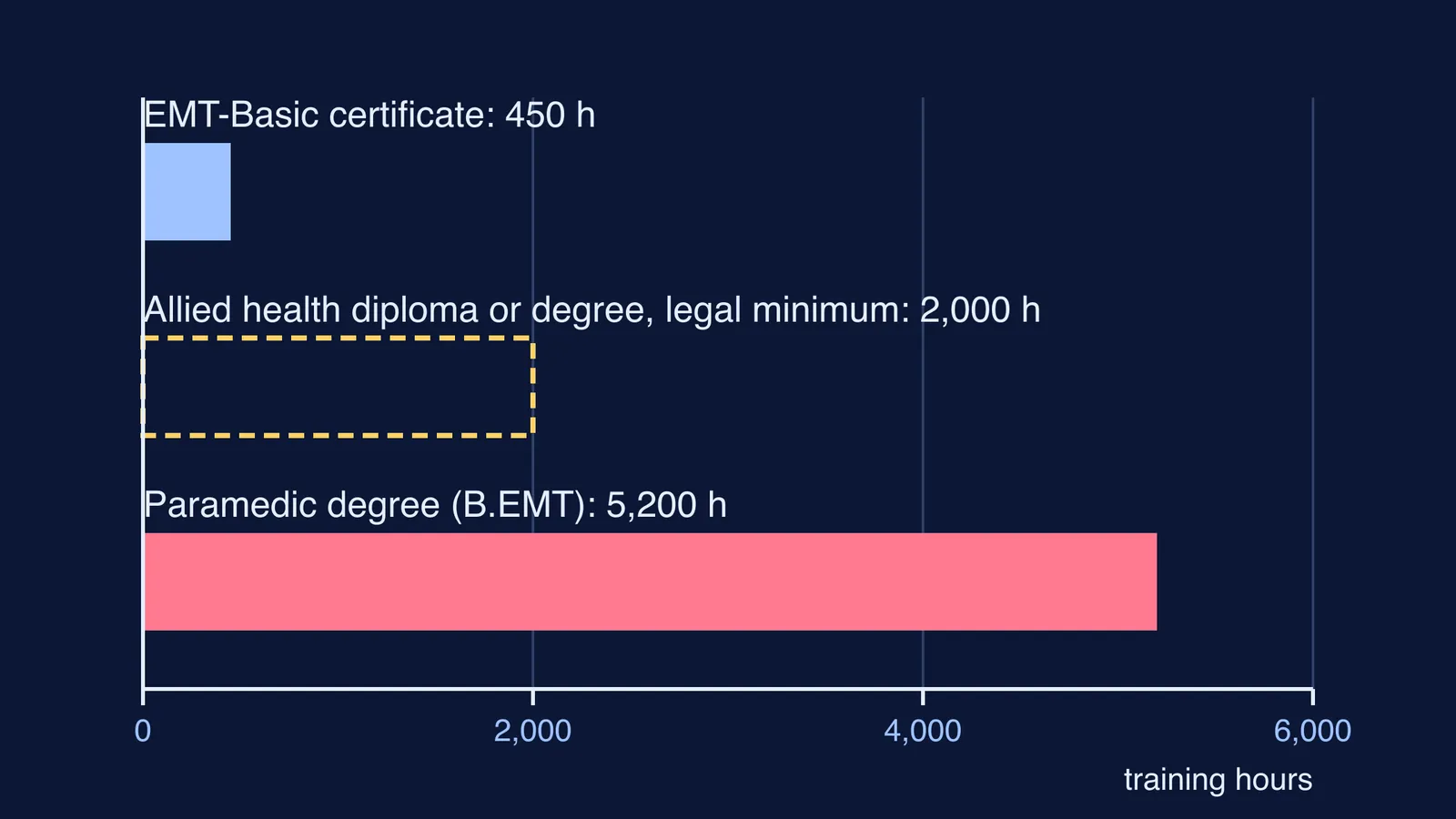
The skills certificate. The EMT-Basic qualification sits at NSQF Level 4, with the Healthcare Sector Skill Council as awarding body. Its listed training time is 450 hours: 90 hours of theory, 150 hours of practicals, 60 hours of employability skills and 150 hours of compulsory on-the-job training (National Qualifications Register). Entry is Class 12 pass, or a student partway through a diploma or the first year of a degree. The register shows the qualification as valid till 31 May 2026, so check whether a course you are offered is on a current version. The Skill Council's model curriculum lists what you practise: scene safety, setting up an ambulance, infection control, moving patients safely, and handling everything from medical emergencies to mass casualties.
The degree. Nagaland University's regulations for the Bachelor of Emergency Medical Technologist (Paramedic) show what a full degree looks like: four years including a one-year compulsory internship, 5,200 hours in total. Entry needs Class 12 with physics, chemistry and biology, and that university admits through NEET followed by counselling. Students learn to assess patients with the Airway-Breathing-Circulation-Disability-Exposure (ABCDE) approach, control bleeding, immobilise injuries, use defibrillators, interpret ECGs and give CPR with advanced life support. Attendance rules are strict: 75% for theory and 80% for skills training.
Admission rules vary by university and state. Our guide to allied health science courses after 12th PCB puts paramedic degrees next to the other options.
Where do EMTs work in India?
Public ambulance services are the most visible place to look. Under the National Health Mission, Dial 108 is mainly an emergency response system for critical care, trauma and accident victims, and people in 35 States and UTs can dial 108 or 102 for an ambulance. The same page lists 3,044 Advanced Life Support and 15,283 Basic Life Support emergency vehicles supported under the mission.
The degree regulations also cover transfers between hospitals and the paramedic's role in working with other health care providers and public safety agencies.
How is EMT training different from nursing?
Where the care happens. EMT training centres on the scene and the ambulance. The Indian Nursing Council's B.Sc. (Nursing) regulations describe a four-year, eight-semester degree that prepares graduates to practise nursing and midwifery in public or private healthcare settings, caring for patients across the life span.
Breadth. Nursing covers wellness, health promotion, illness, disease management and care of the dying. EMT training concentrates on emergencies at the scene and on the way to hospital.
Entry. B.Sc. Nursing needs Class 12 with PCB and English, 45% aggregate, and a minimum age of 17 by 31 December of the admission year (Indian Nursing Council). The EMT-Basic certificate needs a Class 12 pass.
Regulator. Nursing comes under the Indian Nursing Council; paramedics are listed under the NCAHP Act.
If nursing appeals more, our explainer on the B.Sc. Nursing admission process after 12th covers eligibility and exams.
Which route fits you? A five-minute check
Answer these with a parent.
Want a short course before you start work? A skills certificate fits; a four-year degree does not.
Took PCB and want a graduate qualification? Compare paramedic degrees and B.Sc. Nursing side by side.
Prefer caring for patients over days on a ward? Nursing fits. Prefer short, high-stakes encounters? EMT work fits.
Never seen an emergency up close? Do a basic first aid course first to find out how you react.
Both routes rest on Class 11 and 12 biology: the heart, lungs, blood and nervous system. If those chapters feel shaky, the Fermi Concept Library has every concept in biology with its own lesson, so you can rebuild them before term starts.
Next step: shortlist two institutes and check each one's qualification code or university recognition this week.