On this page
If you are aiming for engineering or medicine, there is no single "minimum 12th percentage". Each admission system writes its own rule, and the rule sits in that system's official document. Below are the four that matter most, with a worked example.
What is the minimum 12th percentage for engineering admission?
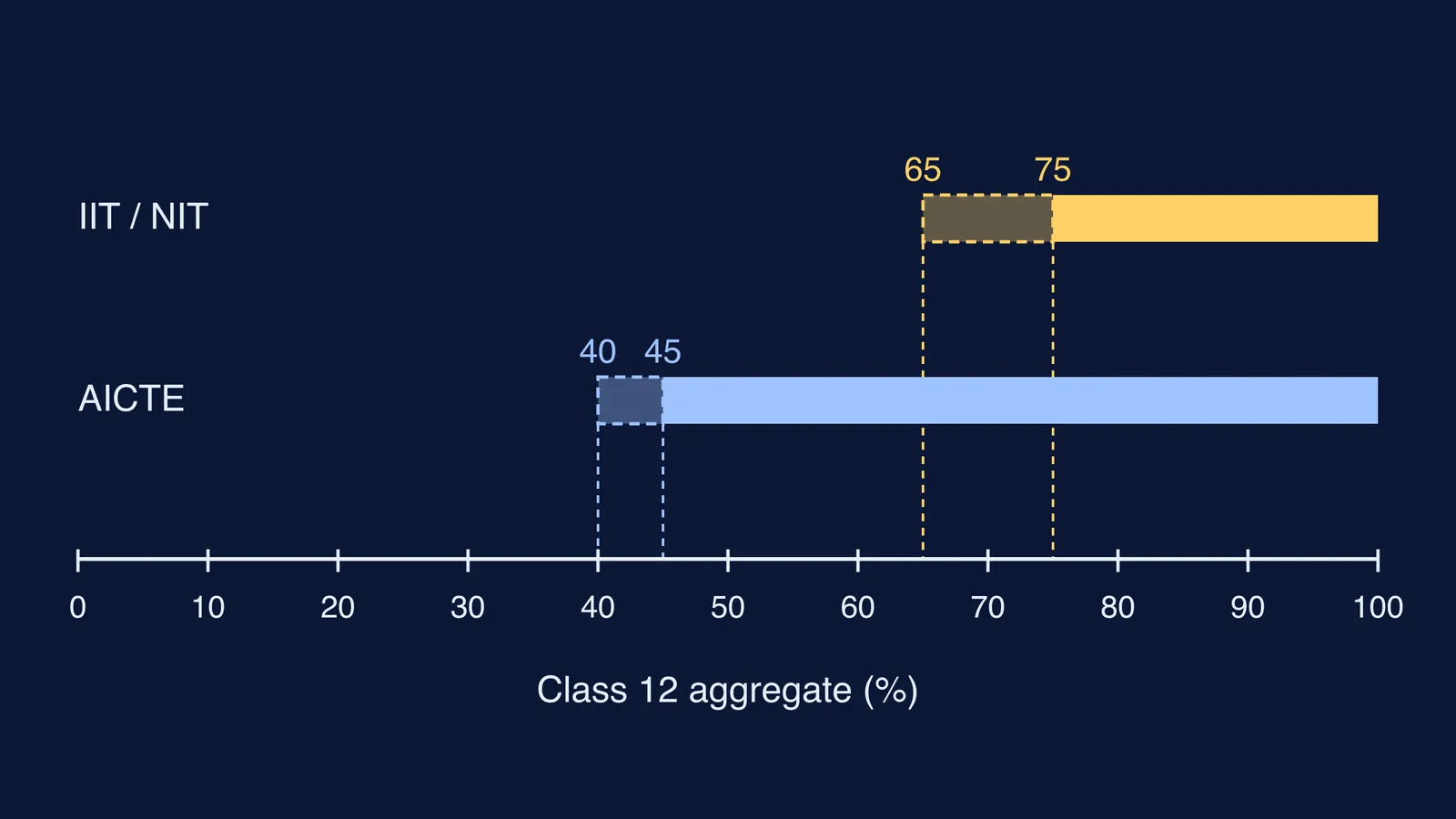
IITs: the JEE (Advanced) 2026 Information Brochure (Section 26) asks for at least 75% aggregate in Class 12 with Physics, Chemistry and Mathematics, or 65% for SC, ST and PwD candidates. The alternative is to be in your board's category-wise top 20 percentile.
NITs, IIITs and other government-funded institutes: the JoSAA 2026 Business Rules (Annexure 2(b)) apply the same test to seats in this NIT+ system: 75% (65% for SC, ST and PwD) or the top 20 percentile.
Other AICTE-approved colleges: the AICTE Approval Process Handbook 2024-25 to 2026-27 (section 8.2) sets the floor at 45% marks, or 40% for reserved categories, in the listed qualifying subjects taken together. States and private universities can ask for more.
Both documents make 75% a condition for admission, not for sitting the exam. It applies when you take an IIT or NIT seat through JoSAA, whatever your rank.
How do IITs and NITs calculate your 75%?
The JEE (Advanced) 2026 brochure counts exactly five subjects: Physics, Chemistry, Mathematics, one language (the higher-scoring one if you took two), and your highest-scoring other subject. Marks that are not out of 100 are scaled to 100, so the total is out of 500. For NIT B.Tech seats, the JoSAA rules let the second science be Chemistry, Biology, Biotechnology or a technical vocational subject.
Worked example. A CBSE student scores Physics 68, Chemistry 72, Maths 81, English 85, Computer Science 90 and Physical Education 92.
Take Physics 68, Chemistry 72 and Maths 81.
Take the language: English 85.
Take the highest remaining subject: Physical Education 92 (higher than Computer Science 90).
Add them: 68 + 72 + 81 + 85 + 92 = 398 out of 500.
Divide by 5: 79.6%, which clears 75%.
Now change Physical Education to 70 and Computer Science to 74. The best "other" subject becomes 74, the total becomes 380 and the aggregate becomes 76%. That still clears 75%, but only just. If Physics is what pulls your total down, the Fermi Problem Library has worked problems with a step-by-step solver that explains the reasoning, so you can see where your method goes wrong.
Is there a minimum 12th percentage for NEET?
Not in the current bulletin. The NEET (UG) 2026 Information Bulletin (Chapter 6) asks you to have passed Class 12 with Physics, Chemistry, Biology or Biotechnology, and English. It does not list a minimum Class 12 percentage. The cut-off applies to your NEET score instead. Chapter 8 of the same bulletin sets the 50th percentile in NEET (UG) for General and General-EWS candidates, the 40th percentile for SC, ST and OBC candidates, and the 45th percentile for General and General-EWS candidates with benchmark disabilities.
Many guides still quote a "50% in PCB" rule from earlier years; follow the bulletin for your year. Chapter 7 says state-quota seats follow each state's own eligibility rules, so read your state's counselling notice too. Our parent's guide to NEET eligibility and attempts covers the age rules.
What if you fall short of 75%?
Section 26 of the JEE (Advanced) 2026 brochure gives two official routes.
Top 20 percentile: the cut-off is worked out each year, by category, from the marks of successful candidates on your board. If your five-subject total is at or above your category's cut-off, you qualify even below 75%. If your board does not publish the cut-off, you need a certificate from the board. Without one, the CBSE cut-off is used instead.
Improvement exam: to reach 75%, you can reappear in one or more subjects, and your higher mark in each subject counts. To qualify through the top 20 percentile instead, you must reappear in all subjects. Our explainer on which marks count after an improvement exam goes through each case.
If you are planning an improvement exam, Fermi's AI tutor can work out what you already know and build a plan for the session, so you know where to start.
How do you check the rule in your own bulletin?
Rules change each year. Open this year's official PDF, such as the NEET (UG) 2026 bulletin or the JoSAA 2026 rules, and:
Search for "Class XII" or "qualifying examination" to find the eligibility section.
Note which subjects count, and whether "aggregate" means five subjects or only PCM or PCB.
Check the relaxation for your category, and whether it covers OBC-NCL and EWS. For IITs and NITs it does not.
Search for "top 20 percentile" and find your board's cut-off for this year.
Read the rules for improvement exams and for marksheets from more than one board.
Note the clause number, in case your documents are questioned when you report.
For a section-by-section tour of these documents, read how to read the JEE Main or NEET information bulletin.