On this page
The Ministry of Health and Family Welfare notes that India adds approximately 2.2 lakh new patients with End-Stage Renal Disease (ESRD) every year. This rising prevalence creates an additional demand for roughly 3.4 crore dialysis sessions annually. Since its launch in 2016, the Pradhan Mantri National Dialysis Programme (PMNDP) alone has delivered over 4.54 crore hemodialysis sessions to 33.16 lakh patients. To run these machines safely and effectively across both urban and rural healthcare centres, the medical system relies heavily on trained dialysis technologists.
What is the scope of a dialysis technology course in India?
A dialysis technologist prepares the patient, sets up the dialyzer machine, monitors the blood flow and dialysate fluid during the procedure, and manages any clinical emergencies that arise such as sudden drops in blood pressure. They are also responsible for explaining the procedure to patients and ensuring they are comfortable throughout the lengthy four-hour treatments that patients typically undergo two to three times a week. Under the National Commission for Allied and Healthcare Professions (NCAHP) Act of 2021, the practice of dialysis technology is now formally regulated in India, giving it a clear professional structure and ensuring uniform standards of care.
The standard qualification for this career is the Bachelor in Dialysis Therapy Technology (B.DTT). It is a four-year degree consisting of three years of academic study followed by a one-year compulsory rotatory internship where students gain hands-on clinical experience across various hospital departments and real patient scenarios. During this final year, students learn to handle the psychological aspects of chronic disease care alongside the technical operation of the machinery. While a two-year Diploma in Dialysis Technology (DDT) also exists, the B.DTT is the preferred standard for full professional registration and advanced supervisory roles.
What does the B.DTT curriculum cover?
The NCAHP has published a standard, competency-based curriculum that becomes mandatory for all institutions starting with the 2026-27 academic session. The training moves systematically from foundational biology to the mechanics of the life-saving machines:
Foundational sciences: Anatomy, physiology and biochemistry, focusing heavily on the renal system. Students explore structures such as the one discovered by William Bowman and the capsule that filters blood in the kidney, learning how healthy kidneys normally remove metabolic waste.
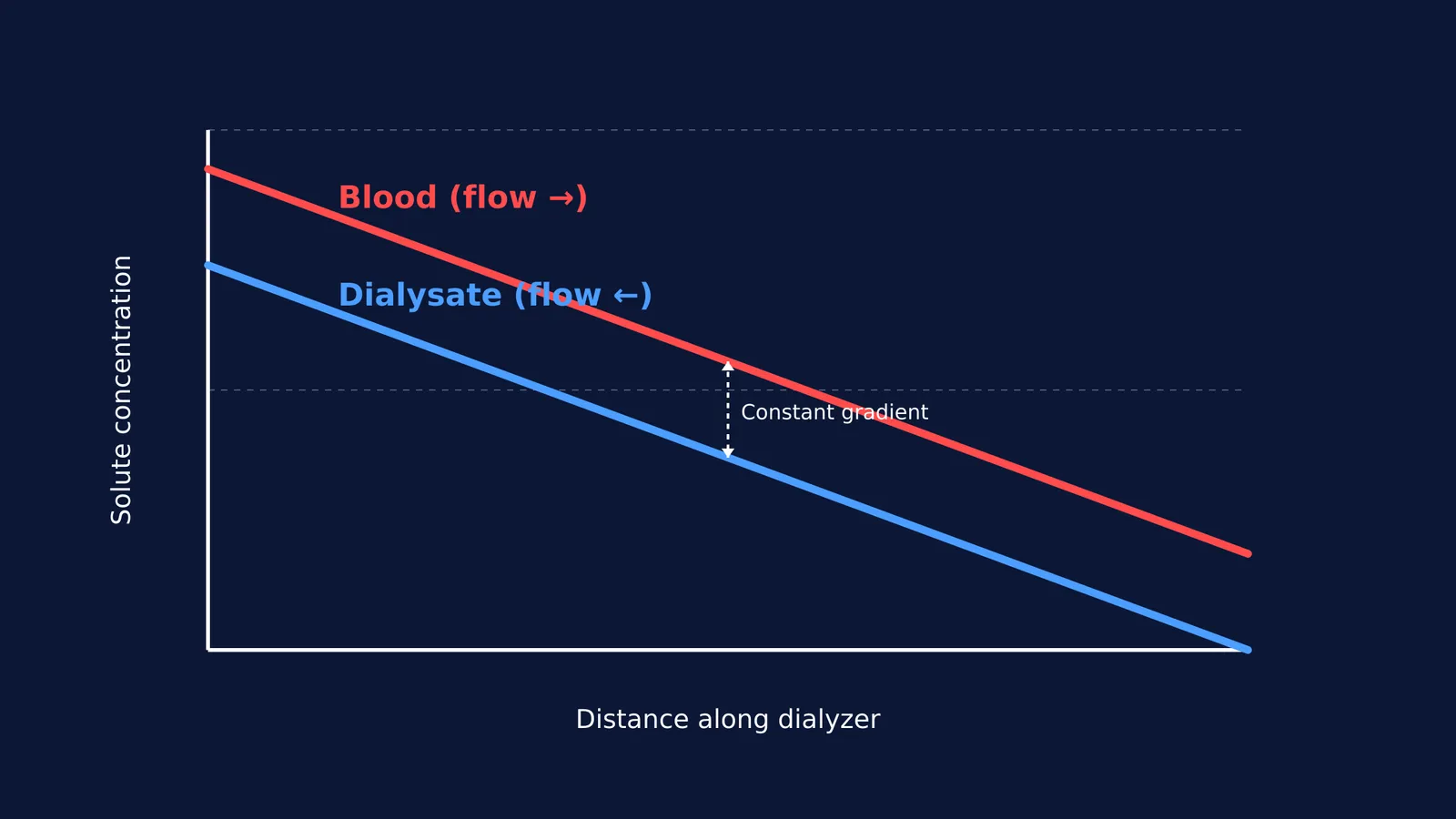
Core technology: The physical principles behind hemodialysis and peritoneal dialysis, which rely heavily on concentration gradients, diffusion and osmotic pressure to move toxins across a semi-permeable membrane.
Equipment maintenance: Managing water treatment plants, since standard tap water contains trace minerals and chloramines that would be fatal to patients if introduced directly into their blood. Technologists learn to test water purity and troubleshoot the dialyzer.
Clinical care: Infection control protocols, vascular access management (safely connecting the machine to a patient's arteriovenous fistula, graft or central venous catheter), and emergency basic life support (BLS).
If you are reviewing human physiology for allied health entrances, the Fermi Simulation Lab lets you adjust variables in biological models to see how they adapt. This active learning approach builds on foundational concepts like those in Regulating kidney function: ADH, the RAAS and ANF explained.
Where do dialysis technologists find jobs?
Graduates must register with their State Allied and Healthcare Council to practice legally. Once registered, they are hired across several rapidly expanding sectors:
Hospitals: Multispecialty government and private hospitals that run round-the-clock dialysis units to accommodate patients with varying schedules.
Standalone centres: Dedicated chains like NephroPlus or Apollo Dialysis that focus entirely on renal care and operate high-volume clinics.
Equipment manufacturers: Companies that build and maintain dialyzers hire technologists as application specialists to train other hospital staff and provide technical support.
According to healthcare education platforms like Virohan, fresh graduates typically earn between ₹15,000 and ₹25,000 per month. With experience, or by taking on leadership roles such as clinical coordinator, quality assurance officer or dialysis unit supervisor, salaries can rise to ₹35,000–₹60,000 per month depending on the city and facility.