

On this page
What is the CUET English exam pattern?
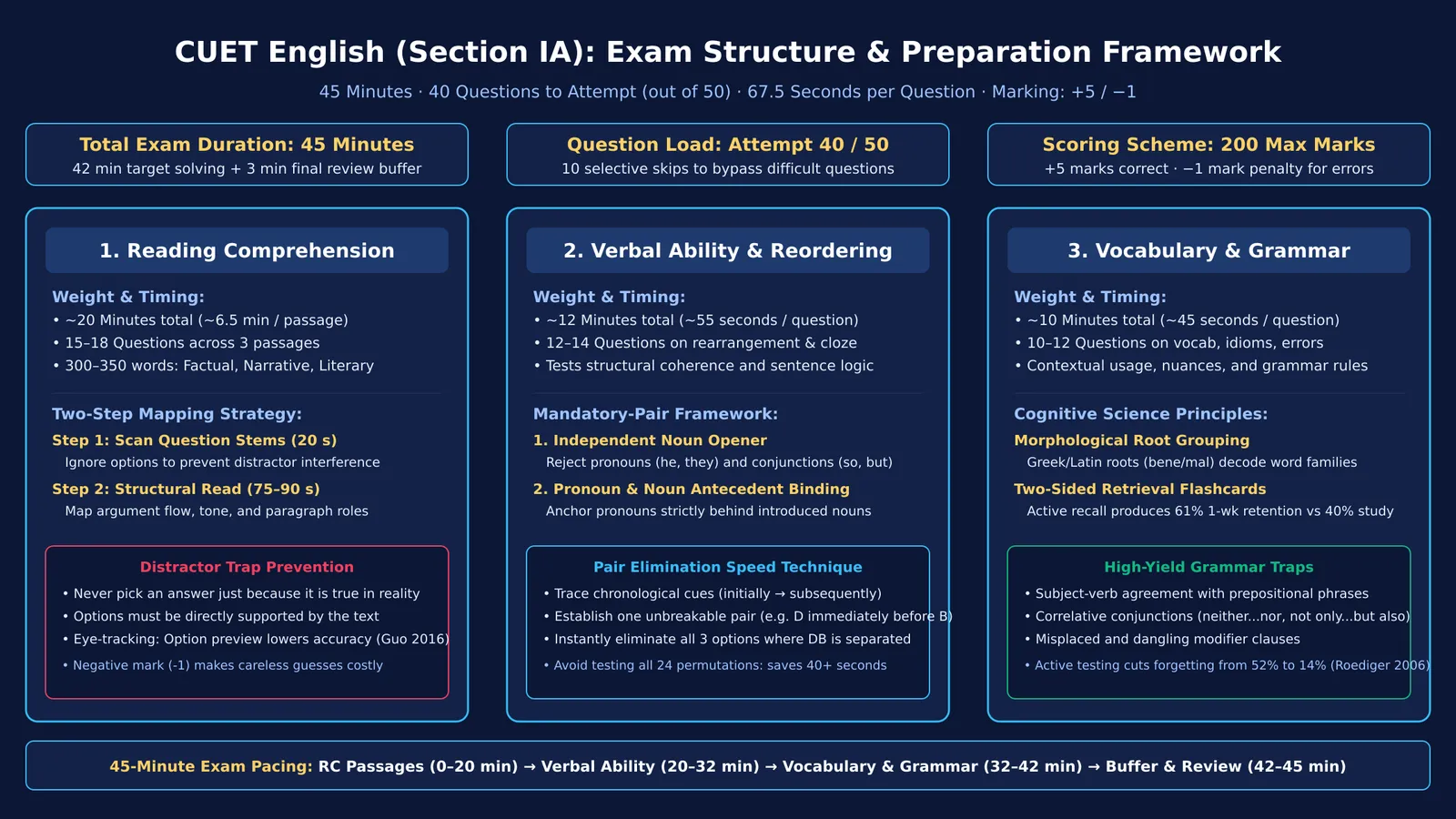
The Common University Entrance Test (CUET UG) English paper (Section IA) evaluates functional reading ability, literary aptitude, and vocabulary under strict time limits. According to official National Testing Agency guidelines, candidates must attempt 40 out of 50 multiple-choice questions within 45 minutes, allotting 67.5 seconds per question. Each correct response earns +5 marks, while an incorrect response deducts 1 mark (unattempted questions receive zero). The maximum score is 200 marks. For university mapping, see our guide on CUET subject combinations for Delhi University.
The syllabus covers three primary components:
Reading Comprehension: Three passages of 300 to 350 words each across factual, narrative, and literary genres.
Verbal Ability: Sentence rearrangement (para-jumbles) and contextual word choice.
Vocabulary and Grammar: Synonyms, antonyms, idioms, one-word substitutions, figures of speech, and error spotting.
How should you approach reading comprehension passages?
Reading comprehension comprises nearly half of the paper. With three 300 to 350-word passages, managing cognitive load is critical. A popular coaching tip suggests reading all questions and answer options before touching the text. However, eye-tracking research in Reading and Writing by Qian Guo and colleagues demonstrated that previewing answer choices significantly lowered accuracy. Plausible-sounding distractors induce proactive interference, biasing comprehension before reading the passage.
Instead, use a two-step mapping routine:
Scan question stems: Spend 20 seconds reading stems—ignoring options—to flag keywords such as dates, names, or line references.
Structural read: Spend 75 to 90 seconds reading the text to grasp the main argument and paragraph functions (such as background, evidence, or conclusion).
For pacing drills, see how to solve an unseen English passage quickly.
How do you build vocabulary without rote memorisation?
CUET tests vocabulary in context rather than isolated lists. Memorising dictionary definitions alphabetically through repeated rereading is inefficient. In Psychological Science, Henry Roediger and Jeffrey Karpicke found that after one week, students who relied on repeated study remembered only 40% of the material, whereas students using retrieval practice retained 61%. Testing dropped the weekly forgetting rate from 52% to 14%.
A review in Psychological Science in the Public Interest by John Dunlosky and colleagues rated practice testing and distributed practice as the two most effective learning techniques across subjects:
Learn morphological roots: Group words by Greek and Latin roots. Knowing that *bene-* means good and *mal-* means bad helps decode *beneficent*, *malevolent*, *benign*, and *malignant*.
Two-sided flashcards: Put the word on one side, and definition and root on the other. Force yourself to recall the meaning before flipping.
Contextual shades: Distinguish tone. Words like *resolute* and *stubborn* share denotations but differ sharply in connotation.
How do you tackle grammar and sentence rearrangement?
Verbal ability questions test structural logic. For sentence rearrangement (para-jumbles), never guess combinations blindly:
Find the opener: Independent statements rarely start with pronouns (*he*, *they*), coordinating conjunctions (*but*, *so*), or transition markers (*therefore*).
Trace pronouns: If sentence C introduces a noun and sentence A uses its pronoun, C must precede A.
Chronological cues: Transition words such as *initially* and *ultimately* fix the sequence.
Eliminate pairs: Once you establish pair DB, immediately eliminate options where DB is split.
For grammar, focus on high-yield error patterns: subject-verb agreement with prepositional phrases (*The bouquet of yellow roses has arrived*, not *have arrived*), misplaced modifiers, correlative conjunctions (*neither...nor*), and conditional clauses.
What does an effective 4-week preparation plan look like?
Preparing for Section IA requires consistent, distributed practice. Matching your daily drills to the official National Testing Agency 45-minute test duration conditions your stamina for exam day. Allocate 45 minutes daily over four weeks:
Week 1: Core mechanics. Revise fundamental grammar (tenses, agreement, voice) and build 60 root-word flashcards. Solve one factual passage daily.
Week 2: Verbal ability. Practice 15 sentence rearrangement questions daily using mandatory pairing. Drill 15 idioms using active recall. Complete one narrative passage daily.
Week 3: Literary devices and speed. Study poetic devices (metaphor, simile, personification). Solve mixed sets of 20 MCQs in 20 minutes to adapt to time pressure.
Week 4: Mock tests. Take three 45-minute timed mock tests under strict conditions. See our guide on simulating full-length mock exam conditions at home. Review every error to categorize mistakes.
When planning your study schedule, balance language revision alongside domain subjects. If you are revising STEM topics, the Fermi Concept Library organizes every concept in physics, chemistry, biology, mathematics and computing, each with its own lesson and its place in the map, while the Fermi Problem Library provides worked problems with a step-by-step solver that explains the reasoning rather than printing an answer. The same discipline of dissecting underlying structure helps you spot verbal traps on test day.


