On this page
Thousands of students finish Class 12 each year looking for a quick route into the workforce rather than a theory-heavy three-year degree. For them, the University Grants Commission (UGC) Community College scheme offers a practical, skills-based alternative.
Unlike traditional undergraduate programmes, community colleges focus directly on employability. They partner with local industries and Sector Skill Councils to teach specific trades, from healthcare and IT to mechatronics, hospitality, and tourism. This ensures that the curriculum is constantly updated to meet the current demands of the local job market.
Here is how these skill-based diplomas work, how the national credit system allows you to build towards a full degree over time, and whether this vocational path is the right choice for you.
What is a skill diploma from a community college?
In India, a community college is usually a separate entity hosted within an existing university or college. Its primary goal is to provide accessible, low-cost training that makes you genuinely "work-ready" from day one.
The curriculum is intentionally split into two parts: a skill component and a general education component. To ensure the training meets industry standards, the skill component carries 60% of the weightage and is assessed by Sector Skill Councils (UGC). This means the vast majority of your time is spent on hands-on training, lab work, internships, and practical projects rather than simply sitting in a lecture hall. By aligning directly with these councils, colleges ensure that students learn exactly what employers need right now.
The remaining 40% covers general education, which includes communication skills, basic computer literacy, and the foundational sciences relevant to your chosen trade. This combination ensures you have both the technical abilities and the soft skills required to succeed in a professional environment.
How do NSQF credits stack in a community college diploma?
The biggest advantage of the community college system is its modular flexibility. The courses follow the National Skills Qualifications Framework (NSQF), which uses a credit-based system with multiple entry and exit points.
According to the University Grants Commission, one credit is equivalent to one hour of theoretical teaching or two hours of practical work per week. Here is exactly how the credits stack if you stay in the system:
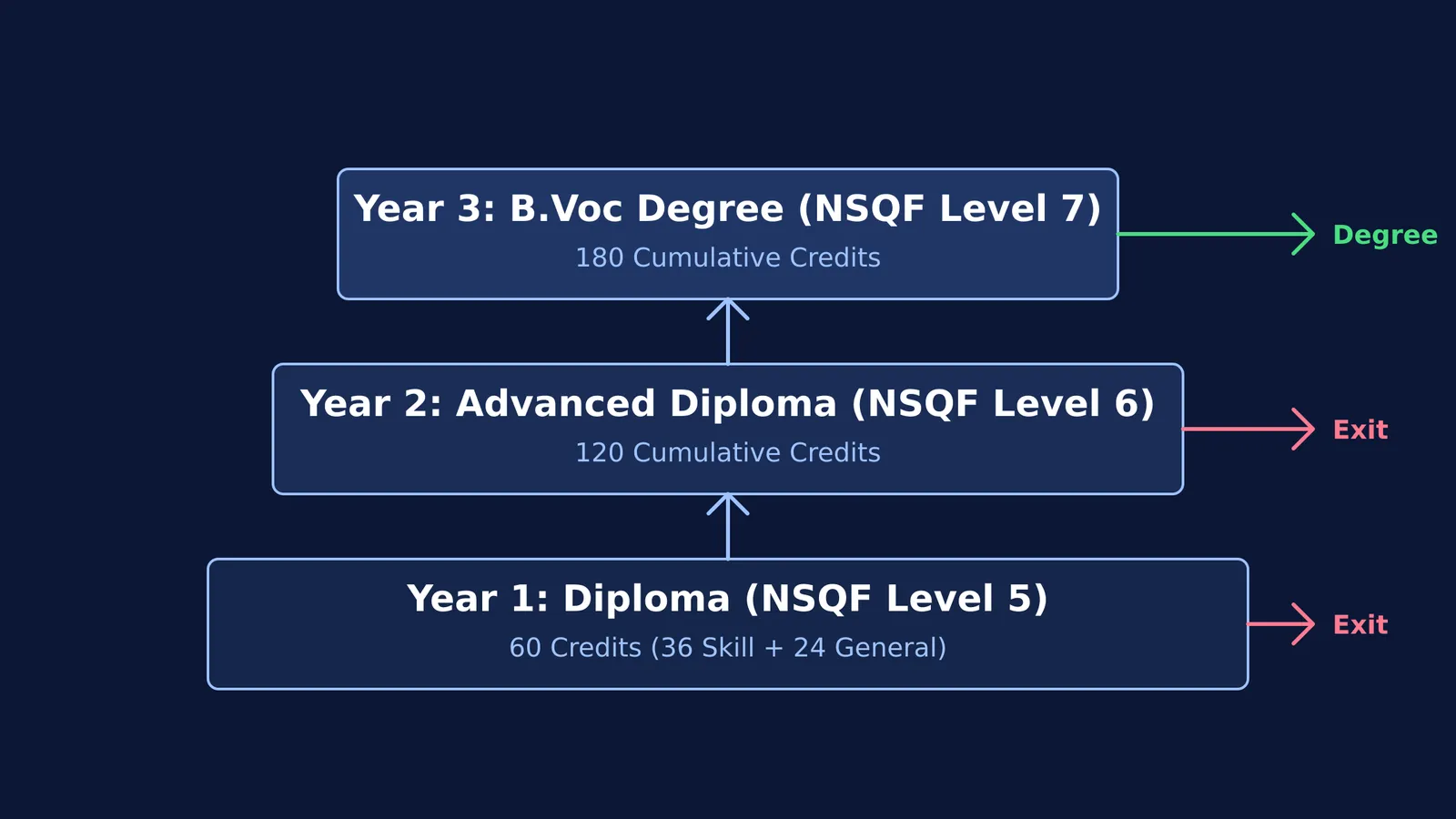
1 Year (Diploma): You need 60 credits (36 skill and 24 general) to reach NSQF Level 5. You can exit here and immediately start looking for a job.
2 Years (Advanced Diploma): If you stay for a second year, you earn another 60 credits. At 120 cumulative credits, you receive an Advanced Diploma (NSQF Level 6).
3 Years (B.Voc Degree): Completing a third year takes you to 180 cumulative credits. This final step qualifies you for a full Bachelor of Vocation (B.Voc) degree (NSQF Level 7).
This "vertical mobility" means you do not have to commit to a three-year degree upfront. You can earn a diploma, work in the industry for a few years, and then return later to complete your Advanced Diploma or B.Voc degree when you are ready.
If you are returning to education and find gaps in the basic science or maths required for your general education modules, the Fermi Concept Library explains every concept in physics, chemistry, biology, mathematics and computing. If you are stuck on a specific topic, Fermi's AI tutor can work out what you already know and build a plan for the session, so you sit down to a clear next step.
Who should choose a community college diploma after 12th?
A community college diploma is not a fallback option; it is a highly specific career strategy. It generally suits students who:
Want immediate employment: If you need to start earning soon after Class 12, a one-year diploma gives you a certified skill set that local employers actively recognise. Instead of waiting three years to graduate, you can enter the workforce almost immediately.
Prefer active learning: If you learn better by doing rather than reading, the 60% practical weightage will suit your study habits. You will spend more time using tools and software than taking notes.
Need financial flexibility: The multiple exit points are ideal if you cannot afford the time or money for a continuous three-year degree programme.
If you are using the time right after your board exams to weigh your options, reading about what to do after Class 12 before college starts can help you set up a strong plan. You might also compare this vocational path with career paths after a B.Des degree or consider what a minor degree in BTech is if you are leaning towards a traditional engineering route.
The final choice comes down to how quickly you want to enter the job market and the environment in which you prefer to learn.