

On this page
The easy way to handle a tutorial sheet is to turn up, watch the tutor solve it on the board and copy it down. That wastes the one class built around your questions. A better plan: try every problem before you go, mark exactly where each one broke down, and use the session to fix those steps.
Why attempt the tutorial sheet before the session?
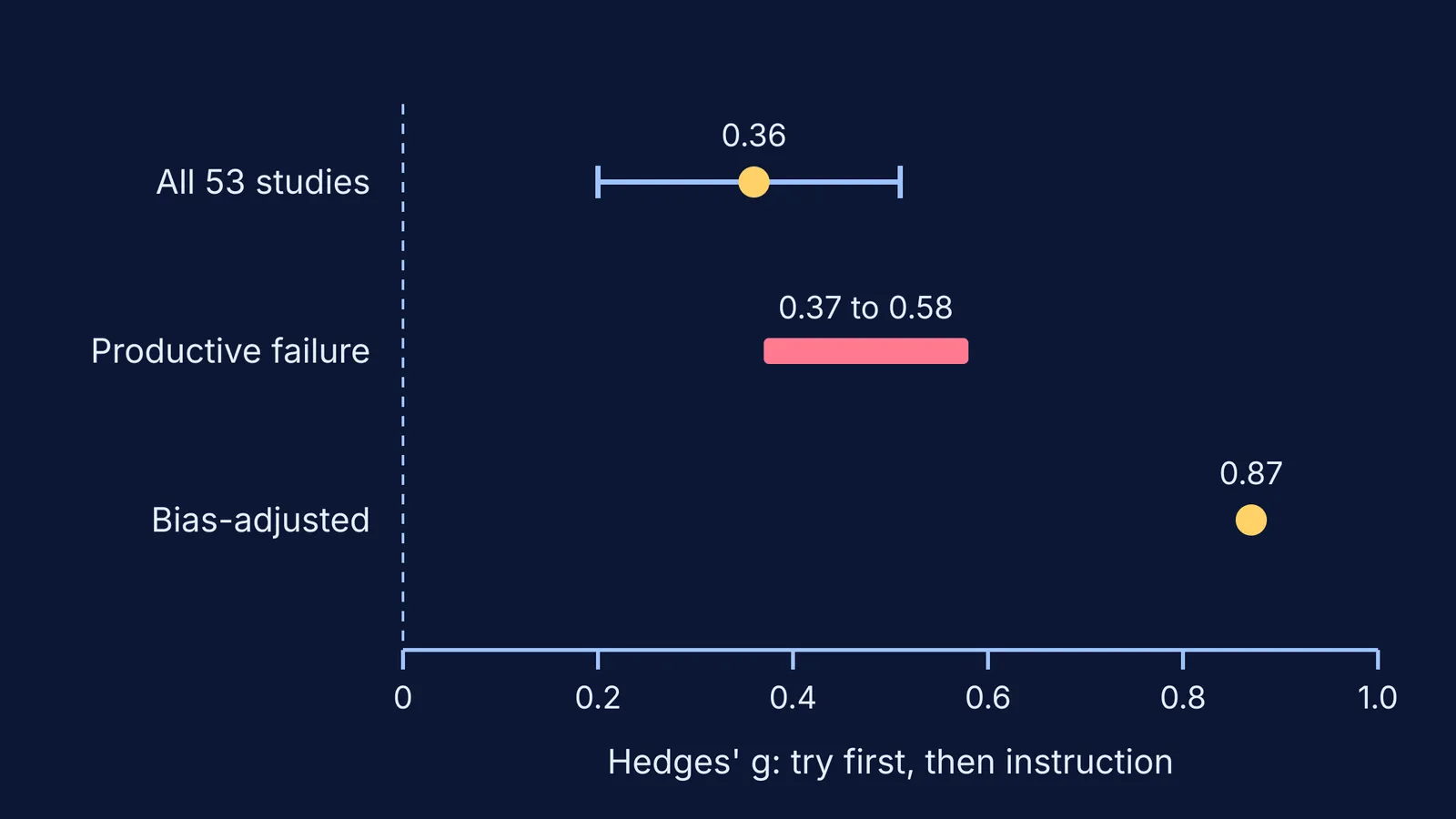
Trying a problem before you have been shown how tends to help the later explanation stick. In a 2021 meta-analysis in Review of Educational Research, Tanmay Sinha and Manu Kapur of ETH Zürich pooled 53 studies with 166 comparisons of "problem solving first, then instruction" against "instruction first, then problem solving" when students learn a new concept. Problem solving first came out ahead, with a moderate effect size (Hedges' g of 0.36). The effect was stronger, between 0.37 and 0.58, when the problem-first phase followed the principles of what Kapur calls productive failure.
There are limits. The same review found the opposite trend for children in grades two to five and for general skills that are not tied to a subject. A college tutorial is not an exact match, since you have usually had a lecture first, but the sheet still lets you struggle with a problem before the tutor explains it. The goal is not to fail on purpose but to arrive with a question the tutor's explanation can land on.
What does a tutorial class add that a lecture does not?
A tutorial is meant to be the active part of a course, and active teaching has strong evidence behind it. A 2014 PNAS meta-analysis of 225 studies of undergraduate science, engineering and maths courses, led by Scott Freeman, found that students in traditional lecture classes were 1.5 times more likely to fail than students in classes with active learning. Average failure rates were 21.8% under active learning and 33.8% under traditional lecturing.
If you only watch the tutor solve problems, it becomes one more lecture.
How should you prepare a tutorial sheet?
Give the sheet one focused sitting before the session, early enough that you can sleep on the problems that beat you. Then mark each problem with one of three symbols:
Tick: solved, and you could explain every step.
Wave (~): started, but stuck at a specific step. Write down the line where you stopped.
Cross: could not start. Write what you tried and what you think the question is asking.
The wave problems matter most, because they produce the sharpest questions. For how long to keep pushing before you mark a problem, see our piece on how long to stay stuck on a problem. If your department hands out solutions, read how to use solution books without copying before you open them; looking too early turns waves into fake ticks.
A worked example
Take a typical first-year mechanics question: a block slides down a rough incline at angle θ; find its acceleration. You draw the forces and write mg sin θ − f = ma, with friction f = μN. Then you stall: is the normal force N equal to mg or mg cos θ?
On your sheet, write: "Q4 ~ stuck at N. Not sure whether N = mg or mg cos θ. Used mg and got a = g(sin θ − μ)." That line tells the tutor exactly where your understanding breaks: resolving forces perpendicular to the incline.
What should you ask in a tutorial class?
Bring your marked sheet and ask in this order:
Wave problems first. Script: "In Q4, I got as far as ___. I'm stuck between ___ and ___. Which is right, and how would I spot that next time?"
Cross problems next. Ask only for the first step: "Could you show me how to start Q7? I'll try the rest myself."
Tick problems last, and only if you used a different method: "I solved Q2 another way. Is this valid?"
Avoid "Can you do Q4?" It hands the thinking back to the tutor and leaves you with a solution to memorise.
If you find it hard to speak up, hand your written question over at the start, or take it to office hours.
What should you do after the session?
Within a day, redo every wave and cross from a blank page, without your notes. If you get through it now, change the mark to a tick. If you stall at the same step, the explanation has not stuck yet, and that step goes on your revision list.
If you stall again while working alone, the Fermi Problem Library has worked problems with a step-by-step solver that explains the reasoning rather than printing an answer, so you can check one step and carry on yourself. If a whole topic feels shaky, Fermi's AI tutor can work out what you already know and build a plan for the session.
Keep your marked sheets: before tests, the remaining waves and crosses are your revision list. Our guide to college mid-sems and internals covers how to plan around them.


