On this page
If someone at your college has harassed you, you do not have to sort it out alone. Every college under the UGC must run an Internal Complaints Committee, or ICC, with fixed steps and deadlines.
What is an Internal Complaints Committee in college?
The ICC is the committee every higher educational institution must set up under the UGC's 2015 regulations on sexual harassment of women employees and students, notified on 2 May 2016 (UGC Compendium of Regulations, regulations 1 and 2).
Under regulation 4, the ICC is chaired by a woman faculty member at a senior level and includes two faculty members, two non-teaching staff and one member from an NGO working on women's issues. If the matter involves students, it also has three students (one each at undergraduate, master's and research level, elected through a democratic process) (UGC, regulation 4). At least half the members must be women. Vice-Chancellors, Registrars, Deans and similar senior administrators cannot be members, so that the committee works on its own.
Your college must print the penalties for sexual harassment in its prospectus, display them on notice boards and tell everyone how to reach the ICC's members (UGC, regulation 3).
Who can file a harassment complaint, and by when?
The regulations protect an aggrieved woman, defined as "a woman of any age whether employed or not" who alleges sexual harassment, and "campus" includes institutional transport, field trips, internships and sports meets (UGC, definitions). Sexual harassment covers unwelcome physical, verbal or non-verbal conduct of a sexual nature, including threats or promises tied to sexual favours (UGC, regulation 2). If you are not a woman, ask the ICC what your college's own policy covers.
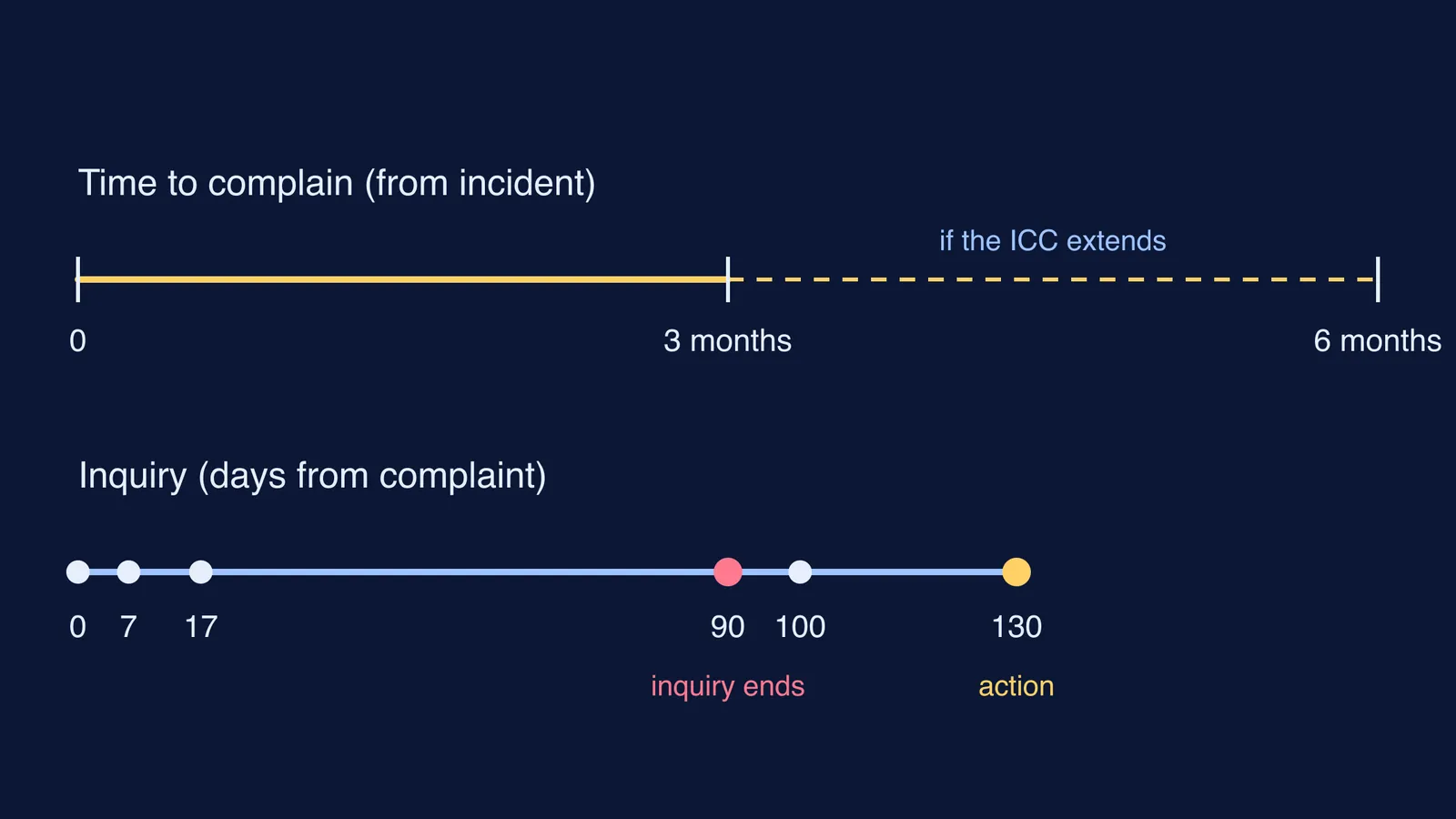
The deadline is the part most students miss. You must submit a written complaint to the ICC within three months of the incident, or of the last incident if there were several. The ICC may extend this by up to three more months if circumstances stopped you filing in time and it records its reasons in writing (UGC, regulation 7). If you cannot complain because of a physical or mental incapacity, friends, relatives, co-students, a psychologist or another associate can file on your behalf.
What happens after you file a complaint?
Regulation 8 sets the order and the clock (UGC, regulation 8):
The ICC sends a copy of your complaint to the person you named (the respondent) within 7 days.
The respondent replies within 10 days, with documents and names of witnesses.
The ICC hears both sides and must finish the inquiry within 90 days of receiving your complaint. Its findings go to both of you.
The report reaches the head of the institution, called the Executive Authority, within 10 days.
The Executive Authority acts on it within 30 days, and either side may appeal within 30 days of the recommendations (UGC, regulation 8 continued).
Under regulation 9, the college can take interim steps: transferring either party, granting you leave of up to three months, stopping the respondent from evaluating your work, or warning them to keep their distance. Conciliation is allowed if you ask for it, but money cannot be the basis of a settlement, and the identities of the complainant, witnesses and respondent must not be made public.
That protection is in UGC regulation 11.
What should you write down before you complain?
Start a dated note the same day, on paper or in an email to yourself:
Date, time and place of each incident
The exact words or actions, as close as you remember them
Who was present, and who you spoke to straight afterwards
Screenshots of messages showing the sender and date, backed up off your phone
Effects on your studies: missed classes, a changed supervisor, marks you think were affected
What you want while the inquiry runs, such as not being evaluated by this person
The date you handed in the complaint, and a signed or stamped copy for yourself
A plain opening for the written complaint can look like this: "To the Presiding Officer, Internal Complaints Committee. I, [name], [course and year], submit a complaint of sexual harassment under the UGC Regulations, 2015 against [name and role]. On [date] at [place], [what happened]. [Name] was present. I attach [list]. I request [interim measure] during the inquiry."
Where else can you get help?
The ICC must help you if you choose to file a police complaint (UGC, regulation 5). The National Commission for Women runs a 24x7 helpline, +91-7827170170 (Ministry of External Affairs). If you feel overwhelmed, Tele MANAS on 14416 offers free, round-the-clock mental health support (DGHS), and you can find your college counselling centre and book a session.
Parents can read how to talk about ragging before college, and students our safety tips for travelling at night.
If a long inquiry has left you behind in a subject, Fermi's AI tutor can work out what you already know and build a plan for the session, so catching up starts with one clear step.