On this page
Your final-year engineering project is your first opportunity to work as an independent practitioner rather than an exam taker. Under the AICTE Model Curriculum for undergraduate engineering, project work and internships account for 12 to 16 credits of the 160-credit B.Tech degree. This allocation gives your final project substantial weight in your graduation transcript and technical portfolio. Yet many students stall early because they confuse an interesting curiosity with a realistic engineering challenge.
Choosing a topic requires balancing personal curiosity, institutional laboratory resources, and strict calendar deadlines.
What makes a good final-year engineering project topic?
A successful topic solves a specific technical problem under measurable engineering constraints. It is neither a generic tutorial copied from the internet nor an open-ended moonshot requiring industrial resources.
In a landmark survey of 360 engineering departments across 173 institutions, Todd et al. (1995) found that project failures stem primarily from ambiguous problem definitions and poorly constrained scopes rather than lack of student technical capability. High-scoring projects generally display three traits:
Specific problem statements: The project targets an observable bottleneck, such as reducing latency in an edge network or improving heat dissipation in a battery module, rather than attempting an all-purpose system.
Quantitative validation metrics: You can benchmark your solution against an established standard using clear numbers, such as error rate, thermal loss, or throughput.
Clear personal relevance: The topic strengthens competencies for your intended career path, whether that is embedded firmware, power systems, or structural analysis.
If you are transitioning from early science coursework to engineering design, our guide on formulating a project from a scientific question shows how to frame testable hypotheses that carry over into engineering prototypes.
How should you evaluate technical feasibility and lab resources?
Before submitting a topic to your department project committee, run it through a systematic feasibility check. An ambitious idea stalls quickly if your laboratory lacks the necessary test benches, sensors, or licensed software.
Evaluate your prospective topic against four practical filters:
Component availability: Can you procure or fabricate every required sensor, microcontroller, or structural material within your budget?
Lab instrumentation: Does your department have working oscilloscopes, calibration rigs, or computing clusters needed to validate results?
Dataset accessibility: If your project involves machine learning or digital signal processing, does an open-source, well-documented training dataset already exist?
Safety compliance: Does the project comply with institutional safety codes regarding high voltage, chemical handling, or RF emissions?
When formulating your analytical models or calculating electrical and mechanical parameters, ground your design in core principles. If your team needs to review foundational equations before running numerical simulations, the Fermi Concept Library covers every concept in physics, chemistry, biology, mathematics and computing, each with its own lesson and its place in the map.
How do you find and approach the right faculty guide?
Your faculty supervisor guides your methodology, approves milestones, and defends your work during viva voce examinations. Research on capstone mentoring by Pembridge and Paretti (2011) shows that effective faculty advisors provide critical coaching through design roadblocks, challenge technical assumptions, and protect student teams from premature dead-ends.
Review recent publications and sponsored grants on your department faculty portal. Approach professors whose active research intersects with your interests.
Avoid vague requests asking an advisor to hand you a topic. Instead, send a concise, structured inquiry:
Subject: B.Tech Major Project Inquiry: [Specific Domain / Problem Area]
Opening: Introduce your team members, branch, and academic standing, supported by our guide on improving your college CGPA.
Core proposal: Outline two specific problem statements you have researched, citing a recent publication from their lab or field.
The ask: Request a ten-minute meeting during office hours to discuss the feasibility of these directions.
How do you scope a project across one or two semesters?
Project duration dictates achievable technical depth. In a decennial survey of capstone design courses across 256 institutions and 464 departments, Howe et al. (2016) reported that 55% of departments organize capstones as a two-semester sequence, while 31% use a single-semester format.
Under a two-semester structure:
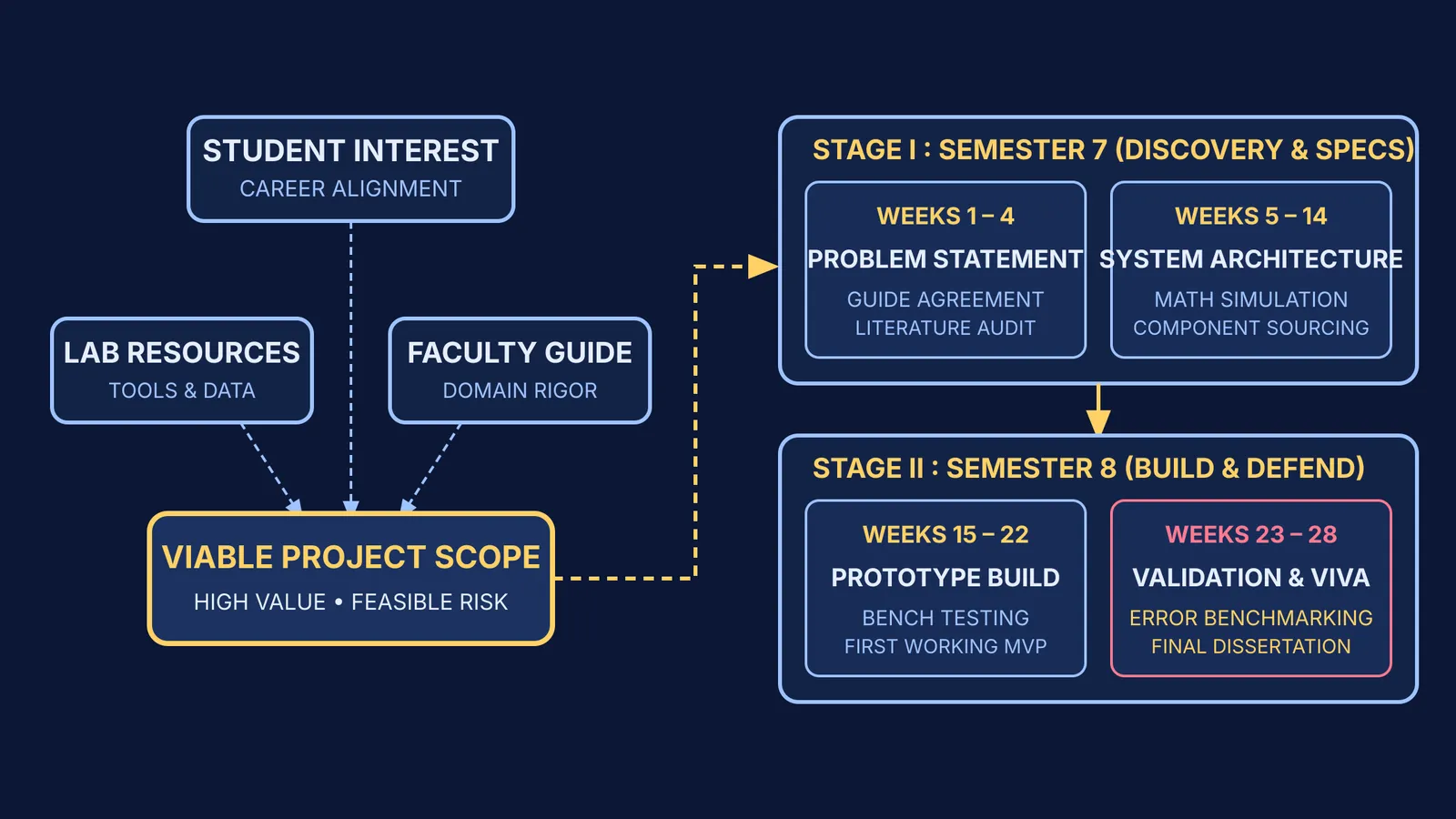
Semester 7 (Project Stage-I): Focus on literature review, mathematical modeling, component selection, and initial simulation. AICTE guidelines define this phase as problem formulation and feasibility analysis.
Semester 8 (Project Stage-II): Dedicate this term to physical fabrication or software integration, empirical testing across edge conditions, and the final viva voce defence.
In a single-semester format, focus strictly on a Minimum Viable Prototype (MVP). Define what must function on evaluation day and record secondary ideas as future work. Regular team check-ins keep progress predictable; our guide on structuring an effective study group offers techniques for setting mutual milestones and peer accountability.
When calibrating theoretical models or diagnosing calculation errors in your simulations, Fermi's AI tutor works through problems alongside the student, noticing where you are stuck and checking understanding as it goes to help verify mathematical fundamentals before you finalize your hardware design.