On this page
A ranking of countries can't know your budget, your subject, or whether you want to come home after your degree. This guide puts the official rules for five countries side by side instead. Rules change often, so check each linked page again before you apply.
How long is an undergraduate degree in each country?
UK: a standard bachelor's degree lasts 3 years full-time in most of the UK and 4 years in Scotland, according to UCAS.
US: a bachelor's degree usually takes four years, says the US government's Study in the States.
Australia: a bachelor's degree takes three to five years depending on its structure, per Study Australia.
Germany: a bachelor's takes 3 to 4 years depending on the subject, says DAAD India. Indian Class 12 alone does not give direct admission. A JEE Advanced rank lets you apply directly to courses in technology and natural sciences; otherwise you usually first complete a Studienkolleg (a foundation course) and its exam, or one academic year of a relevant degree in India.
Each extra year means another year of fees and rent, and one more year before you earn.
What does studying abroad cost, before tuition fees?
Tuition varies too much between universities to compare here, but each visa office states the minimum living money it wants to see.
UK: £1,171 a month outside London or £1,529 a month in London, for up to 9 months, per GOV.UK.
Canada: CAD 23,448 a year for a single student outside Quebec, excluding tuition and travel, for applications from 1 September 2026, per IRCC.
Germany: you must show €992 a month (the rate since 1 January 2025), says DAAD. State universities generally charge no fees for bachelor's courses, but Baden-Württemberg charges non-EU students €1,500 a semester, and universities charge a semester contribution of €70 to €430.
To turn these into a family plan, see our guide to budgeting for abroad applications.
Can you work in the country after you graduate?
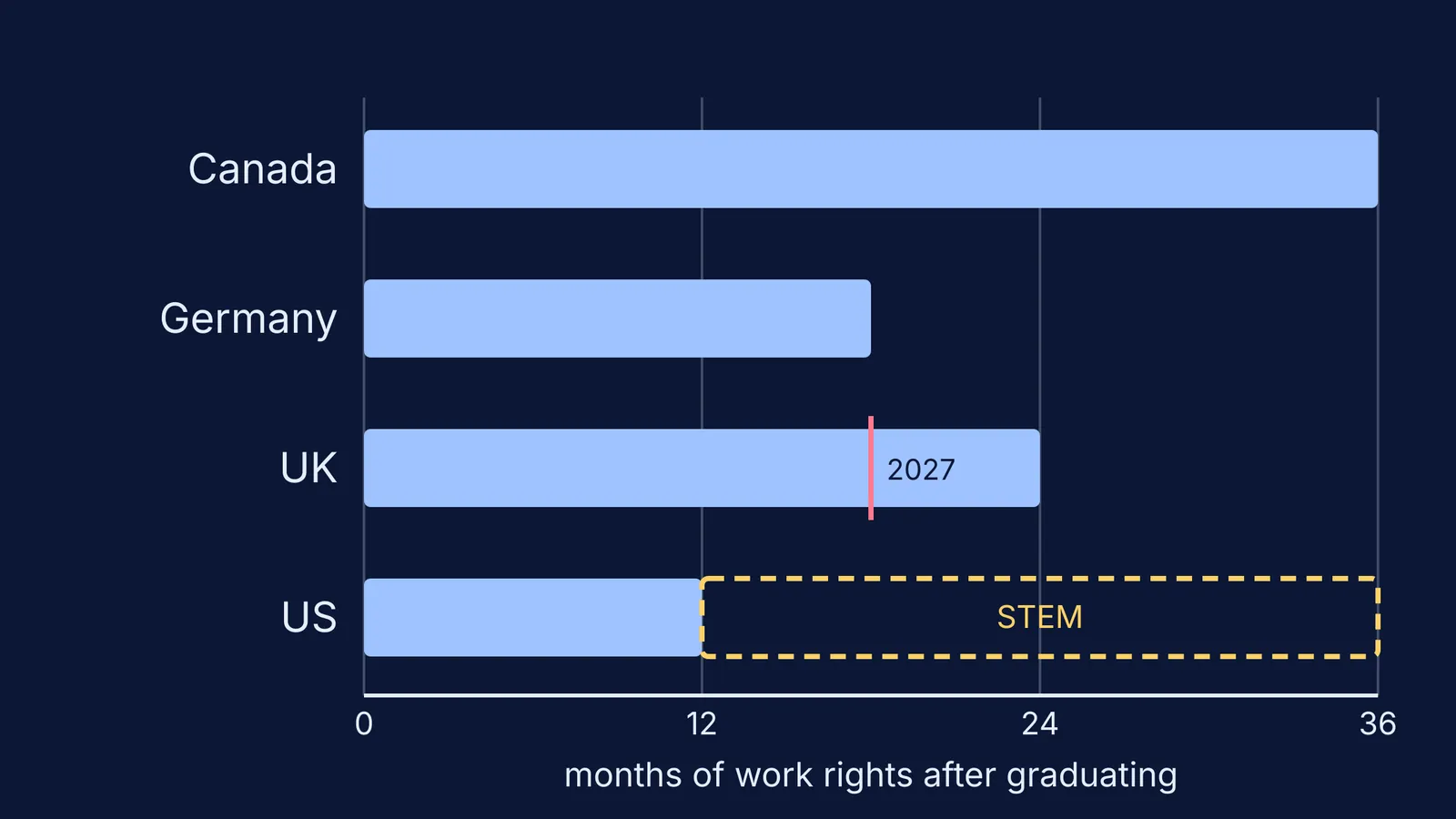
UK: the Graduate visa lasts 2 years if you apply on or before 31 December 2026, and 18 months if you apply on or after 1 January 2027, per GOV.UK. If you start a degree in 2027, plan around 18 months.
US: F-1 students can get up to 12 months of Optional Practical Training (OPT), plus a 24-month extension for eligible STEM degrees with an employer enrolled in E-Verify, per USCIS.
Canada: a programme of 2 years or more can lead to a post-graduation work permit valid for 3 years, per IRCC.
Germany: graduates can get a residence permit for up to 18 months to look for a job if they can support themselves, and may work during that time, per BAMF.
Australia: the Temporary Graduate visa requires you to be 35 or under when you apply, and how long you can stay depends on your qualification, per Study Australia.
Which language do you need, and when?
UK: degree-level study needs English equivalent to CEFR level B2, checked by an approved test or by the university itself, per GOV.UK.
Canada: language counts at the end too. Bachelor's graduates applying for the work permit need CLB 7 in English (or NCLC 7 in French) in all four skills, per IRCC.
Germany: DAAD India counts around 300 English-medium courses against around 2,000 in German, so learning German widens your choice.
How do you compare countries without ranking them?
Fill in four lines for each country on your list:
Years to degree, including any foundation year.
Minimum living money multiplied by those years.
Months you could work after graduating, on today's rules.
Which language test you need, and at which stage.
Then write down your one non-negotiable (a budget ceiling, a subject, or coming home straight after) and cross out any country that fails it. Don't rank the rest; write the trade-off in one sentence.
Worked example. A Class 11 student preparing for JEE wants engineering and some work experience abroad.
Germany: 3 to 4 years; a JEE Advanced rank allows direct applications to technology courses; living money is €992 x 12 = €11,904 a year; up to 18 months to find a job; most courses are in German.
England: 3 years; living money outside London is £1,171 x 9 = £10,539 for the 9 months the visa covers; an 18-month Graduate visa for applications from 2027.
Canada: CAD 23,448 a year in living money; a 3-year work permit after a programme of 2 years or more, with CLB 7.
Their sentence: Germany's state universities usually charge no tuition but most courses are in German; England is shortest; of these three, Canada has the longest work window but tests English again at the end.
If JEE Advanced is part of your route, close your Class 11 and 12 concept gaps first; the Fermi Concept Library has a lesson for every concept in physics, chemistry and mathematics.
Still deciding whether to go at all? Read studying abroad or in India after Class 12, or the step-by-step Germany route after Class 12.