On this page
If Germany is on your list, know this first: your Class 12 certificate is a starting point, not a ticket. Most Indian students need an extra year first, and from Winter Semester 2026/27 there is a minimum percentage too.
Can you study in Germany directly after Class 12?
For most Indian students, no. DAAD India, the German Academic Exchange Service's India office, says that after a Class 12 certificate "one cannot get a direct admission to a German university (the exception being a valid IIT-JEE Advanced result)" (DAAD India, bachelor studies). Everyone else needs a bridge year, in Germany or at home.
The rules tightened in 2026. APS India, the Academic Evaluation Centre at the German Embassy in New Delhi, announced on 23 February 2026 that from Winter Semester 2026/27 you need at least 70% of the maximum overall marks in Class 12, whatever your board (APS India news). Universities are applying it, for example the University of Halle, for both Studienkolleg and bachelor's applicants.
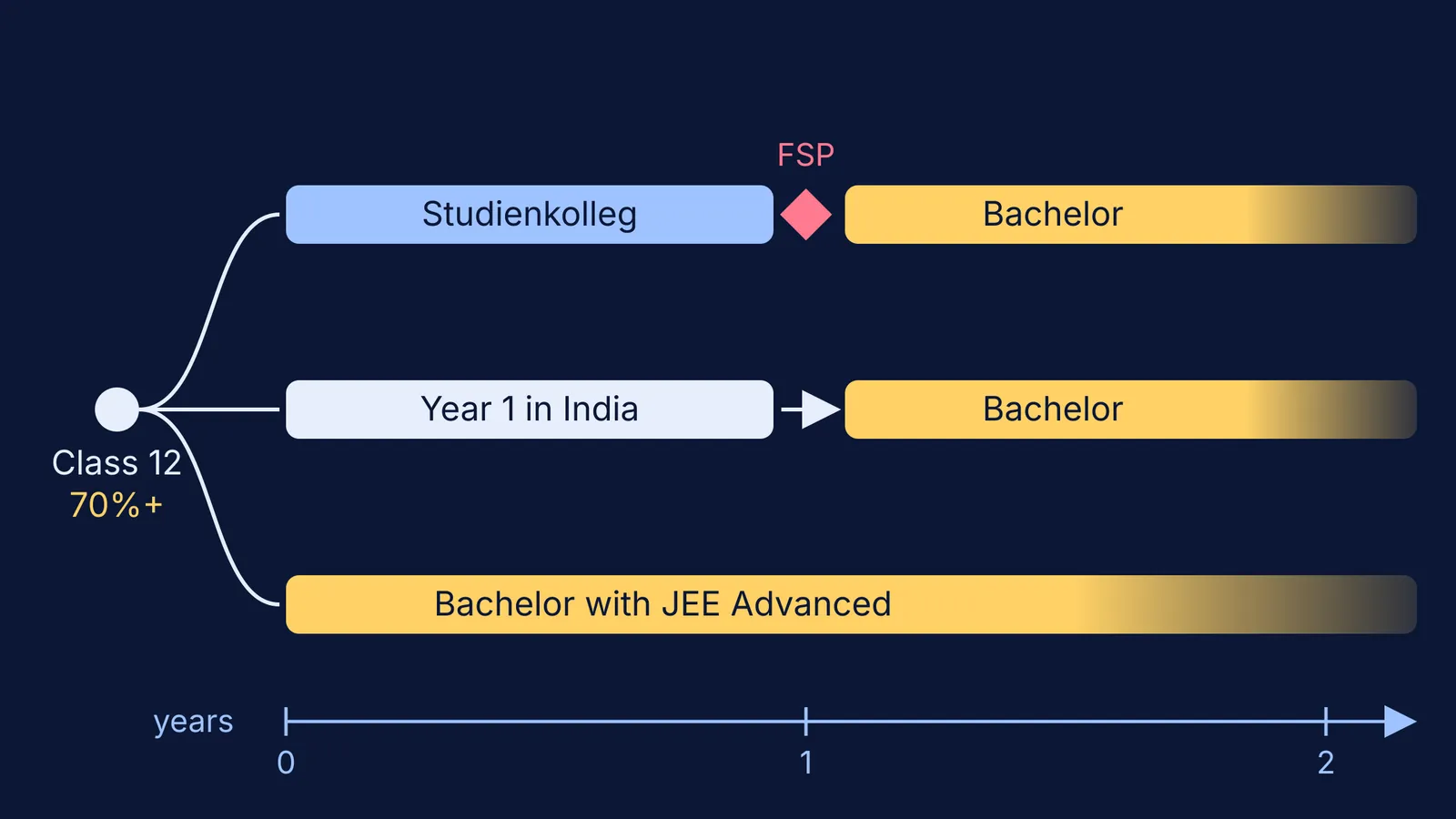
What are the three routes from India?
Between them, the APS India notice and DAAD India describe three ways in:
Studienkolleg (foundation year). Class 12 with at least 70% plus an APS certificate can qualify you for subject-restricted admission via a Studienkolleg.
One year of a bachelor's in India. Class 12 with at least 70%, an APS certificate and one successfully completed year of a regular bachelor's at a recognised institution can give direct admission to the same field and closely related subjects. APS India says this does not guarantee a place.
JEE Advanced. DAAD India says that with a JEE Advanced ranking you may apply directly to a German university for a subject-specific course. The 2026 notice does not mention JEE, so confirm with each university before you rely on it.
Weighing the JEE route? Check the JEE Advanced eligibility rules on attempts, age and Class 12. On the year-in-India route, that year must be passed in full, so read what changes in your first semester at college.
What is a Studienkolleg, and how do you get in?
A Studienkolleg is a two-semester preparatory course at Abitur level that ends in the Feststellungsprüfung (FSP), the assessment test you need for a German degree programme (TU Bergakademie Freiberg). Courses are split by field: the T-course for technical subjects, W for business, S for social sciences and G for humanities (KIT). That is what subject-restricted means: a T-course FSP leads to technical and engineering programmes, not business degrees, and each university decides which course you need.
Freiberg's T-course runs 32 teaching units a week in German, 8 of them maths, and applicants first sit an entrance test in German and maths (TU Bergakademie Freiberg). After the FSP you still apply separately for a bachelor's place, KIT notes.
How much German do you need?
For a Studienkolleg: Freiberg asks for a B1 certificate (TU Bergakademie Freiberg); KIT's T-course needs B1 at minimum with B2 recommended, and the Heidelberg Studienkolleg's G, S and W courses need B2 (KIT).
For the visa: without a preparatory language course, B2 in the language of instruction is the rule, shown by a government-approved certificate such as Goethe-Institut, DSD, IELTS or TOEFL, not a medium-of-instruction letter (APS India Class 12 leaflet).
For a German-taught bachelor's: Freiberg asks for DSH-2 or an equivalent such as TestDaF with level 4 in all four sections (TU Bergakademie Freiberg).
For habits that help, see studying science in a language you don't think in.
Which documents does APS India ask for?
Since 1 November 2022, Indian applicants for a preparatory course or bachelor's in Germany must show an APS certificate when applying for the visa (TU Bergakademie Freiberg). The APS checklist for Class 12 graduates asks for:
signed application form with passport photo, and fee receipt
Aadhaar (with linked mobile number) and passport
Class 10 and Class 12 marksheets and certificates
TestAS results, and proof of any pre-university entrance exam
language certificate and signed student authorisation letter
With JEE Main and Advanced passed, a separate APS checklist asks for proof of both with your admit card instead of TestAS. Warn your school that APS may email; replies must come from an official address, not Gmail.
When should you start planning?
First, do the sum. Say your certificate shows 412 out of 500: that is 82.4%, above the line. At 340 out of 500 you have 68%, and under the 2026 criteria neither APS route is open. Then plan:
Class 11: start German classes and aim for a B1 certificate by the end of Class 12.
Class 12, first term: choose your route and your field.
Class 12, second term: keep maths sharp for the entrance test. If a Class 11 topic still feels shaky, the Fermi Concept Library has a lesson for every concept in mathematics and physics, so you can fill one gap at a time.
After results: apply to APS with the checklist above, then to Studienkollegs or universities by their own deadlines.
Start with the APS eligibility quiz, then check the India rules on two universities' admissions pages.