

On this page
Many families face this question, and most only start on it once Class 12 has begun. By then, some of the most useful options may already be closed. This guide goes through the four questions that matter most and ends with a plan for each school year.
How many Indian students go abroad after school?
About 12.5 lakh Indian students were in higher education abroad in 2025, according to Ministry of External Affairs data reported by The PIE News. That was down from about 13.3 lakh in 2024, the first fall after three years of growth. Going abroad is common, but it is not the default, and it is worth weighing both options on their merits.
What will studying abroad really cost?
In the US, average published tuition and fees for 2025-26 were $45,000 a year at private nonprofit four-year colleges and $31,880 at public four-year colleges for out-of-state students, according to the College Board.
Worked example: at the private-college average, four years of tuition alone comes to 4 × $45,000 = $180,000. That is before housing, food, flights, insurance and visas. Convert it at today's exchange rate and compare it with what you can pay without taking on a loan you could not repay if plans change. Then ask each university what an international student actually pays after any aid, because that figure is the one to compare.
Also think about what happens after graduation. The UK Graduate visa lasts 2 years for applications made on or before 31 December 2026, and 18 months for applications made from 1 January 2027, according to GOV.UK. Rules like this change often, so check them again in the year your child applies. Our guide to planning a budget for applications abroad covers the smaller costs that add up before any offer arrives.
Do Indian entrance exams still matter if you go abroad?
For medicine, yes. Indian students who want an MBBS abroad must qualify NEET-UG to get the eligibility certificate for foreign medical study, and the Supreme Court upheld this rule on 4 February 2025, as LiveLaw reported. To practise in India later, the National Medical Commission's FAQ on its 2021 foreign graduate regulations says the course must:
last at least 54 months and be taught in English
include a 12-month internship at the same foreign institution
leave the graduate registered, or able to be licensed, to practise medicine in the country that awards the degree
Graduates must then pass the NMC's screening test or National Exit Test and complete a further 12-month supervised internship in India.
For engineering and science, foreign universities do not usually ask for an Indian entrance exam, though each sets its own requirements. Many families still keep JEE Main open as a backup. If you plan to do both, read how to apply abroad and in India in the same year before Class 12 starts.
When are the deadlines, and do they clash with Class 12?
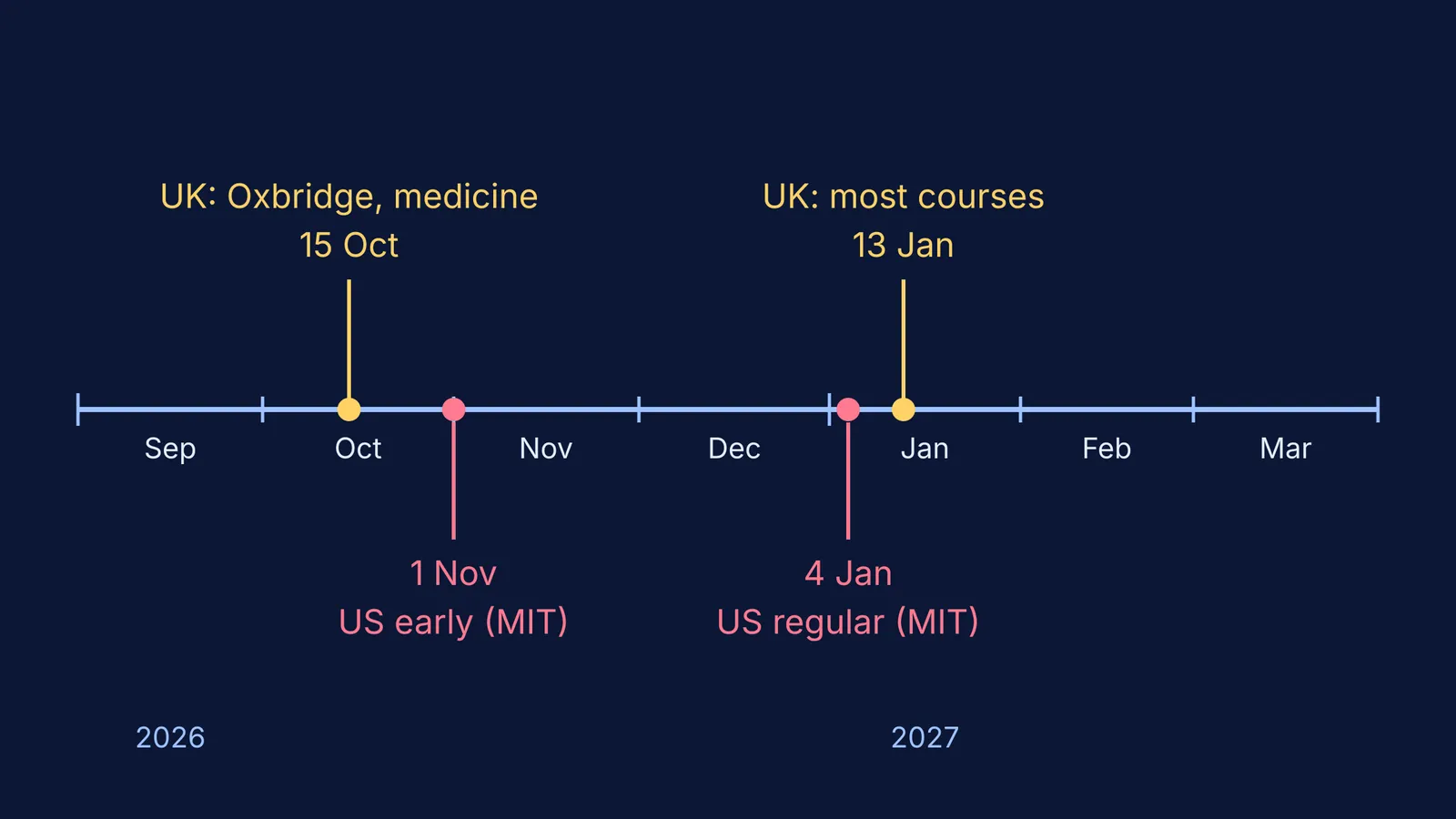
For 2027 entry, UCAS lists 15 October 2026 as the deadline for Oxford, Cambridge and most medicine courses, and 13 January 2027 for most other undergraduate courses. At MIT, early applications are due 1 November and regular ones on 4 January.
That means essays, references and test scores are due in the same months as pre-boards and entrance exam revision. Check the current schedules on CBSE's website and the official JEE Main site and put every date on one family calendar.
Is my child ready to live and study abroad at 17 or 18?
Marks are only part of readiness. Ask together, honestly:
Can they plan a week without reminders from home?
Can they cook a basic meal, manage money and see a doctor on their own?
Do they ask for help when a subject gets hard, or go quiet?
Do they want this course, or just the idea of going abroad?
If the gaps are academic, close them early. When old chapters keep tripping your child up, the Fermi Concept Library has a lesson for every concept in physics, chemistry, biology and mathematics, so they can go back to the exact idea they missed. If the decision starts to feel overwhelming, talk to the school counsellor, or call Tele MANAS on 14416.
When should the family start the conversation?
Class 9-10: talk about interests, not countries. Look at what different degrees are like, and roughly what you can afford. Our guide on when Indian students should take the SAT helps with timing if the US is a possibility.
Class 11: shortlist courses in both places, sit any required tests, and decide whether NEET or JEE stays in the plan.
Class 12: submit applications by the autumn and winter deadlines, keep up with boards, and compare offers on the full cost.
A simple way to start: "We're not deciding today. Let's each write down what we hope your college years give you, and then compare lists."


