

On this page
The SAT is no longer just for students flying to the United States for their undergraduate studies. With the shift to a shorter digital format and growing acceptance by domestic universities, taking the SAT has become a serious option for science, commerce and humanities students in India alike.
If you are wondering whether to add another entrance exam to your already packed school schedule, here is what the data says about the SAT in India, how its syllabus compares to local boards, and how you can plan your attempts without hurting your final board exams.
Should Indian students take the SAT?
Yes, primarily for two reasons: increased flexibility in university admissions and the more accessible digital format. According to the College Board's 2024 SAT Suite Annual Report, more than 1.97 million students globally took the SAT in the class of 2024. In India alone, 40,709 students took the test, a significant jump from previous years.
More than 45 Indian universities—including Ashoka, Krea, Flame, and BITS Pilani (for certain programmes)—now accept SAT scores for undergraduate admissions. This means a good SAT score gives you a strong backup plan for high-quality liberal arts and technical programmes in India, while keeping your international college options completely open. You can apply to multiple institutions across different countries using a single standardized test score.
How does the SAT fit with Indian board exams?
The transition to the digital SAT means the test is now delivered via an application called Bluebook and lasts just two hours and 14 minutes. It consists of two main sections: Reading and Writing, and Math.
For most Indian science-stream students, the Math section feels highly familiar. The syllabus covers algebra, geometry, trigonometry and basic data analysis, which aligns very closely with the NCERT curriculum taught up to Class 10. However, the SAT tests conceptual application rather than long-form calculation. Instead of memorising complex formulas, you need to understand the underlying logic behind them to solve problems quickly. Practising in the Fermi Problem Library helps here, as it offers worked problems with a step-by-step solver that explains the reasoning rather than printing an answer.
The Reading and Writing section is often the harder hurdle for Indian test-takers. Unlike CBSE or ISC English exams that test your familiarity with a set literature syllabus and your ability to write long essays, the SAT focuses entirely on evidence-based reading, determining author intent and applying grammar rules to short, unseen passages.
When should Indian students take the SAT?
The biggest mistake students make is leaving their SAT preparation until the middle of Class 12. That is when balancing Class 12 board exams with JEE preparation takes up all of their available time and energy.
Because the SAT is offered several times a year (typically in March, May, June, August, October, November, and December), you can plan your test attempts strategically to avoid any overlap with your school midterms or final exams.
The 12-month dual-track plan
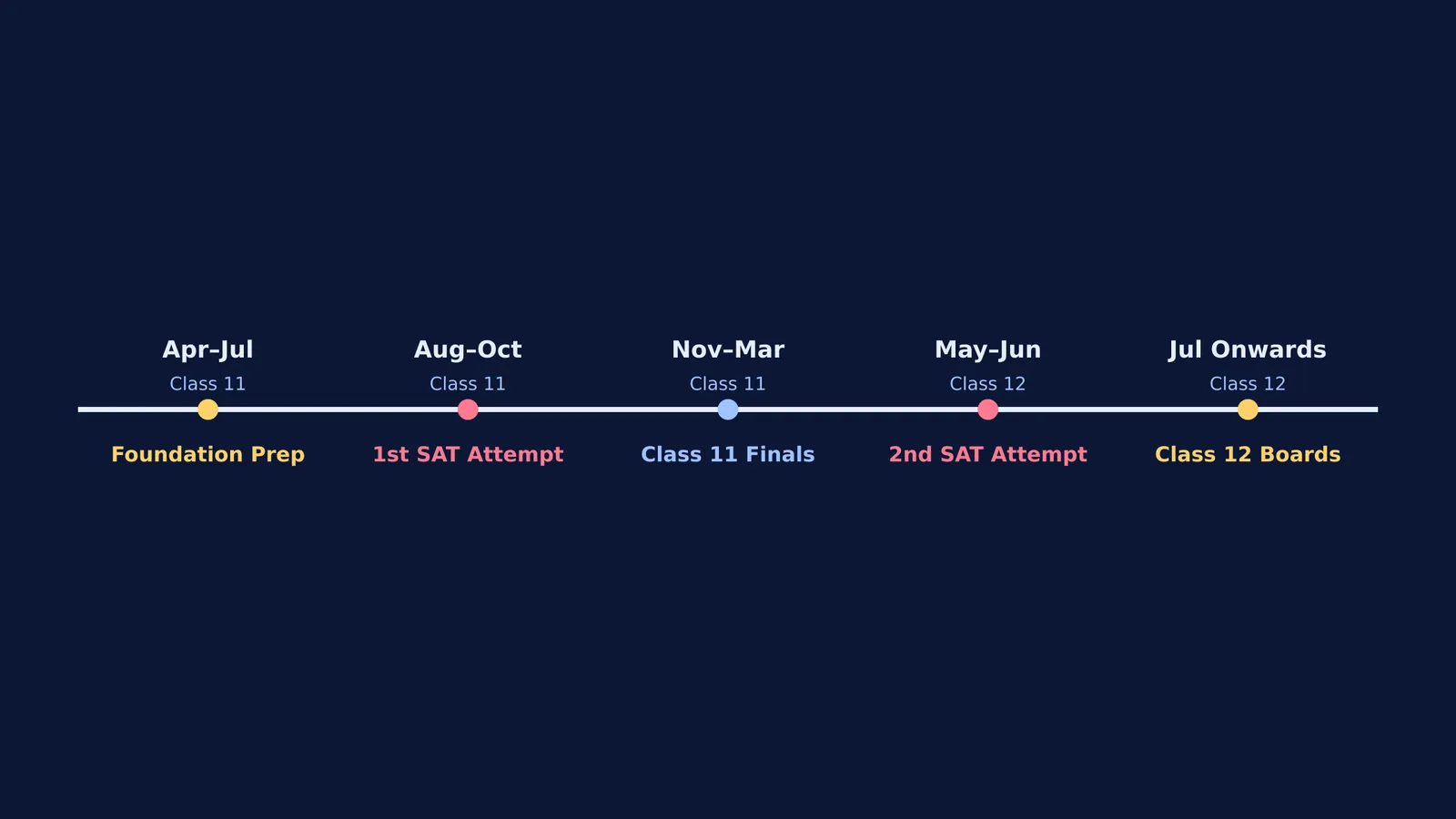
Here is a practical timeline that keeps the SAT out of the way of your board exams:
April to July of Class 11: Start building your foundation. Focus heavily on the Reading and Writing section, as the Math will overlap with your early Class 11 work. If you are unsure where you stand, Fermi's AI tutor can work out what you already know and build a plan for the session, so you sit down to a clear next step.
August or October of Class 11: Take your first SAT attempt. You have enough time to prepare, and the pressure of Class 11 final school exams has not yet started.
November to March of Class 11: Pause your SAT prep. Focus entirely on your Class 11 school finals to ensure your foundational concepts are strong.
May or June of Class 12: Take your second (and ideally final) SAT attempt during the summer holidays before Class 12 begins in earnest.
July onwards: Your SAT is done. You can now dedicate your full attention to your Class 12 boards, perhaps learning how to use NCERT Exemplar problems for boards and entrance exams to maximise your final score.
How much does it cost and are there scholarships?
The standard registration fee for the SAT is around $111 (approximately ₹9,200) for Indian students. However, the College Board India Scholars Program makes the exam highly accessible for low-income families. If your family income is under ₹8,00,000 per year, you can apply for a fee reduction voucher that cuts the registration cost by 90%.
Furthermore, students in Grade 12 who use this fee reduction and achieve a score of 1300 or higher become India Scholars. If their family income is below ₹4,00,000, they become eligible for full-tuition scholarships for their entire undergraduate degree at participating Indian universities.
By planning your attempts thoughtfully in Class 11 and early Class 12, you can secure a strong SAT score and open up multiple university pathways before the final year pressure truly begins.


