

On this page
Preparing for the Joint Entrance Examination (JEE) while simultaneously building a profile for universities in the United States or the United Kingdom is one of the toughest academic paths a high schooler can take. Yet, the appeal of a global education remains strong. A record 36,056 Indian undergraduates studied in the U.S. in the 2023–2024 academic year, a 13.0% increase from the previous year (Open Doors Data).
The challenge is structural: JEE Main vs JEE Advanced: how the two exams really differ reveals an exam system requiring immense technical depth and fast problem-solving. In contrast, holistic admissions abroad ask for introspection, compelling personal essays, and sustained extracurricular engagement. Attempting both at full intensity in Class 12 is a recipe for burnout. The solution is a staggered timeline.
How do I balance JEE prep with SAT and ACT?
The greatest advantage of this dual track is the "PCM overlap." The physics, chemistry, and mathematics foundation you build for the JEE is significantly more rigorous than what the SAT or ACT requires. If you are solving standard JEE mechanics or calculus problems, you already possess the quantitative skills for a perfect SAT Math score. You will only need to spend a few dedicated hours on statistics and data analysis topics specific to the SAT.
To manage your time, plan to take your first SAT or ACT between July and October of Class 11. Do not leave this requirement for December of Class 12, as it will inevitably clash with your final revision for JEE Main Session 1.
When you are switching gears between a nuanced reading comprehension passage and a tough rotational motion problem, getting stuck wastes precious time. Fermi's AI tutor can work out what you already know and build a plan for the session, so you sit down to a clear next step. Rather than passively reading answers, the tutor holds a line of reasoning with you, ensuring you master the concept quickly before moving back to your schoolwork.
When should I start writing my common app essays?
Your personal statement for the Common Application is unlike any essay you write in school. It requires reflection, drafting, and several rounds of edits. The Common App prompts usually release in August of your Class 12 year, which is exactly when your school will be conducting mid-terms and your coaching institute will be wrapping up the heaviest parts of the syllabus.
To avoid a crisis, adopt an 80/20 weekly split. During the week (Monday through Friday), give 80% of your study time to JEE preparation and your school curriculum. On the weekends, specifically Sunday mornings, dedicate three to four hours purely to your abroad applications. Use this time to brainstorm essay topics, draft your personal statement, or refine your activity list.
By keeping the two tracks conceptually separated by days of the week, you can maintain focus on both without letting one bleed into the other. This strategy is especially useful when balancing Class 12 board exams with JEE preparation in the final stretch.
Does JEE Physics overlap with AP courses?
Yes, there is substantial overlap. Advanced Placement (AP) exams in Physics C (Mechanics and Electricity & Magnetism) or Chemistry map closely to the core concepts tested in the JEE. Taking a few AP exams at the end of Class 11 can strongly signal your academic rigor to universities abroad, while acting as an excellent milestone for your JEE preparation.
However, the style of questioning differs. AP exams test clear conceptual application and calculus-based derivation, whereas the JEE often layers multiple concepts into a single high-pressure numerical problem. When practicing for these heavily layered problems, you can use the Fermi Problem Library. It offers worked problems with a step-by-step solver that explains the reasoning behind each jump in logic, ensuring you understand the underlying physics rather than just memorising a formula.
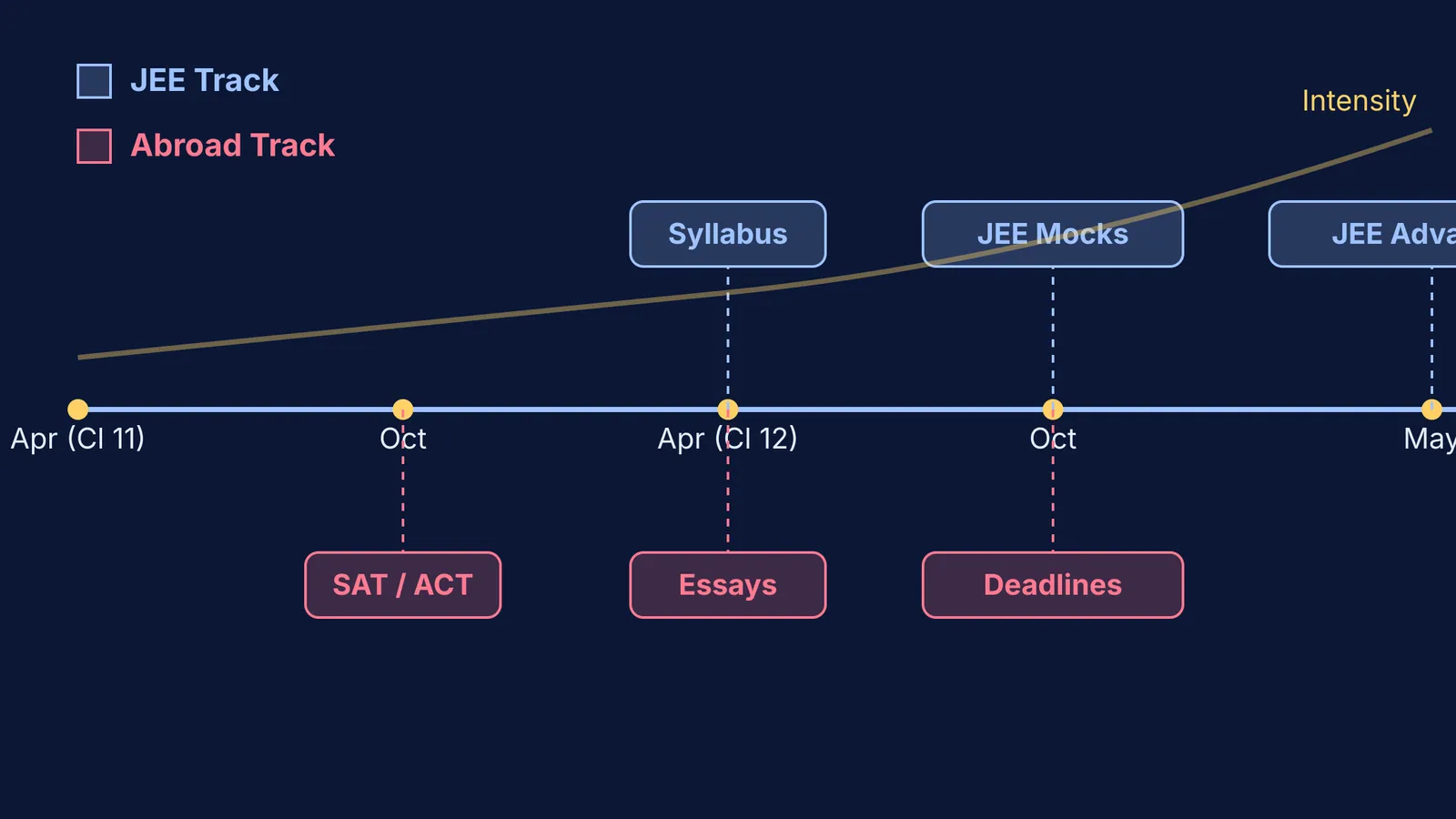
The 18-Month Dual-Track Checklist
To execute this parallel track, keep your milestones clearly separated:
Class 11 (April – October)
Focus on building strong PCM foundations for both school and JEE.
Research and shortlist 10–15 prospective universities.
Take a diagnostic test and attempt the SAT or ACT by October.
Class 11 (November – March)
Secure summer internships, research projects, or leadership roles for profile building.
Retake the SAT or ACT if necessary, and complete English proficiency tests (IELTS/TOEFL).
Clear any Class 11 JEE backlogs.
Class 12 (April – August)
Start drafting your main Common App Personal Statement.
Finalise your "Reach, Match, and Safety" university list.
Request your Letters of Recommendation (LORs) before teachers get busy.
Class 12 (September – January)
Submit Early Action or Early Decision applications by November 1.
Submit Regular Decision applications by January 1.
Transition into peak JEE Main intensity and take Session 1 in January.
By front-loading your standardised testing and profile building into Class 11, you leave the high-stress months of Class 12 free for what matters most: perfecting your essays and achieving your best possible score on the JEE.


