

On this page
During counselling rounds, thousands of applicants secure admission to a college they respect but remain stuck between two attractive departments. According to the Ministry of Education's All India Survey on Higher Education (AISHE) 2021-22, Engineering and Technology represents 11.8% of all undergraduate enrolments in India. When you are deciding between two branches on the same campus, examining first-year course titles is rarely informative. Most institutes run a shared curriculum across the first two semesters covering foundational calculus, physics, and introductory programming.
How do you compare two branch syllabi side by side?
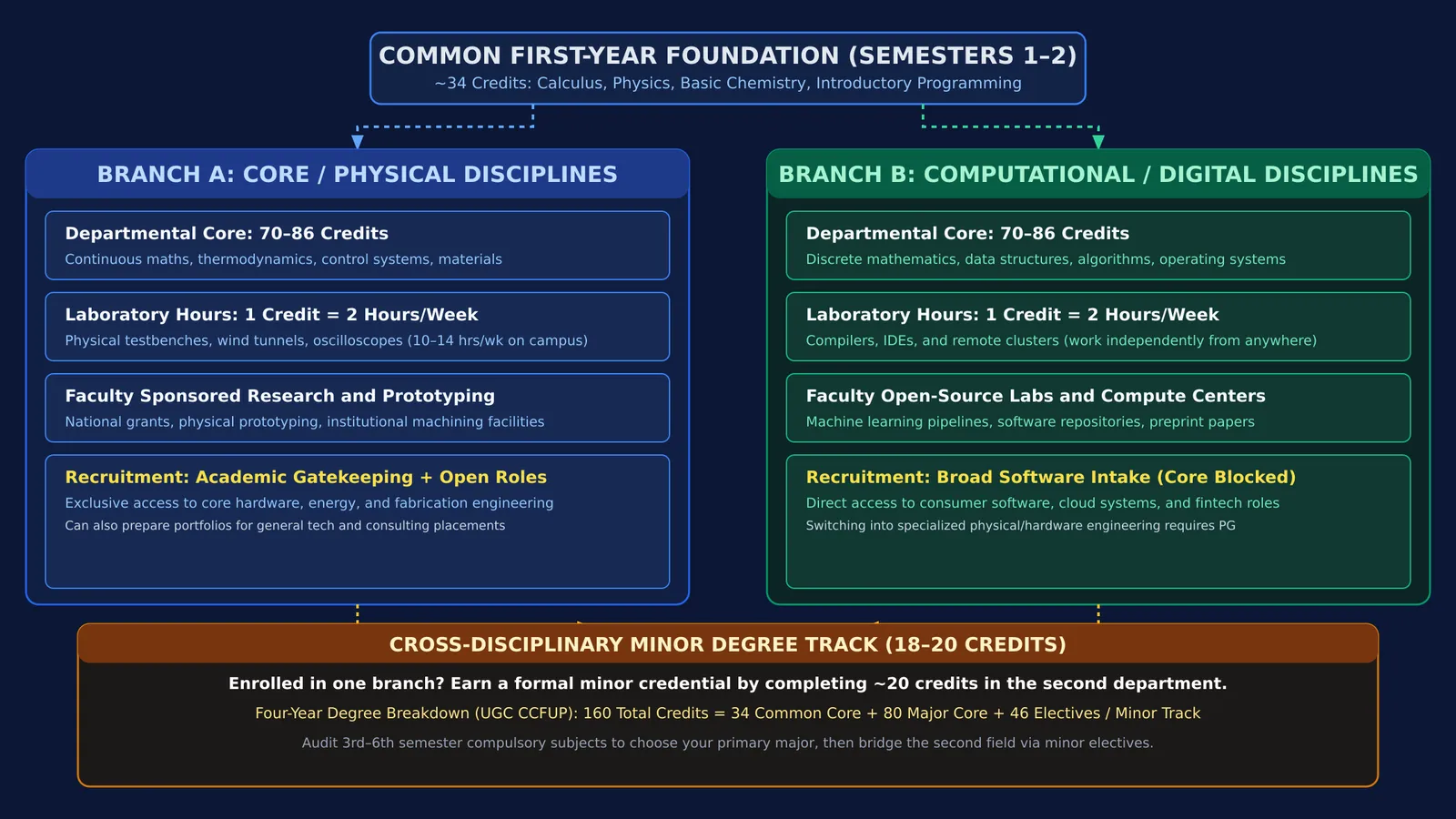
The real academic divergence begins in the third semester. Under the University Grants Commission (UGC) Curriculum and Credit Framework, a four-year undergraduate honours degree requires a minimum of 160 credits, with the major discipline accounting for at least 50% of the total credit volume. Similarly, the IIT Delhi Courses of Study curriculum mandates 70 to 86 departmental core credits out of 142 to 155 graded credits for graduation, while reserving approximately 34 credits for common first-year foundational coursework. To make an objective comparison, download the detailed curriculum handbook from your college website and evaluate the compulsory courses scheduled between semesters three and six.
To conduct an effective branch audit, follow this four-step checklist:
Count core theory credits: Note the exact volume of mandatory departmental courses versus open electives across semesters three to six.
Examine prerequisite maths: Check whether the syllabus relies on continuous mathematics like differential equations and vector calculus, or discrete mathematics like combinatorics and graph theory.
Identify lab formats: Determine whether weekly practicals require physical bench equipment or digital development suites.
Review elective depth: Count how many advanced departmental electives align with emerging sub-fields you want to explore.
Evaluating textbook lists shows whether a discipline matches how you enjoy studying. If one department focuses heavily on continuous signals, electromagnetism, and control systems while the other centres on data structures, algorithmic complexity, and operating systems, your day-to-day assignments will demand completely different cognitive skills. When exploring whether abstract models suit your learning style before finalizing an option, the Fermi Simulation Lab provides interactive simulations for the ideas that are easier to see than to read.
What do lab hours and faculty research tell you about a branch?
Curriculum handbooks do not merely prescribe lectures; they define your weekly physical presence on campus. Under national academic guidelines from the University Grants Commission (UGC) Curriculum and Credit Framework, 1 theory credit corresponds to 1 hour of classroom lecture per week, whereas 1 practical credit requires 2 hours of laboratory engagement per week over a 15-week semester. A department with 6 practical credits in a semester requires at least 12 hours inside physical laboratories each week.
The nature of those practical contact hours establishes your daily lifestyle. In hardware disciplines such as electrical, mechanical, or chemical engineering, practical coursework demands hands-on operation of oscilloscopes, wind tunnels, or analytical test benches that cannot be accessed outside dedicated building hours. In computational fields, practical assignments typically use compilers, simulation scripts, and remote repositories that you can run flexibly from a library or hostel desk. If you value tangible experimentation, hardware labs provide irreplaceable practical satisfaction; if you prefer rapid iteration, software environments offer greater autonomy.
Departmental faculty research provides another reliable measure of academic vitality. Review the faculty profile pages of both departments on the institute portal. Look at the volume of sponsored research laboratories, recent doctoral dissertations, and project grants awarded by national agencies. A department with active research centres frequently recruits second-year and third-year undergraduates for paid assistantships, hardware prototyping projects, and international conference papers.
How do career paths and recruitment rules differ?
Placement reports often confuse incoming undergraduates because headline compensation figures represent individual high achievers rather than cohort-wide averages. Rather than focusing solely on highest packages, examine the campus placement eligibility rules published by the college training and placement cell. Many consumer technology companies, financial technology firms, and business consulting groups allow students from every branch to sit for preliminary aptitude and coding rounds, provided they meet a threshold grade point average.
However, significant asymmetry exists for engineering roles with strict academic barriers. Core design firms in semiconductor fabrication, power systems, aerospace structures, and chemical processing rarely accept candidates outside their target departments. If you select a computing branch, switching later into specialized power electronics or thermal engineering becomes difficult without a formal postgraduate qualification. Non-computing students, on the other hand, can build programming portfolios, solve data structure problems, and compete for open software openings alongside their primary curriculum.
Consider career longevity alongside initial job offers. While software positions offer abundant starting roles, established core engineering disciplines offer sustained career stability as engineers develop deep technical authority over decades. When deciding whether college or branch matters more, choosing the discipline whose fundamental questions hold your lasting interest gives you the stamina to perform well across four demanding academic years.
Can you study both branches through a minor degree?
You do not always have to give up your second interest. Major Indian engineering institutions, aligned with the IIT Delhi Courses of Study curriculum, provide structured minor degree programmes requiring approximately 20 credits of coursework taken from another department across semesters three through eight. Under this framework, an undergraduate enrolled in mechanical engineering or chemical engineering can complete a formal minor credential in computer science, robotics, or data analytics.
Before counting on this route, verify your college's intake guidelines for pursuing a minor degree in another engineering branch. Minor tracks often have strict seat limits and allocate admissions based on first-year academic performance. Furthermore, avoid assuming you can easily change your primary major later. Depending on branch change rules after your first year is unreliable because numerous leading institutes have restricted or completely discontinued first-year branch changes to reduce student pressure.
To prepare for interdisciplinary courses across physical systems and computing, the Fermi Concept Library maps every concept in physics, chemistry, biology, mathematics and computing, each with its own lesson and its place in the map. Evaluating your choices through actual curriculum credits, laboratory commitments, and formal minor tracks turns an emotional dilemma into a structured, confident decision.


