On this page
Collegiate case study competitions challenge students to act as executive consultants for an organisation facing an urgent strategic dilemma. In *Business and Professional Communication Quarterly*, researchers Joelle Davis Carter, Monica Galloway Burke, and Aaron Hughey evaluated 18 undergraduate students participating in competitive cases (Carter et al., 2019). They found that navigating complex, ambiguous scenarios accelerated students' critical thinking, teamwork, and readiness for professional advisory careers.
What happens during a college case competition?
Competitions frequently feature intensive lock-in formats, such as a 24-hour sprint where teams analyze an extensive business brief under strict deadlines. Finalists deliver a 15-minute oral pitch followed by a 5-minute question-and-answer defense before a panel of industry judges (Carter et al., 2019).
As documented by Patricia Doyle Corner and colleagues in the *Journal of Management Education* (Corner et al., 2006), case competitions provide grounded learning: integrating theoretical frameworks with real operational data while shifting complete decision ownership to students.
How should you divide roles within your case team?
A standard team consists of 3 to 4 students, and attempting to solve every slide together leads to analysis paralysis. Research across 6 undergraduate business courses by Elisabeth J. Umble, Michael Umble, and Kendall Artz showed that deliberate project structure and complementary skills directly drive problem-solving success (Umble et al., 2008). If your group struggles with coordination, our guide on resolving group project imbalances offers scripts for setting early accountability.
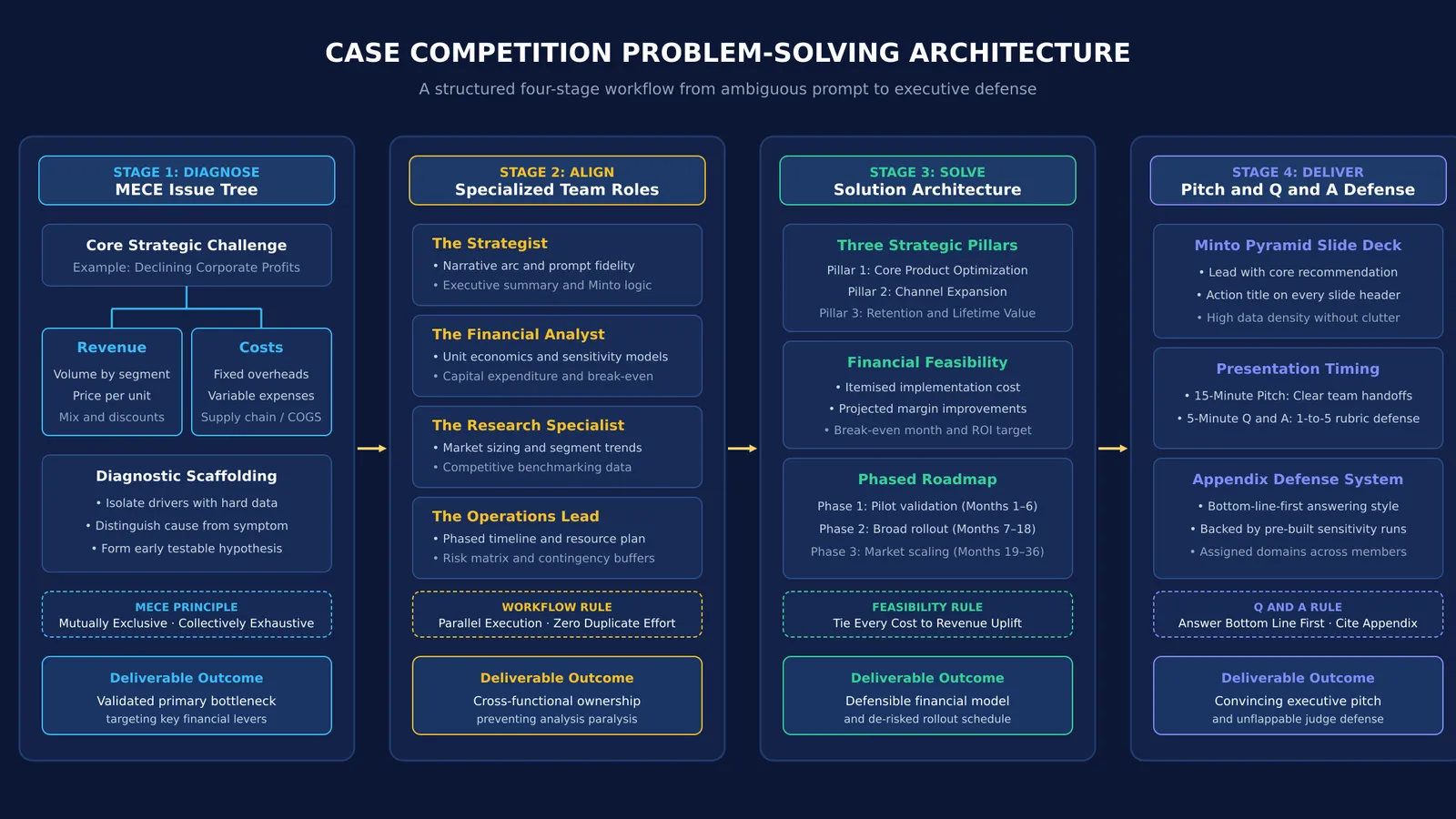
Successful teams divide responsibilities into four distinct functional roles:
The Strategist: Owns the overarching narrative and ensures every proposal directly answers the case prompt.
The Financial Analyst: Builds quantitative models, calculates unit economics, and tests sensitivity.
The Research Specialist: Investigates customer segments, benchmarks competitors, and verifies secondary data.
The Operations Lead: Maps out phased implementation roadmaps, resource allocations, and risk mitigations.
How do you structure the case analysis using MECE?
Beginners often jump straight to brainstorming without diagnosing why the organisation is struggling. Research in business education demonstrates that explicit project scaffolding and clear analytical guidelines help student teams move past superficial symptoms to core business drivers (Umble et al., 2008). Management consultants rely on the MECE framework (Mutually Exclusive, Collectively Exhaustive), originated by Barbara Minto at McKinsey & Company. An issue tree breaks a strategic challenge into sub-questions that do not overlap and leave no gaps.
If a company faces declining profits, a MECE tree splits the challenge into Revenue and Costs. Revenue divides into Volume and Price across target segments. Costs divide into Fixed Overheads and Variable Expenses. By isolating each branch, your team avoids arguing over vague impressions and pinpoints the exact operational lever to fix.
When formulating quantitative estimates and unit economics, the Fermi Problem Library provides worked problems with a step-by-step solver that explains the reasoning rather than printing an answer. To strengthen foundational data logic and calculations, the Fermi Concept Library covers every concept in mathematics and computing, each with its own lesson and its place in the map. For teams validating market surveys, our guide on applying basic statistical methods to student projects explains how to handle sample distributions reliably.
What makes a winning case competition slide deck?
Judges review dozens of decks under tight deadlines. Research highlights that structured, hypothesis-driven presentations improve audience comprehension over descriptive narratives (Corner et al., 2006). Using the Minto Pyramid Principle, state your recommendation first, follow it with two to three logical pillars, and anchor each pillar with verified data.
A competitive presentation deck typically follows this sequential structure:
Executive Summary: Core recommendation, targeted impact, and timeline.
Root Cause Analysis: Quantified findings from the case facts.
Strategic Pillars: Actionable solution initiatives.
Financial Feasibility: Itemised cost projections, revenue uplifts, and break-even targets.
Implementation Roadmap: Execution across phased pilot, rollout, and scaling stages.
Risk Matrix: Major operational threats paired with preventive buffers.
How should you handle the judge Q&A session?
Judges evaluate teams across research depth, analytical rigor, presentation delivery, and strategic practicality on a 1-to-5 rubric scale, using the 5-minute question-and-answer defense to test students' assumptions and composure under pressure (Carter et al., 2019). To maintain composure under scrutiny, review our practical tips on speaking with composure in oral examinations.
Assign question domains in advance: the strategist fields scope inquiries, the analyst addresses margin calculations, and the operations lead explains rollout friction. Deliver the bottom line first by stating your direct conclusion before detailing your supporting data or financial assumptions. Rather than debating hypothetical objections during the pitch, refer judges directly to pre-calculated scenarios in your appendix slides. Maintaining a structured appendix of supplementary models and sensitivity tests turns the defense into clear proof of your thorough preparation.