

On this page
If you are doing everyone's share of a school project, you are not imagining it, and you are not stuck. The fix is mostly structure: a written task split, deadlines that make each person's work visible, polite messages that get firmer, and a calm note to your teacher if nothing changes.
Why do some teammates stop doing their share?
Psychologists call it social loafing: the tendency to put in less effort when working in a group than when working alone. A meta-analysis of 78 studies by Steven Karau and Kipling Williams found the effect holds across many kinds of tasks and people (Journal of Personality and Social Psychology, 1993). Among the factors with the strongest influence were whether each person's work could be evaluated and how meaningful the task felt.
Classroom research points the same way. A study of university students' group projects found that loafing rose with the size of the group and the scope of the project, and fell when students did several peer evaluations during the project (Aggarwal and O'Brien, Journal of Marketing Education, 2008). The lesson is practical: make every person's part small, named and checked.
How do you split a group project so everyone has a job?
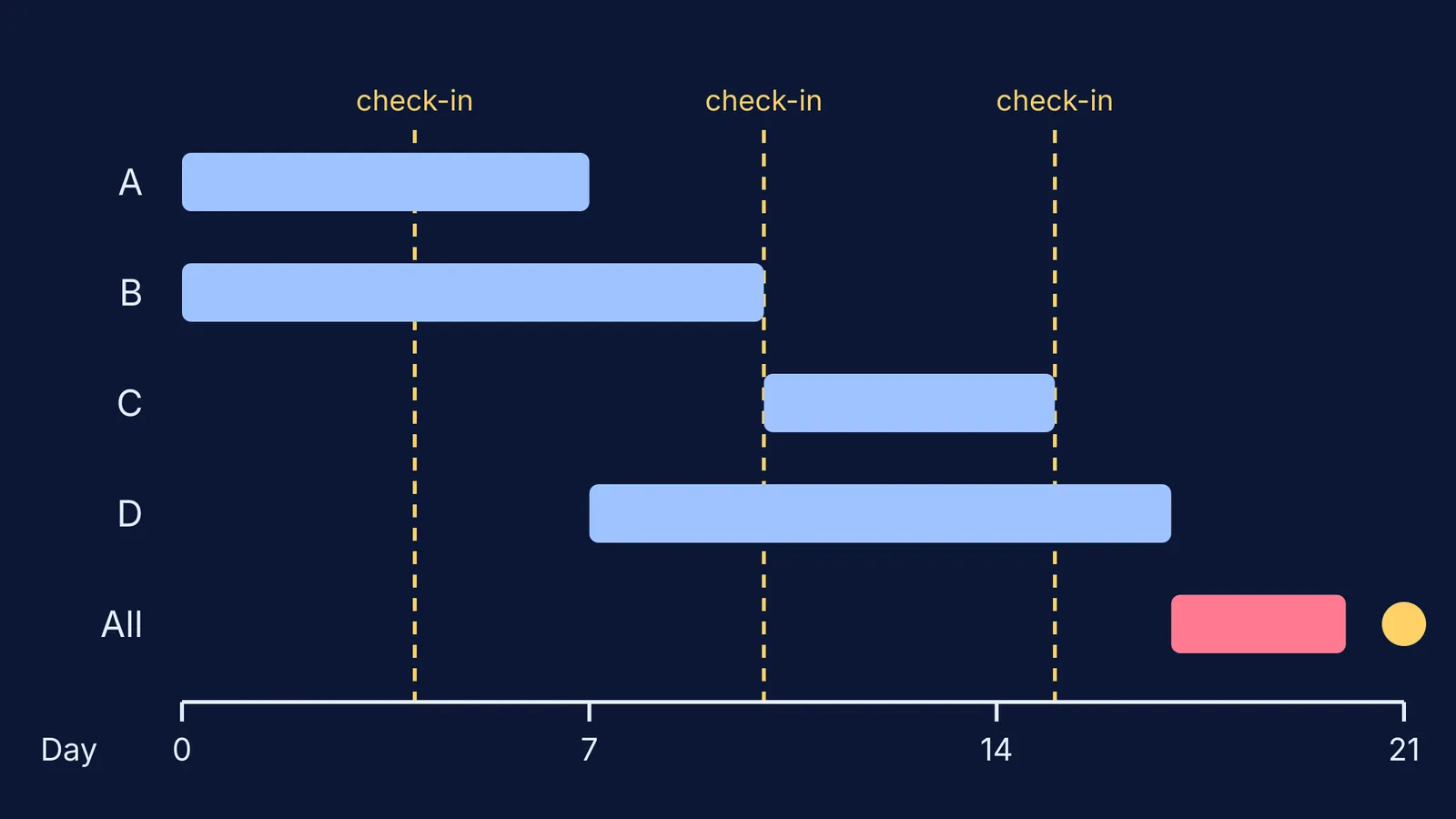
A worked example: four Class 11 students, A, B, C and D, have 21 days to submit a physics project on how a pendulum's length changes its period.
Day 1: meet for 20 minutes. Agree the parts and post them in the group chat with a name and a date beside each.
A: background research and sources, due day 7.
B: run the experiment and record readings, due day 10.
C: analysis and graphs from B's data, due day 15.
D: report and slides, due day 17.
Everyone: review and rehearse on days 18 to 20, then submit on day 21.
Check-ins on days 4, 10 and 15: each person posts two lines on what they have done, with a photo or file.
Hand-offs matter: C can't start the graphs until B shares the data, so B's deadline protects everyone. Barbara Oakley and colleagues, writing for college teachers, suggest teams of three or four and roles such as coordinator, recorder and checker that rotate between members (Journal of Student Centered Learning, 2004).
What do you say to a teammate who isn't doing their work?
Start friendly and assume there may be a reason, such as illness or not understanding the topic. Message privately first, and get firmer only if nothing changes.
First missed check-in: "Hey, how's the research part going? Anything stuck? I can send you the two links I found if that helps."
Second miss, two or three days later: "We need your section by Thursday so C can start the graphs. Can you send what you have, even if it's rough?"
Third miss: "I don't want to go to Ma'am about this, but the deadline is close. If your part isn't in by Saturday, we'll have to tell her who did which section."
Keep it about the work, not the person. If they say they are stuck on the topic itself, help them find a starting point: a short lesson in the Fermi Concept Library can be easier to start with than a whole textbook chapter.
When should you tell the teacher, and how?
Tell the teacher if a polite but firm warning has had about a week to work and hasn't. Oakley's team describe a similar step for college teams thinking of removing a member: after meeting the instructor, they send a written warning copied to the instructor and act only if a week passes with no improvement. In their experience, roughly one group in ten had problems serious enough for members to raise with the instructor, and most of those were resolved through active listening (Oakley et al., 2004).
Go before the deadline, not after the marks. A script:
"Ma'am, our group made a plan on day 1, and here it is with the dates. Three of us have finished our parts. We messaged D on these dates and haven't received the report section. We don't want to get anyone in trouble. Could you advise us on what to do so the project is submitted on time and marked fairly?"
Bring the task list and check-in messages, and ask for advice rather than punishment.
How can parents help without taking over?
Listen first, then help your child draft the message, rather than writing to other parents or the teacher yourself. If worry about school is affecting sleep, appetite or mood for weeks, talk to the school counsellor or a doctor; India's free Tele MANAS helpline is 14416 (IIT Kanpur counselling page).
Read next: our guides on running a study group that actually helps you learn, why procrastination is about feelings, not laziness and time blocking for students juggling school and coaching.


