On this page
Public sector banks need engineers for their software, networks and buildings. The main door is the Specialist Officer (SO) exam that the Institute of Banking Personnel Selection (IBPS) conducts for 11 participating public sector banks, set out in the CRP SPL-XVI notification for vacancies of 2027-28.
Which bank jobs can engineering graduates apply for?
The IBPS notification lists six Scale I posts. Three are open to engineers:
IT Officer: a 4-year engineering or technology degree in computer science, computer applications, information technology or one of the listed electronics branches (including telecommunications, communication and instrumentation), or a postgraduate degree in these fields.
Agricultural Field Officer: the accepted 4-year degrees include Agricultural Engineering, Food Technology, Dairy Technology, B.Tech Biotechnology and Fisheries Engineering.
Marketing Officer: open to any graduate who also holds a two-year full-time MBA, MMS, PGDM or similar qualification in marketing, so an engineer with one is eligible.
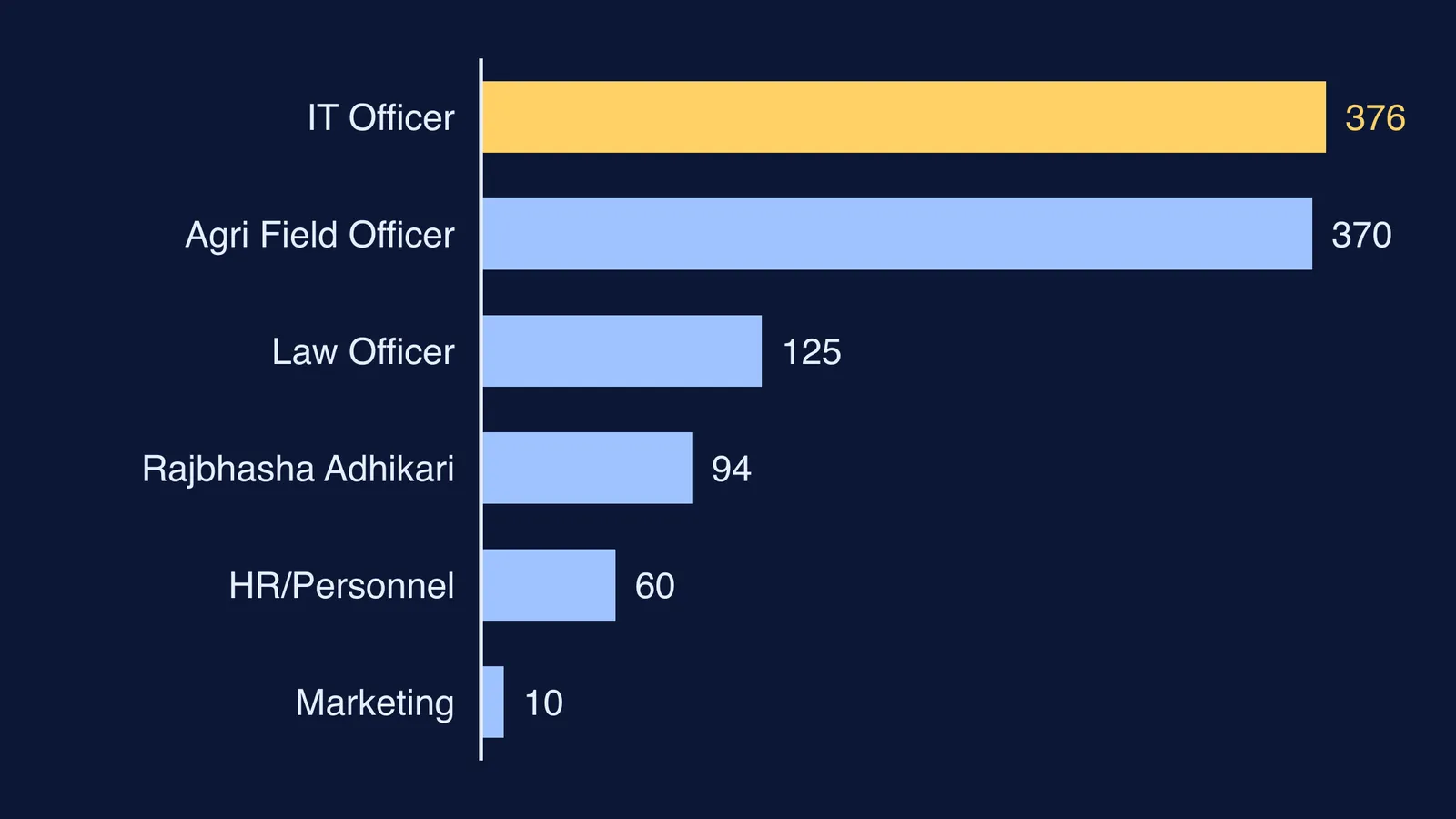
In the updated vacancy list (as on 20 July 2026), IT Officer had 376 indicative posts and Agricultural Field Officer had 370, out of 1,035 across all six posts.
Civil, electrical and fire engineers have a separate door. The State Bank of India is not on the IBPS list of participating banks; it runs its own specialist cadre recruitment, and its careers page shows past advertisements for Assistant Manager (Engineer – Civil, Electrical and Fire).
Why do some engineers move to banking?
No official survey tracks this, so treat these as questions to ask yourself:
Do you want a technology job inside a large public sector employer?
Is your branch one where core public sector jobs through GATE are scarce? Compare this route with PSU jobs through GATE before you decide.
Are you comfortable being posted wherever the bank needs you?
The notification gives the Specialist Officer Scale I basic pay as ₹48,480 rising in stages to ₹85,920, plus each bank's allowances (IBPS notification). The trade-off is choice: selected candidates are provisionally allotted to one participating bank on a merit-cum-preference basis, keeping in view vacancies, reservation rules and administrative needs. If you are weighing several government routes, read our guide to civil services for engineers too.
How does the IBPS SO exam work?
These rules for IT, Agricultural Field and Marketing Officers come from the CRP SPL-XVI notification and can change each cycle.
Eligibility: age 20 to 30 as on 1 July 2026, with relaxations for reserved categories, and your degree result declared by 21 July 2026. You may apply for only one post.
Preliminary exam (80 minutes): English, Reasoning and Quantitative Aptitude with 25 questions each, plus Professional Knowledge with 25 questions worth 50 marks. You must clear the cut-off in every test.
Main exam (155 minutes): Professional Knowledge has 50 questions worth 100 marks in 40 minutes, alongside English, Reasoning, Quantitative Aptitude and a descriptive English paper.
Interview: 100 marks, with a minimum of 40% (35% for SC/ST/OBC/PwBD candidates).
Final score: main exam and interview are weighted 80:20.
Each wrong answer in the objective tests costs a quarter of that question's marks; a blank costs nothing.
Worked example: does guessing help on Professional Knowledge?
Under the IBPS marking rules, each main-exam Professional Knowledge question is worth 2 marks, so a wrong answer costs 0.5.
Riya attempts all 50: 36 right, 14 wrong. Score = 72 − 7 = 65.
Arjun attempts 42: 35 right, 7 wrong. Score = 70 − 3.5 = 66.5.
Fewer answers, higher score. If a question has five options, a blind guess is worth 0.2 × 2 − 0.8 × 0.5 = 0 marks on average. Rule out one option and it becomes 0.25 × 2 − 0.75 × 0.5 = +0.125. So guess only after you have eliminated something.
For the final score, IBPS does not publish the exact formula and normalises scores across sessions, so this is only a rough illustration: if both were out of 100, Arjun's 66.5 and an interview score of 70 would give 0.8 × 66.5 + 0.2 × 70 = 67.2.
How should you prepare in your final year?
A 12-week plan that fits around college:
Weeks 1 to 4: revise the core subjects from your degree that a bank uses; for IT Officer, think databases, networking, operating systems and information security.
Weeks 5 to 8: add 30 minutes of quantitative aptitude and reasoning a day. It overlaps with placement aptitude test preparation, so one routine covers both.
Weeks 9 to 12: one timed 80-minute mock a week, the length of the IBPS preliminary exam, then mark every wrong answer by cause: concept gap, slow method, or careless guess.
For concept gaps in computing or maths, the Fermi Concept Library has a lesson for each concept. If a percentage or ratio question keeps going wrong at the same step, the Fermi Problem Library has worked problems with a step-by-step solver that explains the reasoning, so you can see where your method slipped.
Start by opening the latest notification on ibps.in and checking your branch against the qualification list.