On this page
Why does coding feel different from school maths?
Many students worry that struggling with Class 11 or 12 calculus means they cannot succeed in computer science. School curricula and entrance exams often treat mathematics and programming as inseparable twins, yet writing code day to day relies on a very different cognitive toolkit.
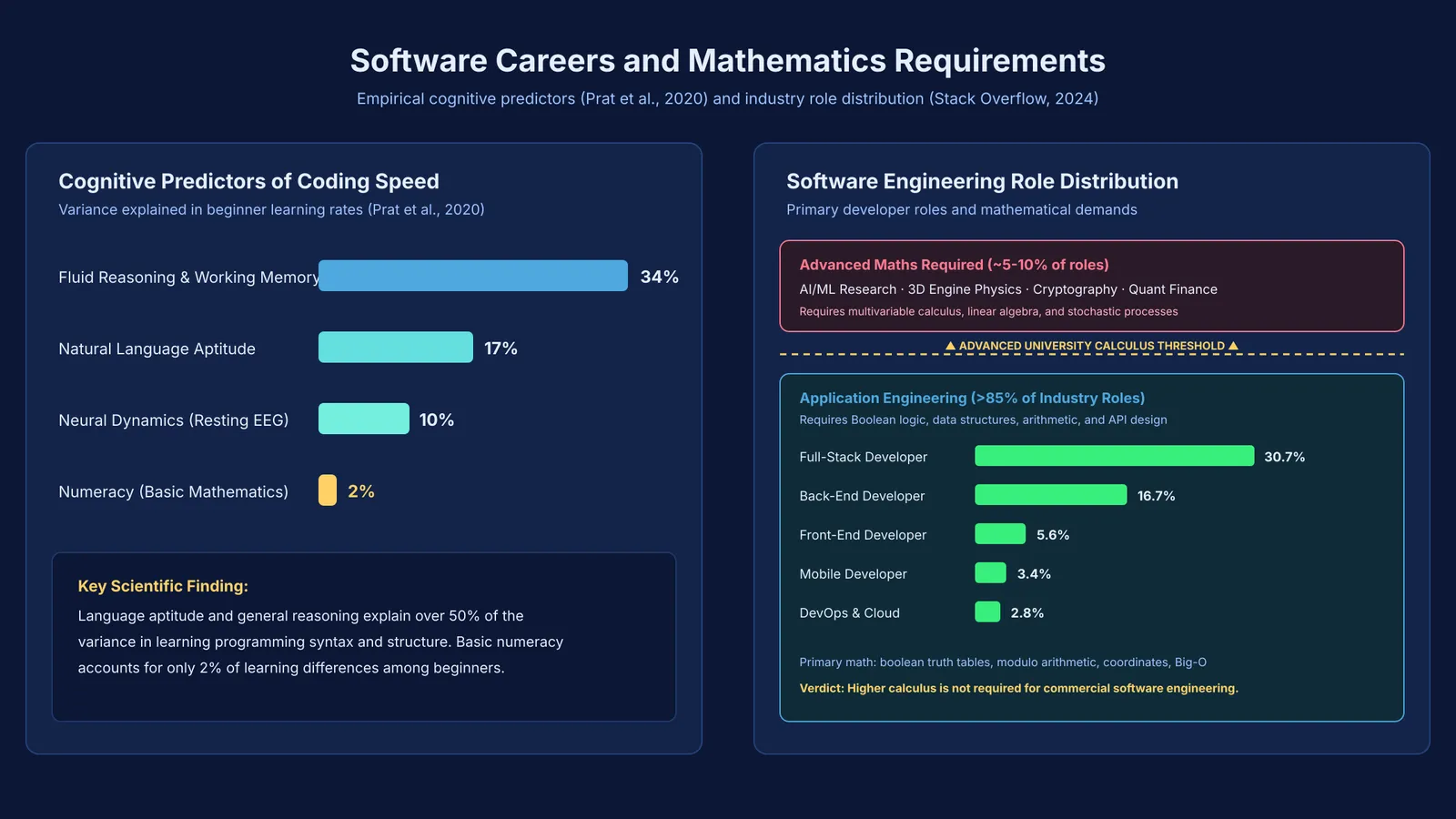
Cognitive neuroscientists have confirmed this distinction experimentally. In a landmark 2020 study published in *Scientific Reports*, lead author Chantel Prat and colleagues tracked how quickly beginners learned to program in Python (Prat et al., 2020). The researchers tested participants on language aptitude, fluid reasoning, working memory, and numeracy. Their statistical models revealed that fluid reasoning and working memory accounted for 34% of the variance in learning rates, and natural language aptitude explained 17%. Basic mathematical ability, by contrast, accounted for only 2% of the variance.
As educational researchers Valerie Shute and colleagues highlighted in *Educational Research Review*, programming primarily exercises computational thinking—the ability to decompose problems, recognise repetitive patterns, and construct unambiguous sequences of instructions (Shute et al., 2017). When you write software, you are translating human intentions into precise syntax and managing information flow. You do not need to integrate functions or calculate tangents to build a robust application.
Which software engineering roles require minimal maths?
The vast majority of professional software engineering positions focus on building products, managing databases, and keeping services online. These roles require deep architectural understanding and clean design patterns, but very little pencil-and-paper mathematics.
According to the 2024 Stack Overflow Developer Survey, which surveyed over 64,000 developers worldwide, application engineering dominates the industry:
Full-stack developers make up 30.7% of all respondents.
Back-end developers account for 16.7%.
Front-end developers represent 5.6%.
Mobile developers account for 3.4%.
DevOps specialists and cloud infrastructure engineers comprise 2.8% combined.
In these day-to-day specialisations, engineers write business rules, build secure user authentication flows, fetch data from REST APIs, and optimize page rendering speeds. A front-end engineer spends their day organizing components, handling user clicks, and managing state across screens. A back-end engineer designs database schemas, manages user permissions, and ensures that payment webhooks process reliably.
If you worry that school entrance cutoffs will block you because of your math marks, remember that there are multiple educational routes into software. In our detailed comparison of BCA vs BTech for software careers, we examine how applications-focused degrees allow students to bypass intensive engineering calculus while building commercial development skills.
What maths does every software developer actually use?
Saying that programming does not require advanced calculus does not mean it uses zero mathematics. Instead, software engineers use practical discrete maths and arithmetic. These concepts are intuitive and can be learned directly through code:
Boolean logic: Every conditional statement relies on AND, OR, and NOT. For example, granting access checks whether a user is logged in and holds the required role. Mastering these evaluation rules prevents logical bugs.
Modular arithmetic: The modulo operator (%) returns division remainders. Programmers use it daily for pagination, alternating table row styles, and cycling round-robin tasks.
Cartesian coordinates: User interfaces position elements on horizontal (x) and vertical (y) pixel grids. Basic addition and subtraction are enough to calculate margins, responsive layouts, or scroll offsets.
Counting operations: Developers use Big-O notation to estimate efficiency. Big-O counts how operations scale as data grows, requiring no calculus.
Which tech specialisations require advanced mathematics?
While standard software engineering is math-light, certain specialised domains do require rigorous university-level mathematics. If you dislike advanced maths, knowing which fields to avoid helps you target the right career tracks:
Machine learning research: Training deep models from scratch requires multivariable calculus for gradient descent, linear algebra for matrix operations, and probability distributions.
3D graphics and game engines: Rendering three-dimensional worlds requires vector algebra, matrix transforms, quaternions for rotation, and trigonometry for lighting shaders.
Cryptography and security protocols: Designing encryption algorithms relies on modular arithmetic, prime numbers, and elliptic curves.
Quantitative trading and finance: Automated trading desks require stochastic calculus, differential equations, and continuous time-series statistics.
The key distinction is between researching foundational algorithms and applying existing tools. Even in artificial intelligence, software engineers who integrate AI features into apps use pre-trained models and cloud APIs without needing to derive backpropagation equations by hand.
How can you build a coding career starting today?
If you enjoy coding, your focus should be on building projects and developing logical problem-solving habits rather than dreading maths exams:
Build standalone applications: Start small with utility scripts or web tools. Explore our guide on first Python projects for students for practical starter ideas.
Publish your code publicly: Tech hiring managers value tangible code far more than board exam scores in trigonometry. Follow our roadmap for building a student GitHub profile to showcase your projects.
Master computing concepts visually: When you encounter algorithms, explore their structure intuitively. The Fermi Concept Library maps every foundational topic in computing and mathematics so you can see where each concept fits into the broader picture.
Practice step-by-step reasoning: When a logic challenge feels overwhelming, break it into checkpoints. The Fermi Problem Library provides worked problems with a step-by-step solver that explains the reasoning rather than printing an answer, strengthening your algorithmic intuition.