On this page
In India, the choice between a Bachelor of Computer Applications (BCA) and a Bachelor of Technology (BTech) in Computer Science is a trade-off between speed, cost and the depth of mathematics. Both degrees lead to careers in software, but they prepare you for different roles in the industry.
How long does it take, and what does it cost?
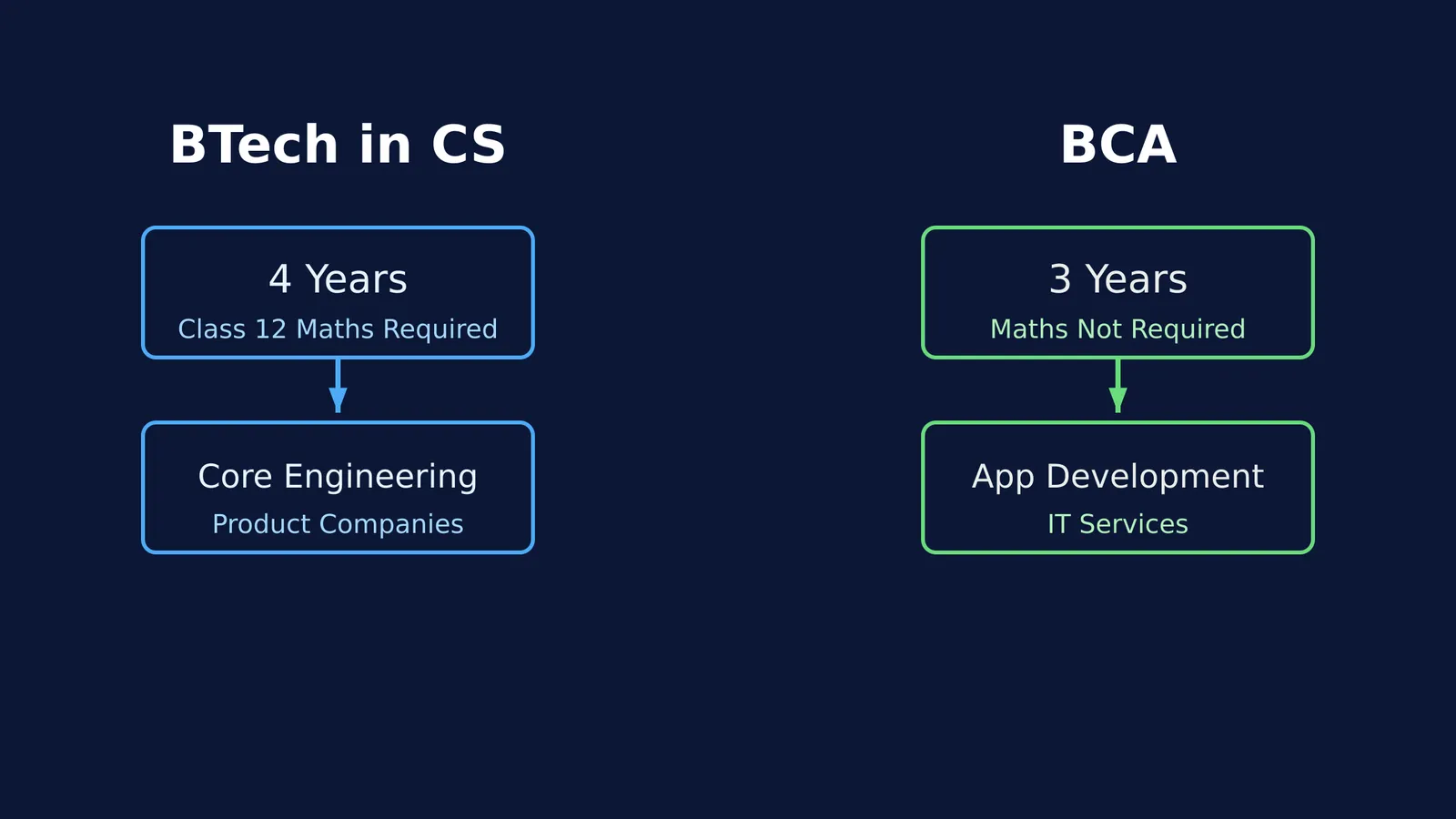
The most immediate difference is the time and money required to graduate. A BTech is a four-year professional engineering degree. Because it requires extensive laboratory work and infrastructure, the fees are higher. A BTech typically costs more. For example, total tuition fees at private institutions like Arya College start around ₹4.8 lakh and can run much higher.
A BCA is traditionally a three-year undergraduate degree, meaning you can enter the workforce and start earning a year earlier. It is also significantly more budget-friendly, with total fees generally ranging from ₹1.5 lakh to ₹6 lakh, according to Careers360 data. This makes a BCA a practical choice if you want to start writing code without the higher financial commitment of an engineering programme.
How much maths is in a software degree?
Computer science relies on mathematics, but the two degrees teach it at different levels. A BTech is highly theoretical and rigorous. You must have studied Physics, Chemistry and Mathematics (PCM) in Class 12 to be eligible. The syllabus includes advanced calculus, differential equations and linear algebra. If you find these topics difficult to track, the Fermi Concept Library covers every concept in mathematics, each with its own lesson and its place in the map. For tricky calculations, the Fermi Problem Library has worked problems with a step-by-step solver that explains the reasoning rather than printing an answer.
A BCA is more application-focused. The mathematics is generally easier and centres on the subjects you actually need for coding and databases, such as discrete mathematics and statistics. Because the maths requirement is lighter, a BCA is often open to students from commerce or arts backgrounds.
What do employers look for: BTech vs BCA?
Your degree influences the kind of company that hires you for your first job. BTech graduates are typically preferred for core engineering, research and development, and deep-tech roles at product-based companies, and therefore often start on higher salaries.
BCA graduates are often hired as web developers, application testers and system administrators. They are primarily recruited by large service-based IT companies through specific hiring tracks. However, as the IT industry shifts to skill-based hiring, training platforms like Skillyards note that companies increasingly prioritise a strong portfolio over the name on the degree.
Decision framework: BCA or BTech?
Ask yourself these three questions to choose your path:
What is your budget and timeline? If you need to start earning quickly and keep fees lower, a BCA is the faster route.
Did you study PCM in Class 12? A BTech requires Physics, Chemistry and Mathematics. If you are from a commerce or arts background, a BCA is your primary entry into software.
What is your target job? If you want to build web applications and work in IT services, a BCA is sufficient. If you aim for core engineering at a product company, choose a BTech.
Whichever degree you choose, your first job is only the start. If you choose a BCA, focus on building practical applications and consider earning certifications in cloud computing or cybersecurity to close the early salary gap. If you choose a BTech, focus on the theoretical foundations of system architecture.
For a broader view on educational choices, read our guide on Choosing a stream after Class 10: a guide for families or explore Computer Science or Informatics Practices in Class 11: how to choose to help set up your foundation. If you and your parents have different views on these options, When your child's career choice differs from yours offers a way to talk it through.