On this page
It starts small: Rs 200 for a late-night order, Rs 1,500 because someone's home transfer is late. By month-end you are short on your own mess bill, and asking feels harder than losing the money. Here is a limit, a record and the words to use.
Why do friends in hostel borrow money and not return it?
Usually not because they are bad people. Lenders and borrowers often think about the same loan differently.
In six experiments on small loans between friends, Coby Morvinski and Yaniv Shani found that lenders, in a "communal" mindset, often do not expect small amounts back, while borrowers, in an "exchange" mindset, intend to repay (Organizational Behavior and Human Decision Processes, 2022). The authors suggest this expectation gap may explain why many small debts between friends stay unpaid: nobody says anything, so the loan quietly fades.
A second set of six studies found that lenders get angrier when borrowed money is spent on treats rather than needs, and that the anger can stay even after full repayment (Angulo, Goldstein and Norton, Journal of Consumer Psychology). Lenders, it seems, still feel the money is partly theirs. If you see new earphones after lending for "a book", that sting is common; talk about it rather than storing it up.
How much should you lend a hostel friend?
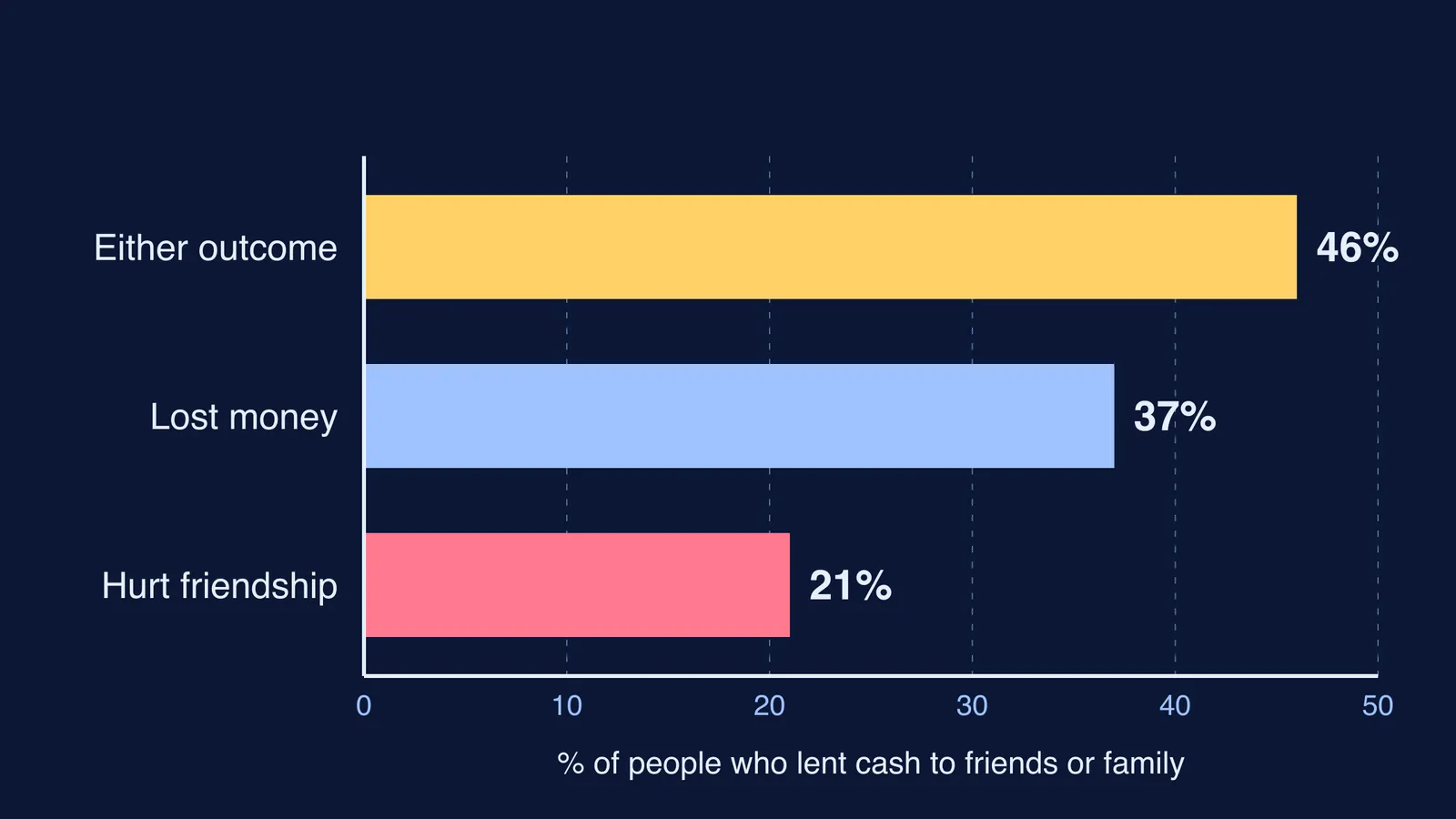
Start with how often lending goes wrong. In Bankrate's 2019 poll, run by YouGov with 2,490 US adults, 37% of people who had lent cash to friends or family lost money and 21% said the relationship was damaged (Bankrate press release, September 2019). The data is American, but the lesson travels.
Bankrate industry analyst Ted Rossman's advice in that release was: "only offer as much assistance as you can afford to lose. In your mind, assume it's a gift and that you won't get paid back."
Turn that into a personal limit before anyone asks:
Write down your fixed monthly costs: mess, rent, travel home, phone and data.
What is left is your spending money. Decide what share of it, if any, you could lose without trouble. That is your lending ceiling for the month.
Lend once per person until the last loan is repaid.
Never lend money that was meant for fees, rent or a ticket home.
If you have not yet set a budget, our guide to making a monthly budget when living away from home walks you through it.
How do you keep a record without making it awkward?
A record replaces two fuzzy memories with one shared fact. Keep it light and the same for everyone:
Send money by UPI rather than cash, so there is an entry with a date. Add a note such as "loan, back by 5th".
Send a one-line message straight after: "Sent Rs 500 for the cab. Back by Friday works?" A reply of "yes" is your agreement.
Keep one note on your phone: name, amount, date, what it was for, date agreed.
Never share your UPI PIN or OTP, even with a close friend. Our post on UPI and online money safety covers the basics.
What do you say when a friend does not pay you back?
Ask early, in private, with a specific amount and date. Waiting makes it bigger. Try these, in order:
Gentle reminder, a day after the due date: "Hey, checking on the Rs 500 from last week. Can you send it by Sunday?"
Offer a plan if they are short: "No stress if it's tight. Rs 250 now and Rs 250 when your transfer comes?"
Saying no to a new request: "I've hit my limit this month, but I can share my notes or come with you to ask the warden about the late transfer."
If money is causing tension across a whole room or group, our guide to resolving conflicts in hostel groups has steps for a calm group conversation.
When should you tell parents or someone else?
Tell a parent or warden if the amount is large, if a friend keeps borrowing and avoiding you, or if anyone pressures or threatens you over money. If worry about money is affecting your sleep, mood or studies, talk to someone you trust, or call Tele MANAS, the government's free 24x7 mental health helpline, on 14416 or 1800-891-4416 (IIT Kanpur Counselling Service).
And if a stressful week has left your study plan in pieces, Fermi's AI tutor can work out what you already know and build a plan for the session, so you sit down to a clear next step.
Tonight, write your lending ceiling in your phone notes. A line drawn before anyone asks is easier to hold.