

On this page
Moving to Kota or a college town usually means handling money alone for the first time, mostly by UPI, from one fixed transfer from home. The plan below is built for that: one transfer, seven categories and a tracker you can keep in a notebook.
How much money do you need per month living away for coaching?
There is no single honest number, because rent and mess charges vary widely between cities and between a coaching hostel, a PG and a shared flat. Start from the quotes you actually receive. Before you sign, note what the monthly fee includes (meals, electricity, Wi-Fi, laundry), because the gaps become your extra spending. If you are still deciding where to live, our guide on choosing between a hostel and staying as a day scholar in a coaching city walks through the trade-offs.
Then sort every cost into one of three kinds:
Fixed: rent, mess or tiffin, phone recharge.
Lumpy: test series, books, the train ticket home, exam registration. They arrive once or twice a year but need money set aside monthly.
Variable: snacks, autos, photocopies, toiletries. This is where budgets leak.
What goes in a monthly student budget?
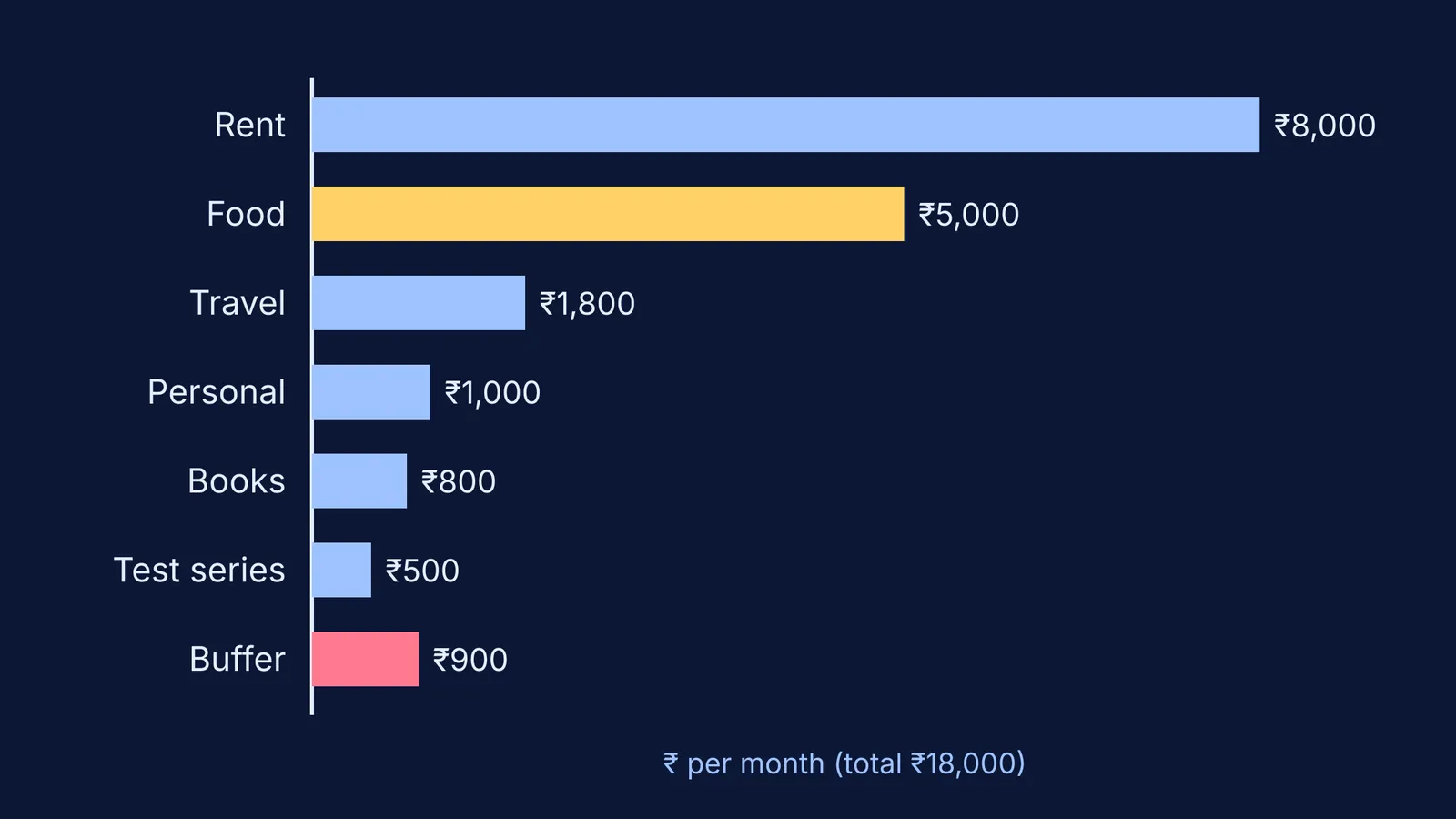
Here is a worked example for a student receiving ₹18,000 a month. The amounts only illustrate the method; use your own quotes.
Rent (PG room, electricity included): ₹8,000
Food (mess ₹4,000, plus ₹1,000 for fruit, milk, curd and eggs): ₹5,000
Travel (local autos ₹600, plus ₹1,200 saved for the trip home): ₹1,800
Phone, toiletries and laundry: ₹1,000
Books and stationery: ₹800
Test series (a ₹6,000 yearly fee divided by 12): ₹500
Buffer for surprises: ₹900
Two habits make this work. Pay fixed costs the day the money arrives, and on the same day move lumpy-cost money into a separate savings pot.
On books, buy one standard reference per subject before adding a second. A weak chapter is often one missing idea, not the wrong book. Fermi's Concept Library covers every concept in physics, chemistry, biology, mathematics and computing, each with its own lesson, so you can check the idea before paying for another book.
How do you budget for food without eating badly?
On a mess budget, cheap and healthy often point the same way. The ICMR-National Institute of Nutrition's Dietary Guidelines for Indians advise eating at least 400 g of vegetables a day and restricting foods high in fat, sugar and salt and ultra-processed foods such as biscuits, cakes and carbonated drinks. The same booklet says combining cereals with pulses in a 3:1 ratio improves the quality of protein in a meal, and that protein powders are unnecessary for normal healthy life.
In budget terms:
Treat the mess as your base and top it up with fruit, curd, eggs or sprouts, not outside meals.
Set a weekly snack allowance (your monthly top-up divided by four) and stop when it runs out.
Spend on dal, milk and eggs, not supplements.
If the mess food is poor, read our comparison of tiffin service versus hostel mess before you switch.
How do you track spending without giving up after a week?
Keep the tracker small enough to fill in before bed. One line per spend, with these columns:
Date
Item
Category (Rent, Food, Travel, Books, Test series, Other)
Amount
Paid by (UPI or cash)
Need or want
Every Sunday, total each category and compare it with the plan. Pick one change for the coming week, such as two outside meals instead of four. At month end, move any unused buffer into savings.
A short script for the monthly call home helps too: 'This month I spent ___ on food and ___ on travel, and saved ___. Next month I need ___ more because the test series fee is due.'
What should you do when money runs short or a refund is refused?
Check your log first: which category went over? Cut the want lines before you cut food, and tell home early.
Money can also vanish through fraud. Never share a UPI PIN or OTP, and read our guide to staying safe while using UPI as a student. According to a Kerala Police notice, the national cybercrime helpline 1930 is available 24 hours a day, and financial frauds can be reported at cybercrime.gov.in.
Keep every fee receipt and the written refund policy for your coaching centre and hostel. If an institute refuses a refund you are owed, you can complain to the National Consumer Helpline, which takes calls on toll-free 1915 from 8 am to 8 pm and complaints on WhatsApp. In February 2025, All India Radio News reported that complaints filed through the helpline had helped over 600 coaching students get ₹1.56 crore in refunds.
If money stress starts affecting sleep or study, talk to someone you trust, or call Tele MANAS, the free government mental health helpline, on 14416 or 1800-891-4416, available 24x7 as listed on IIT Kanpur's counselling page.
Set up your seven categories tonight and log tomorrow's first spend.


