On this page
If your NEET-UG rank puts MBBS out of reach, AYUSH degrees can fill a large part of your choice list. The four you will see most often are BAMS (Ayurveda), BHMS (Homoeopathy), BUMS (Unani) and BSMS (Siddha). They look alike on the counselling screen, but they lead to different lifelong practices. Here is how they differ, and a way to rank them that you can still defend to yourself years from now.
What do BAMS, BHMS, BUMS and BSMS have in common?
All four need a NEET-UG score. Under the NCISM's 2022 Ayurveda undergraduate regulations, general-category candidates need marks at the 50th percentile, and SC, ST and OBC candidates at the 40th.
Two national bodies set the rules. The National Commission for Indian System of Medicine Act, 2020 covers Ashtang Ayurveda, Unani, Siddha and Sowa-Rigpa. Homoeopathy has its own regulator under the National Commission for Homoeopathy Act, 2020.
Counselling is split too. The Ayush Admissions Central Counselling Committee (AACCC) fills 15% All India Quota seats in government and government-aided colleges, plus 100% of seats in deemed universities and in central universities and national institutes (apart from their state or institutional quotas). States fill the rest. Our guide to how AACCC and state counselling allot BAMS and BHMS seats walks through both rounds.
How are the syllabus and internship different?
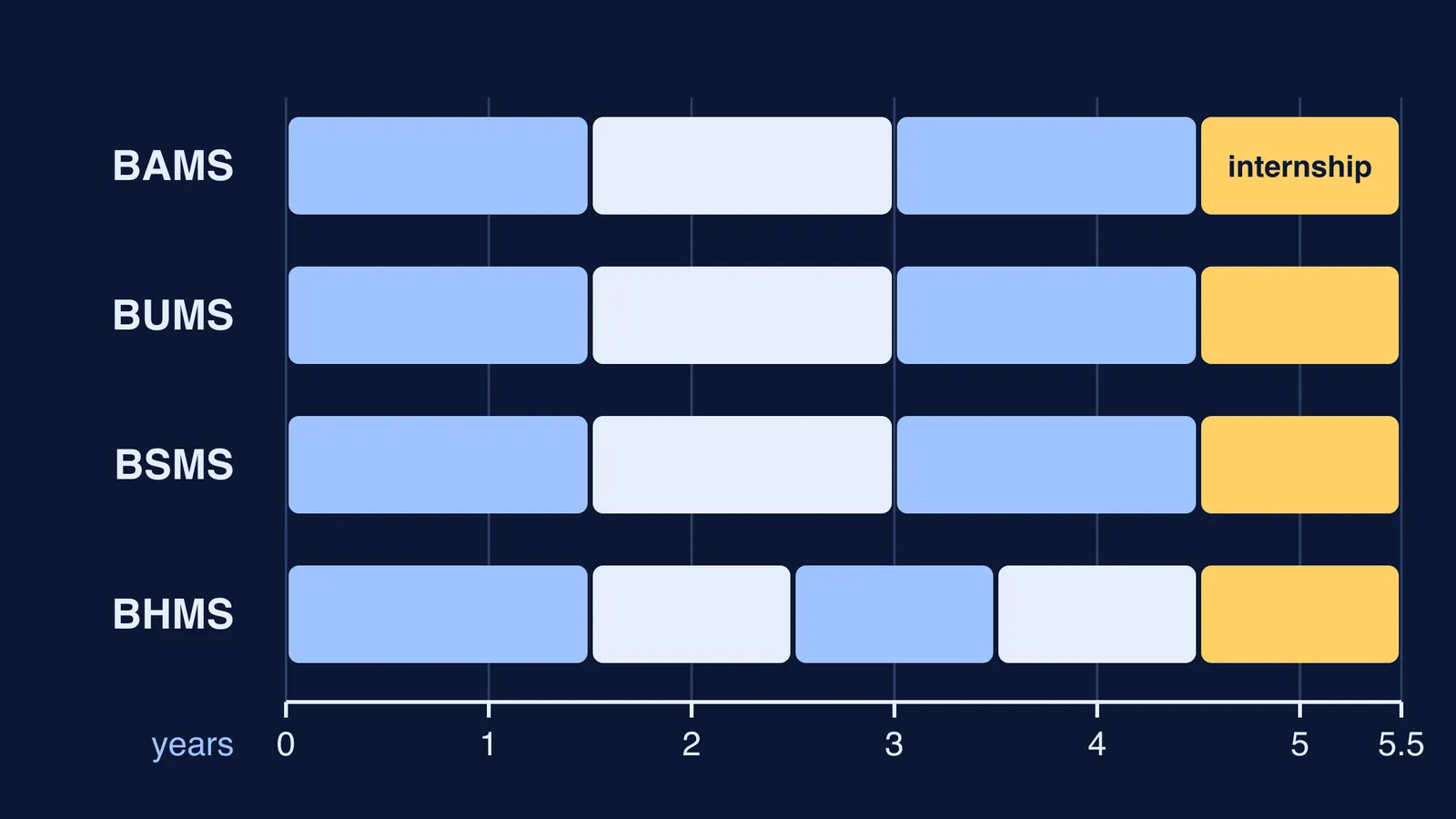
Every degree lasts five years and six months, ending in a 12-month compulsory rotatory internship, under both the NCISM and NCH rules. What changes is how the years are split and what you study.
BAMS: three professional years of 18 months each, then the internship, according to the NCISM Ayurveda regulations. First year has Sanskrit and history of Ayurveda, fundamental principles, human anatomy, human physiology and classical texts.
BHMS: an 18-month first year, then three 12-month years and the internship, according to the BHMS regulations NCH circulated in draft in 2022. Homoeopathic materia medica, organon and repertory are taught in all four years; anatomy and physiology come first, pathology, surgery and obstetrics later. Teaching is in English.
BUMS: three 18-month years plus the internship under the NCISM Unani regulations of 28 February 2022. If you did not pass Urdu, Arabic or Persian in Class 10 or 12, you study Urdu, Arabic and logic and philosophy in the first year.
BSMS: the same 18-month blocks and one-year internship, according to NCISM's Siddha standards. Students who did not take Tamil in Class 10 or 12 study it in the first year.
All four start with anatomy and physiology, so your NEET biology carries straight over. If any of it still feels shaky, the Fermi Concept Library has a lesson for every concept in biology, with its place in the wider map of the subject.
Which degree lets you practise, and where?
Each degree licenses you in its own system only. Under section 34 of the NCISM Act, only people enrolled in a State Register or the National Register may practise Indian System of Medicine as qualified practitioners.
Both Acts also provide for a National Exit Test, a common final-year exam for the licence and registration: section 15 of the NCISM Act and section 15 of the NCH Act. Rules for when it applies can change, so check your commission's website for your batch.
So is BAMS or BHMS the better career?
None of the Acts or regulations linked here ranks one above the other. The usual routes after graduation are broadly similar: private practice, government AYUSH posts, teaching, research and the medicine industry. Postgraduate seats come through AIAPGET, which the National Testing Agency runs for MD/MS admission in Ayurveda, Siddha, Unani and Homoeopathy.
The real difference is what you will do every working day. As a BAMS doctor, you will spend your career on Ayurvedic diagnosis, medicines and therapeutic procedures. As a BHMS doctor, you will spend it on case-taking, repertory and homoeopathic prescribing. Pick the one you can explain to a patient with conviction.
How should you rank them in choice filling?
Score every college-course pair before the window opens:
Fit with the system (veto): if you would not practise it for your whole working life, leave it off.
Language: add BUMS only if you can manage Urdu, BSMS only if Tamil is workable.
College type: government or aided colleges first; check private fees before you add them.
Hospital: a working attached hospital matters for your internship year.
Distance and cost of living: you will live there for the whole course, internship included.
Worked example: a student from Bhopal who likes Ayurveda, is unsure about homoeopathy and has no Urdu or Tamil. Their order becomes: government BAMS colleges, then government BHMS colleges, then affordable private BAMS colleges. BUMS and BSMS stay off the list. Before locking, they read our NEET choice-locking checklist and compare AYUSH with other routes after a NEET score.
If counselling season feels heavy, talk to someone you trust, or call Tele MANAS, the government's toll-free mental health helpline, on 14416.