On this page
A student who is fascinated by aviation might dream of becoming a pilot, but the person who ensures the aircraft is actually safe to fly is the Aircraft Maintenance Engineer (AME). Before any commercial flight takes off, a licensed AME must carefully inspect the aircraft, clear any technical defects, and sign a Certificate of Release to Service (CRS). Without this signature, the aircraft cannot legally leave the ground. Unlike a standard university degree, becoming an AME in India is a professional licensing process governed by the Directorate General of Civil Aviation (DGCA).
What is required for an aircraft maintenance engineering course after 12th?
To start training for an AME license after the 12th grade, you must meet the DGCA's basic academic and medical standards. The foundational requirement is passing your 10+2 board examinations with Physics, Chemistry, and Mathematics (PCM).
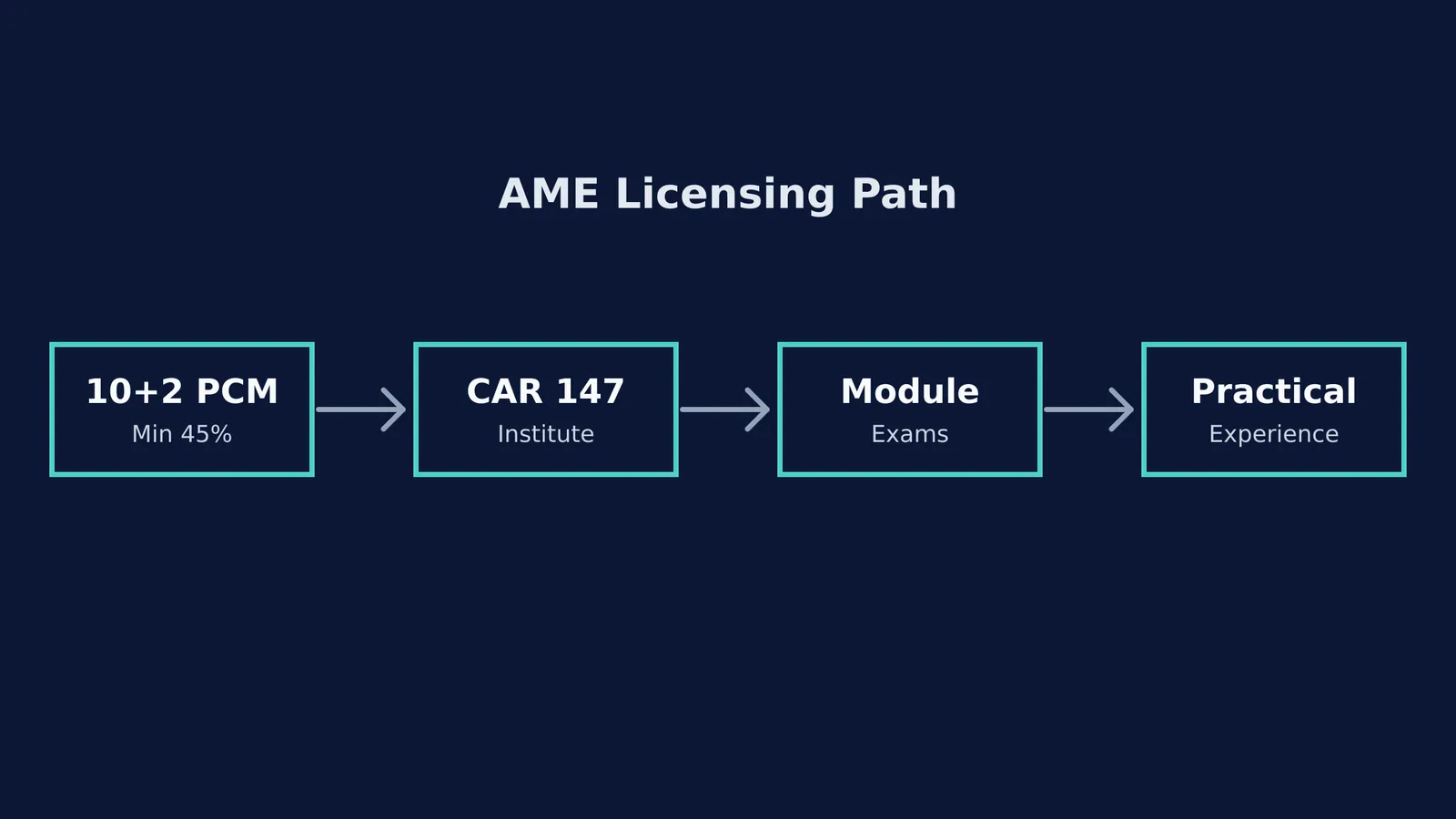
While the official DGCA CAR 66 regulation only mandates a "pass" in these subjects, most approved training institutes require a minimum aggregate of 45% in PCM for admission (wcat.in). If you hold a 3-year AICTE-recognized engineering diploma in mechanical, electrical, electronics, or aeronautical streams, you are also eligible to apply.
Because aircraft maintenance is a safety-critical job, there are strict medical fitness standards. You must have normal vision (with or without glasses), and most importantly, you must not have colour blindness (wcat.in). Identifying colour-coded wiring, alert lights, and electronic displays is an essential part of the daily work. A medical certificate from a DGCA-authorised doctor is required before you can receive your license.
How do you get a CAR 66 AME license?
Getting an AME license is very different from getting a B.Tech degree. It is more similar to becoming a doctor or a lawyer: you must pass professional exams and complete a mandatory period of supervised practical work.
The process involves three main steps:
Join a CAR 147 Approved Institute: You must enroll in a training organisation that has been formally approved by the DGCA under the CAR 147 regulations.
Clear the Module Exams: The DGCA's Central Examination Organisation conducts basic knowledge examinations, known as modules. You must pass all the required modules for your chosen license category.
Gain Practical Experience: Passing the exams does not automatically give you a license. You must complete a period of practical maintenance experience on live, operating aircraft before the license is granted.
If you struggle with the core science concepts required for the module exams, Fermi's AI tutor can help. The tutor teaches rather than answers: it holds a line of reasoning across a whole session, notices where a student is stuck, and decides whether to explain, ask, or show.
What to look for in a CAR 147 training institute?
Choosing the right institute is critical because the DGCA closely monitors training standards. When evaluating a potential AME college, you should look beyond the marketing brochures and verify their credentials directly.
First, check their current approval status on the DGCA website to ensure they hold a valid CAR 147 certification. Second, ask about their tie-ups with active airlines or maintenance, repair, and overhaul (MRO) organizations. Practical experience is a mandatory part of the licensing process, and an institute with strong industry partnerships can help you secure those crucial training opportunities on live aircraft. Finally, review their infrastructure; they should have well-equipped laboratories, access to a hangar, and modern aircraft systems for you to practice on.
Category B1 vs Category B2: Which role to choose?
When you begin your AME course, you will have to choose a specific license category. The DGCA divides the AME license into two primary streams: Category B1 and Category B2.
Category B1 (Mechanical) engineers deal with the physical structure of the plane. This includes the airframe, the engines, the propellers, and the mechanical systems like landing gear and hydraulics. If you are interested in turbines and structural mechanics, this is the path to take.
Category B2 (Avionics) engineers focus on the "brain" of the aircraft. They maintain the electrical systems, navigational instruments, radar, and radio communications. If you prefer electronics and software over heavy machinery, the B2 category is a better fit. As aircraft become more reliant on complex computer systems, the demand for avionics specialists is rising.
What is the career scope for an AME?
The demand for licensed AMEs in India is growing rapidly as airlines expand their fleets. Boeing's 2026-2045 Pilot and Technician Outlook projects a need for 44,000 new aviation maintenance technicians in the South Asia region (primarily India) over the next 20 years (Boeing). The region is identified as one of the fastest-growing globally for aviation personnel.
For parents, it is helpful to explore this path when talking about STEM careers beyond engineering and medicine. While the training is rigorous and the exams are difficult, a licensed AME enters a highly specialized, globally recognized profession. Just like starting your first semester at science or engineering college, the transition into an AME institute requires dedication, but it leads directly to a vital role in the aviation industry.