

On this page
A paper bridge, a newspaper tower and an egg drop need almost nothing you don't already have at home. What makes them engineering rather than craft is the loop: build, test, measure, change one thing, test again. Here are three challenges, a weekend plan and what to say when the tower falls and you want to fix it.
What engineering challenges can kids do at home with paper and cardboard?
Each challenge has a goal, fixed materials and a test that gives a number, which turns "it's bad" into "version 2 held more".
Paper bridge. Span a gap of about 20 cm between two equal stacks of books using five sheets of A4 paper and a strip of tape. Hang a paper cup from the middle and add coins one at a time until it collapses. Count the coins. A flat sheet sags straight away; folding it into a zigzag or rolling it into tubes changes the shape, and the shape carries the load.
Tallest tower. Use ten sheets of newspaper and tape to build the tallest tower that stands on its own for 30 seconds. Then test it against a table fan on low. Children often find that tight rolled tubes, a wide base and triangles hold up better than flat walls.
Egg drop. Protect a raw egg sealed in a zip bag using cardboard, paper, straws and rubber bands. Drop it first from chest height, then from a step stool, with an adult holding the stool. Never drop from a balcony, terrace edge or window. A good design makes the egg slow down over a longer time; our explainer on why a cushion stops an egg breaking shows the impulse physics behind it.
For younger children, keep to one challenge per session; teenagers can add a material budget.
What is the test-and-improve cycle?
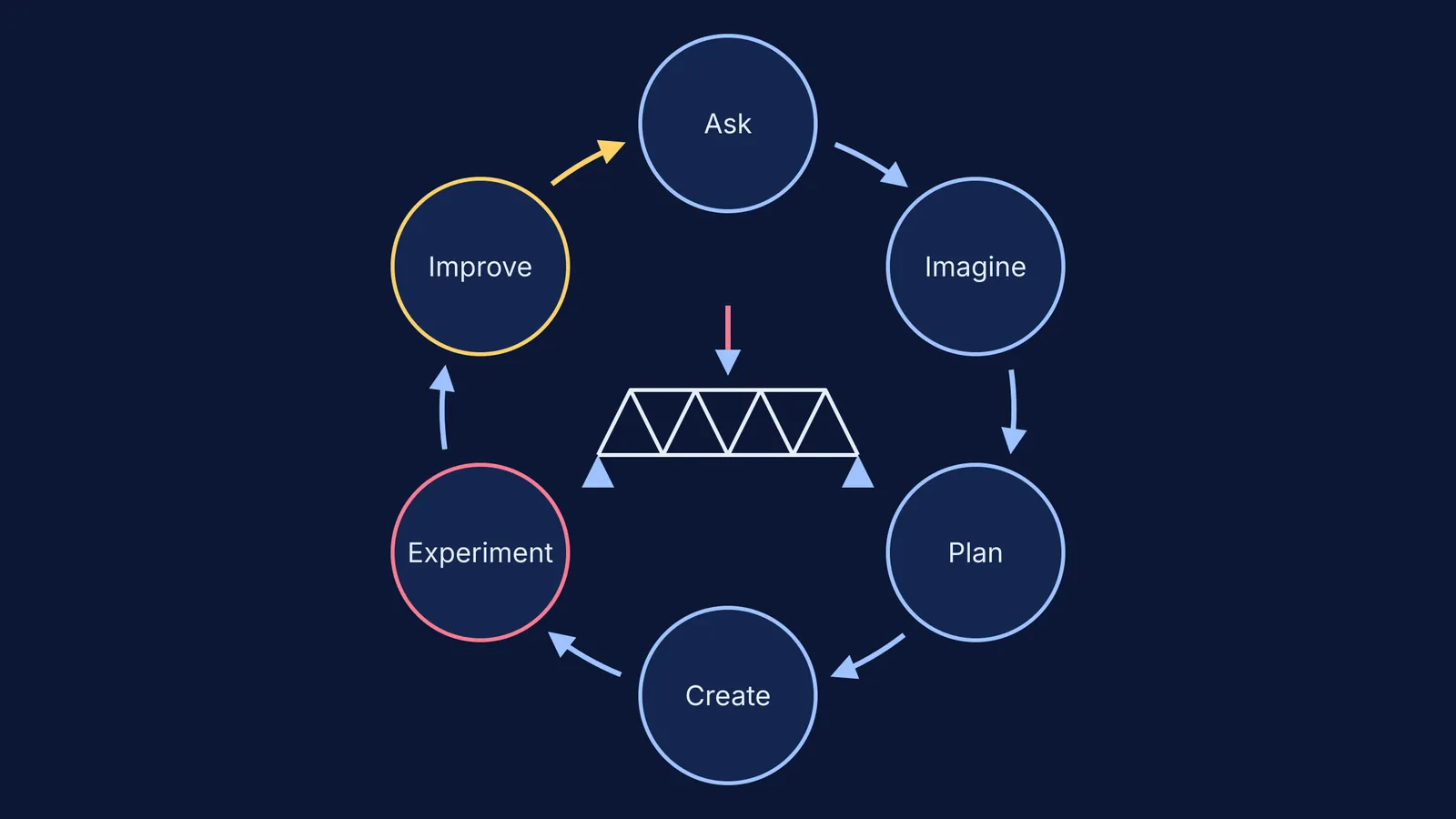
NASA's education programme teaches students a six-step engineering design process: ask, imagine, plan, create, experiment and improve, and it stresses that the process is cyclical, with students revising their designs over time (NASA BEST engineering design process series).
At home, that looks like this:
Ask: What exactly must it do, and how will we test it?
Imagine and plan: Sketch two ideas before touching the tape.
Create: Build version 1, quickly.
Experiment: Run the same test every time and write the number down.
Improve: Change one thing, then test again.
Changing one thing at a time matters most: change the fold, tape and base together and nobody knows which helped.
How do you help a child without fixing their design?
A 2011 study in Cognition by Elizabeth Bonawitz, Laura Schulz and colleagues found that preschoolers whom an adult deliberately taught one function of a new toy focused almost exclusively on that function, while children who saw the function without teaching, or no demonstration, explored the toy more broadly (Bonawitz et al., 2011). When you show the "right" fold, you may get a stronger bridge and a child who stops looking for other folds.
Praise matters too. Across six studies, Claudia Mueller and Carol Dweck found that fifth graders praised for intelligence showed less persistence and enjoyment after failure than children praised for effort (Mueller and Dweck, 1998). So praise the effort, the strategy and the change, not the child's brain.
What should you say instead?
Instead of "Put more tape here", ask "Where did it bend first?"
Instead of "That won't work", ask "What do you predict will happen? Let's test it."
Instead of "You're so clever", say "Folding it held more coins. What gave you that idea?"
When they want to quit, ask "What is one thing you'd change for version 2?"
If your child gets upset when a design fails, our guide to helping a child who is afraid of making mistakes has more on this, and the same hands-off rule applies when you are deciding whether to correct your child's homework.
A weekend plan you can copy
Saturday, 45 minutes: the bridge. Agree the goal and test, then run three rounds of ten minutes' building plus testing. Keep a one-page log. A log might read: "Version 1, flat sheet, 2 coins. Version 2, zigzag fold, 11 coins. Version 3, zigzag plus rolled edges, 19 coins." These are example numbers, not targets; your child's own numbers are the point.
Sunday, 60 minutes: the egg drop. Build a carrier, drop it from chest height and look at what crushed or bounced. Improve once, then try the step stool. End by asking your child to explain why version 2 worked better.
If your teenager gets curious about the physics behind these builds, the Fermi Simulation Lab has interactive simulations for ideas that are easier to see than to read.
Pick one challenge, clear the dining table this Saturday, and let the first version fail.


