On this page
Your child can find a science video on almost anything, from black holes to why onions make you cry. Some are made by teachers and scientists. Others are made mainly to keep people clicking. The useful question is not whether YouTube is good or bad for learning, but which videos teach and what your child does after the video ends.
Are science videos on YouTube good for my child's learning?
They can be, and one study shows what separates the good ones. Derek Muller and colleagues tested short videos explaining Newton's first and second laws, with students pre-tested and post-tested around them (Muller, Sharma and Reimann, Science Education, 2008). In the first experiment, students who watched a dialogue that brought up common wrong ideas reported more mental effort and scored higher than students who watched a standard lecture-style presentation. In all, 272 students took part across the two experiments.
The interviews in that study suggested students took a more active approach when wrong ideas were raised. That is the surprising part for parents: a video that feels smooth and easy is not always the one that teaches. A video that makes your child say "wait, I thought..." often does more.
How do you choose a good science video?
Use this quick check before you press play:
It asks a question or states a common wrong idea before explaining ("Do heavier things fall faster?").
It shows something real: an experiment, a measurement or a photo, not only animation and music.
It says how we know, by naming a source, showing data or doing the test on camera.
It covers one idea, in a length short enough to talk about afterwards.
It links to what your child is studying this term, so the chapter and the video support each other.
Skip it if the title promises a shock, the presenter never explains why, or the video is mostly selling something.
For younger children, decide first where they watch; our guide to choosing between YouTube Kids and supervised YouTube walks through the settings. For longer films on a weekend, see our guide to science documentaries for families.
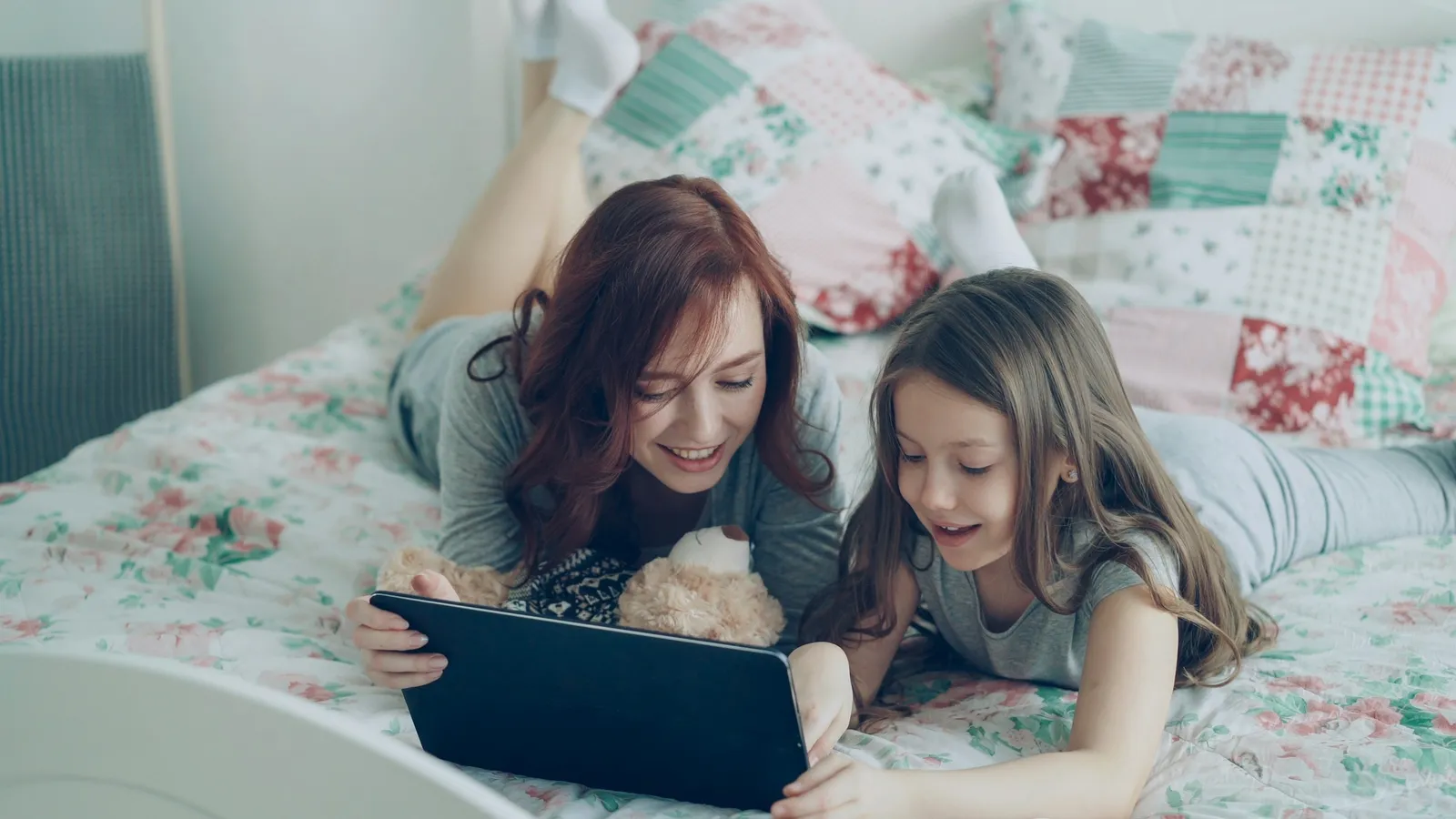
Why does watching together help?
The American Academy of Pediatrics stressed parent–child shared media use, not only time limits, in its 2016 policy statement on media for children up to age 5 (AAP, Pediatrics, 2016), which has since been replaced by a broader 2026 statement.
A 2025 experiment suggests how a science programme can feed family conversation (Bonus and colleagues, Developmental Psychology). It randomly assigned 116 parents and their children aged 4 to 7 to watch science television either before or after an engineering activity. Watching first led to more exchanges in which children answered their parents' open-ended questions with science explanations.
Those studies were about young children. With a teenager, "together" can simply mean ten minutes on the sofa after dinner. You do not need to know the science. Your job is to ask, listen and be curious.
What questions should you ask after a science video?
Ask these three, in order, once the video is closed:
"Tell me what happened, without the video." Pulling an idea out of memory strengthens it. In experiments with prose passages, students who took recall tests remembered substantially more two days and one week later than students who restudied the material the same number of times (Roediger and Karpicke, Psychological Science, 2006).
"Why did it happen? What did you think before?" Explaining in your own words links the new idea to what you already know. In one study, 14 eighth-grade students prompted to explain each line of a passage on the circulatory system gained more from pre-test to post-test than 10 students who read it twice (Chi and colleagues, Cognitive Science, 1994).
"Where else would we see this, and how could we check?" This moves the idea out of the screen and into your home.
A worked example: why does a steel ship float?
Say your 12-year-old has just watched a video on buoyancy.
You: "Tell me what happened, without the video." Child: "A steel block sank but a steel boat floated."
You: "Why? What did you think before?" Child: "I thought heavy things always sink. The boat's shape pushes aside a lot of water, and when the water pushed aside weighs as much as the boat, it floats."
You: "Where else, and how could we check?" Child: "A ball of clay should sink but a clay boat should float. Let's try it in a bucket."
That last answer is a ready-made weekend activity; our clay boat buoyancy challenge sets it up.
If an idea still will not settle after the video, the Fermi Simulation Lab has interactive simulations for ideas that are easier to see than to read, and the Fermi Concept Library gives each concept in physics, chemistry, biology and mathematics its own lesson.
Tonight, pick one short video, watch it together and ask the three questions. Your child should do most of the talking.