

On this page
If you drop a solid ball of modelling clay into a bowl of water, it drops straight to the bottom. Yet massive cruise ships made of steel, which is far heavier than clay, float effortlessly across the ocean. This classic paradox is the basis for the clay boat experiment, a hands-on way to teach children about density, displacement, and Archimedes' principle.
By challenging your child to reshape a sinking lump of clay into a boat that floats, you can turn an abstract physics lesson into an afternoon of active learning. Practical experiments like this help students build an intuitive feel for physics long before they have to solve equations in an exam hall.
What do you need for the experiment?
You only need a few household items to set up this floating clay challenge:
Modelling clay: Oil-based clay (such as Plasticine) works best because it does not dissolve or fall apart in water.
A large container: A deep bowl, a plastic tub, or even the kitchen sink, filled halfway with water.
Cargo: A handful of coins (like one-rupee or two-rupee coins), metal washers, or small pebbles of roughly equal weight.
A towel: To catch the inevitable spills when boats sink.
How do you run the clay boat challenge?
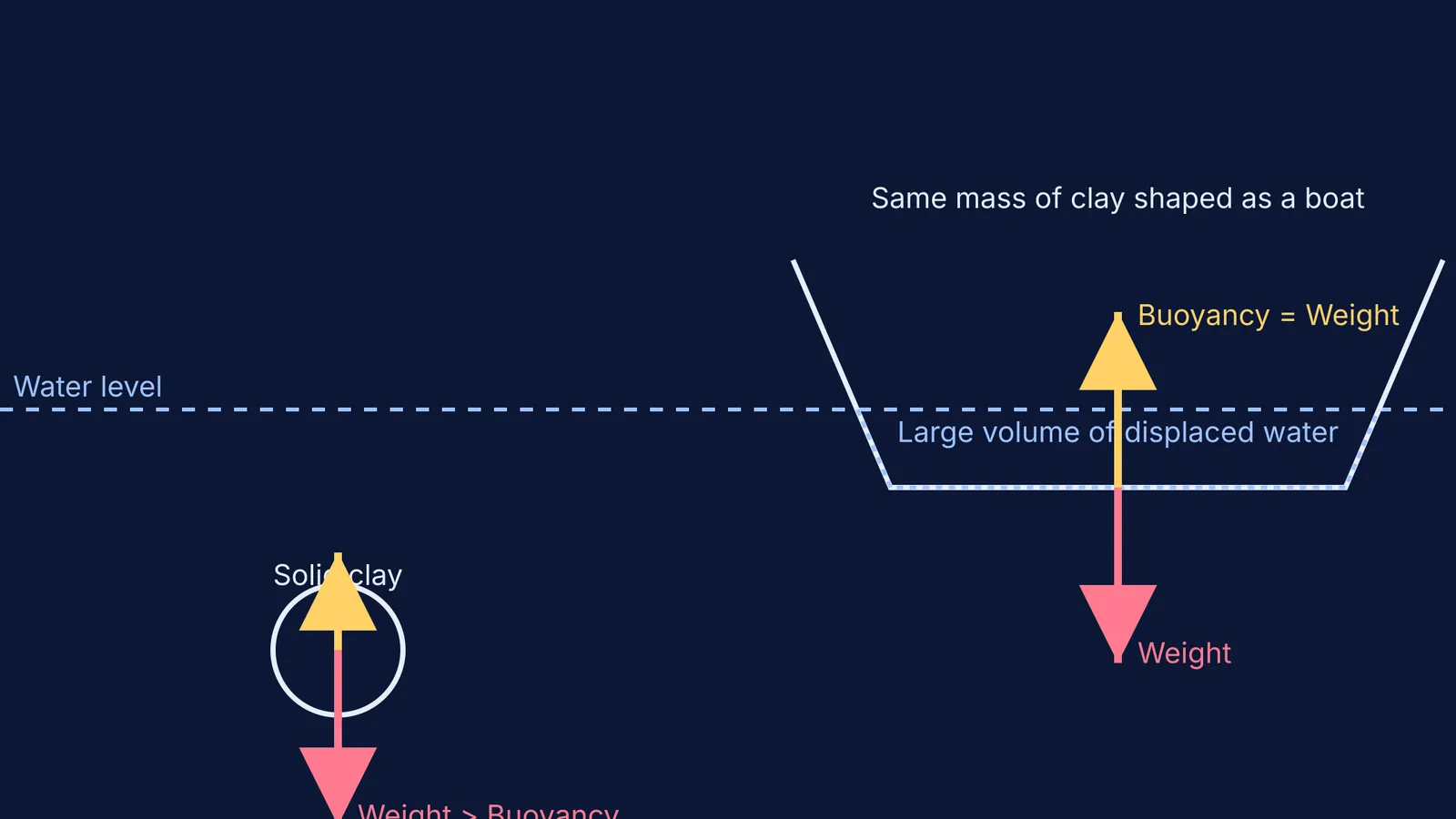
Start by demonstrating the problem. Roll a piece of clay into a tight, solid ball. Ask your child to predict what will happen when you place it in the water. Oil-based modelling clay is denser than water. Because of this, a solid ball of clay will sink immediately to the bottom.
Next, present the challenge: using that exact same piece of clay, they must design a shape that floats.
Let them experiment without giving them the answer. They might try flattening the clay like a pancake, rolling it into a long cylinder, or making a raft. Most of these initial attempts will sink. Eventually, they will discover that a boat shape—wide, hollow, and with high walls—is the only design that stays on the surface.
Once they have a floating boat, introduce the cargo test. Place one coin at a time gently into the centre of the boat. Ask them to count how many coins the boat can hold before the water spills over the sides and sinks it. They can then pull the wet clay out, dry it off, and redesign their boat to see if a wider base or taller sides can hold more weight.
Why does the clay boat float?
To understand why the shape matters when the mass remains exactly the same, we have to look at what happens to the water. When you place an object in water, it must push water out of the way to make room for itself. This process is called displacement.
Water resists being moved, so it pushes back. The upward push of the water against the object is called the buoyant force. Over two thousand years ago, the Greek mathematician Archimedes discovered the rule that governs this interaction. According to Archimedes' principle, any object totally or partially immersed in a fluid is buoyed up by a force equal to the weight of the fluid that the object displaces (Wikipedia).
We can write this mathematically as the buoyant force formula: F = ρgV Here, F is the buoyant force, ρ is the density of the fluid, g is gravity, and V is the displaced volume (Wikipedia).
This is exactly how a heavy steel ship stays afloat. The hull is shaped to encompass a massive volume of air, meaning the ship's overall density is lower than the water, and it displaces a volume of water that weighs as much as the ship itself. You can read more about how the ancient mathematician first formulated these ideas in our profile on Archimedes on buoyancy and levers.
Building a strong physics foundation
The clay boat is a fantastic starting point for middle-school science, laying the groundwork for topics covered in Class 9 gravitation: weight, free fall and buoyancy. However, as students progress to higher classes and prepare for exams like JEE or NEET, fluid mechanics becomes much more mathematically demanding.
If your child struggles to picture how forces like buoyancy and gravity interact in these more complex scenarios, the Fermi Simulation Lab provides interactive simulations for the ideas that are easier to see than to read.
For students who might be dropping marks on advanced fluid problems, Fermi's AI tutor works out what they already know and builds a plan for the session. If they have foundational misunderstandings about density or pressure, they can review the Fermi Concept Library, which covers every concept in physics, chemistry, biology, mathematics and computing, each with its own lesson and its place in the map. Ensuring these basics are perfectly solid helps students avoid the common Fluid mechanics: pressure, buoyancy and Bernoulli mistakes to avoid.


