

On this page
Sitting beside your child while they watch television does more than keep them company—it changes how their brain and body process what they see. When a parent is in the room, children treat the educational content as more important.
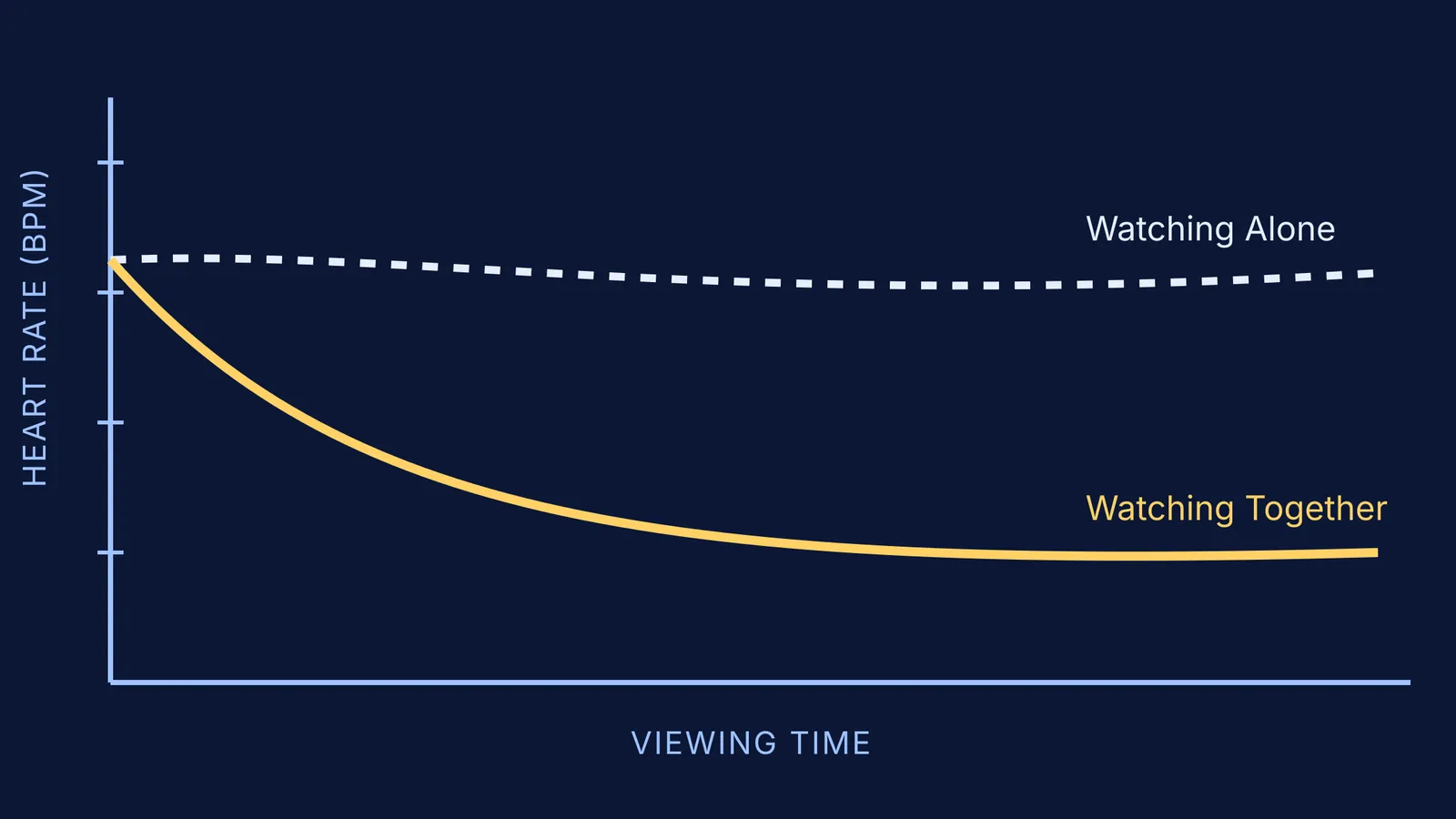
A study of 88 children by Texas Tech University found that co-viewing educational media lowers a child's heart rate, a physiological response indicating increased cognitive effort and focus. Watching together turns a passive documentary into an active learning session.
Here is how to choose the right science films, watch them together, and ask the right questions when the credits roll.
Why do children learn more when you watch together?
The Texas Tech University research measured both heart rate and skin conductance to track how children reacted to educational shows. When parents were present, children experienced a drop in heart rate. In psychophysiology, this drop means the brain is allocating more resources to encoding new information.
The researchers call this "social facilitation." You do not even need to speak during the show; your physical presence signals that the programme has value. Because you are paying attention, your child pays attention, capturing more plot points, scientific vocabulary and overarching themes.
Which science documentaries to watch with kids?
The right documentary depends on your child's age, maturity and current attention span. Pushing a highly technical film too early can cause a "boomerang effect", where a child becomes overwhelmed or bored and actually allocates fewer mental resources to the screen.
Ages 6 to 9: Look for visually stunning nature documentaries that focus on animal behaviour and survival, such as those exploring mimicry in butterflies or deep-sea habitats. Keep viewing sessions under 45 minutes to prevent fatigue.
Ages 10 to 13: Branch into deeper, systems-level science. Documentaries on climate change, space exploration, or environmental issues like biological magnification offer complex problems to unravel. Older children can usually engage with 50-to-60-minute films and handle darker, more serious themes about conservation.
How do you turn watching into active learning?
The difference between passive screen time and active learning is how you mediate the experience. You do not need to be a science expert or have a background in teaching; you just need to be engaged and curious.
Use the pause button: If a documentary introduces a hard-to-picture idea—such as how atmospheric refraction bends light to make stars twinkle—pause the film. Ensure they understand the basic principle before the narrator moves on.
Model curiosity: Treat the film as a shared discovery rather than a lecture. Saying, "I didn't know that!" shows your child that learning is a lifelong habit and that it is perfectly fine not to know all the answers.
Bridge to real life: Connect the on-screen phenomena to your own environment. If you are watching a film on plant biology, relate it to the weeds in your garden or the vegetables in your kitchen.
If a documentary introduces a difficult concept and your child struggles to grasp it, Fermi's AI tutor can work out what they already know and build a plan for the session, teaching through the missing foundational ideas.
A practical framework for family movie night
To make co-viewing a regular and stress-free habit, try structuring your documentary nights with a simple three-step framework:
Before pressing play: Set a shared goal. Instead of simply turning the television on, give your child a specific "mission" for the film. You might say, "Let's see if we can spot three different ways these animals hide from predators." This primes their brain to look for patterns.
During the film: Maintain physical proximity. Sit on the same sofa, react visibly to surprising facts, and do not look at your smartphone. Your undivided attention validates their focus.
The next day: Revisit the topic casually. Ask a follow-up question over breakfast or during the school run. "I am still thinking about those deep-sea volcanoes we saw yesterday. Did anything from the film stick in your mind?"
What questions should you ask after the documentary?
Testing a child with closed, pop-quiz questions (for example, "What was the name of that bird?") often shuts down conversation. If they do not know the answer, they feel as though they failed a test. Instead, use open-ended questions that require reasoning, reflection, and imagination.
Predictive questions: Ask these during a pause or right as a scene changes. "The ice is melting faster this year. What do you think the polar bears will have to do next?"
Relational questions: Ask these as the credits roll to connect the science to their personal world. "Have we ever seen an insect that behaves like the one in the video? Where did we see it?"
Clarification questions: Help them identify what they do not know, which builds metacognition. "That part about the Earth's orbit was tricky—what was the most confusing bit for you?"
When your child identifies a concept gap after watching, you can use the Concept Library to find a dedicated lesson on that exact topic. For complex ideas that are easier to see than to read, the Simulation Lab provides interactive models that let you test the physics or biology firsthand.


