On this page
Many parents consider tuition in Class 3. India's Comprehensive Modular Survey: Education 2025 found that 22.9% of primary-level students were taking or had taken private coaching in the current academic year. First, find out what your child should manage, and whether home practice can close the gap.
What should a Class 3 child be able to do?
Under NIPUN Bharat, launched by the Ministry of Education in July 2021, every child should attain foundational literacy and numeracy by the end of Grade 3, by 2026-27.
The same release sets a reading benchmark: by the end of Grade 3, a child should read at least 60 words per minute correctly, with understanding, from an age-appropriate text they have not seen before.
The numeracy goals for Grade 3, as listed in a Kendriya Vidyalaya summary of the NIPUN targets, are reading and writing numbers up to 9999, adding and subtracting numbers up to 999, and solving simple multiplication problems.
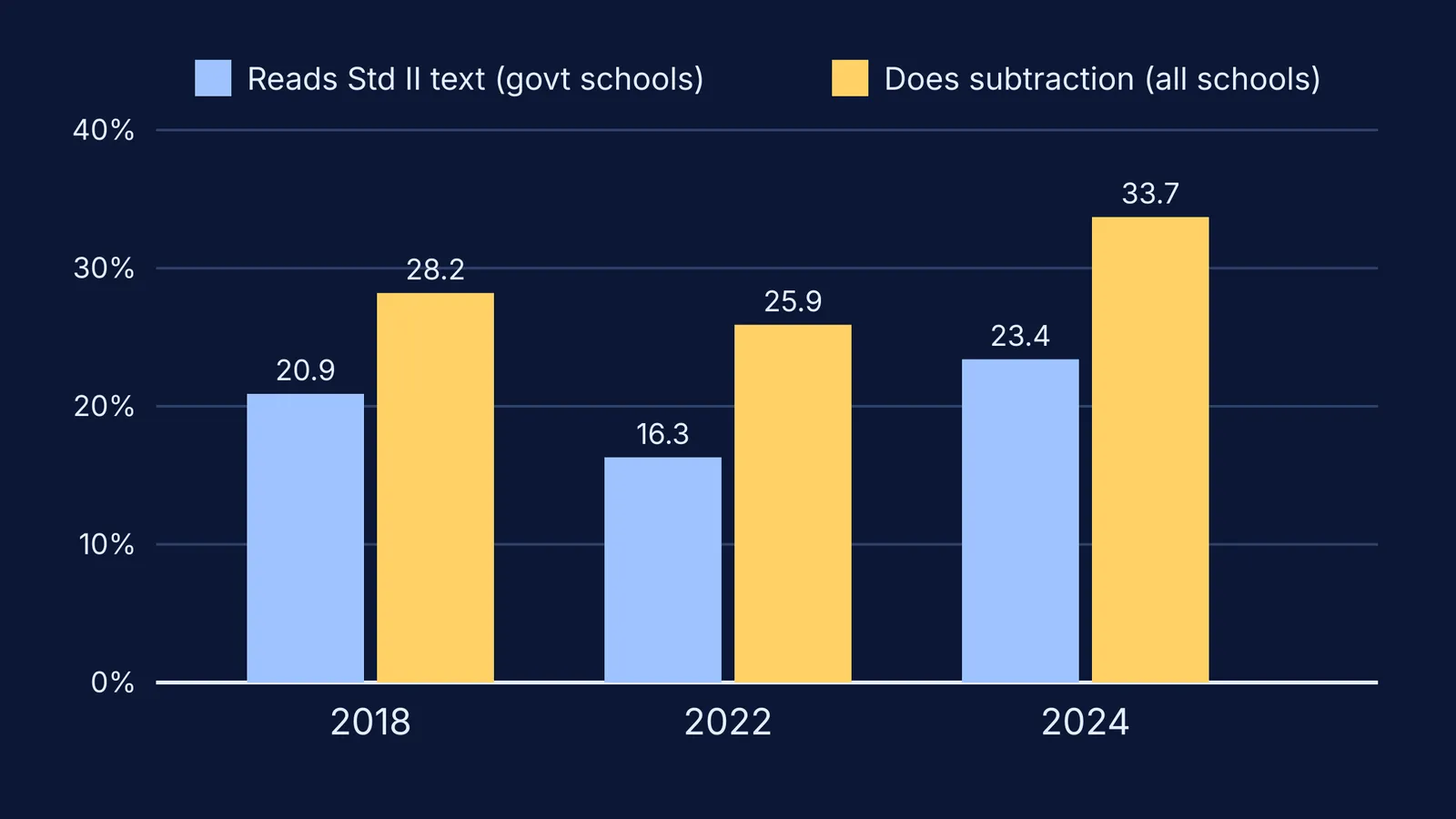
Many children are not there yet. In the ASER 2024 national findings, a household survey of rural India, only 33.7% of Class 3 children could at least do a two-digit subtraction with borrowing. Only 23.4% of Class 3 children in government schools could read a Class 2 level text. See our summary of what the ASER 2024 report found.
What are the signs a young child needs extra help?
Look for patterns that last for weeks, not one bad test.
They guess words from the first letter, or cannot tell you what a page said.
They count on fingers for sums like 7 + 5 long after classmates have stopped.
Homework takes far longer than the teacher expects, or ends in tears most days.
The teacher raises the same gap more than once.
They avoid reading aloud, or say "I'm bad at maths".
Messy handwriting or one low mark after an absence are not signs on their own.
How can you check at home in 15 minutes?
Call it a game, not a test.
Reading (5 minutes). Pick an unseen short story at their class level, in the language they learn in. Time one minute of reading aloud and count the words read correctly. Then ask: "What happened first?" and "Why did she do that?"
Numbers (5 minutes). Dictate 4,072 for them to write. Ask them to solve 52 − 27 on paper, then: "Three bags with four mangoes each. How many mangoes?"
Talk (5 minutes). Ask: "Which part of school feels easy? Which feels tricky?"
A made-up example: Riya reads 38 words in a minute and answers both questions. She writes 4,072 and gets the mangoes right, but writes 52 − 27 = 35. That is not "needs tuition". She reads slowly but understands, so daily reading may close the gap. Her subtraction shows one exact mistake: in the ones column she took 2 from 7 instead of borrowing. A patient explanation with bundles of ten sticks can fix that.
What should you try at home before paying for tuition?
Give it four weeks, about 20 minutes a day.
Week 1: tell the class teacher what you saw and ask what they notice.
Every day: 10 minutes of shared reading. Your child reads one page aloud, you read the next.
Every day: 10 minutes of number talk: shop prices, cricket scores, sharing rotis.
Fix one mistake at a time, and praise the method, not just the answer.
Week 4: run the 15-minute check again.
To refresh a maths idea yourself before explaining it, the Fermi Concept Library has a lesson for each concept in mathematics.
If gaps stay wide after a month, read our guide to dyslexia, dyscalculia and other learning differences and speak to the school. If school worries are making your child very anxious, call the government's Tele MANAS toll-free mental health helpline on 14416.
What should you check if you do choose a tutor?
A 2024 meta-analysis of tutoring experiments by Nickow, Oreopoulos and Quan in the American Educational Research Journal found that tutoring programmes had consistently substantial positive effects on learning. Effects tended to be largest when tutors were teachers or paraprofessionals, in earlier grades, with sessions at least three days a week, during school. Those were organised programmes, not neighbourhood tuition, but they tell you what to ask for.
Before you pay, check:
Does the tutor start by finding out what your child can already do?
Is there a named goal, such as "reads 60 words a minute with understanding by March"?
Are sessions short and frequent, rather than one long session a week?
Will they teach the gap, or just finish school homework?
Will they tell you each month what changed?
A script for the first meeting: "She reads slowly and gets stuck on borrowing. Could you check where she is first, and tell us what you will work on for six weeks?" Agree a review date too: if the goal is met, tuition can stop.
Start with the 15-minute check this weekend.