

On this page
If your child came home from the first trigonometry class looking defeated, they are in large company. The fear often has a clear source, and a clear way back.
Why is my Class 10 child suddenly scared of trigonometry?
Look at how the chapter moves. The NCERT Class 10 chapter Introduction to Trigonometry opens with friendly pictures (the Qutub Minar, a river, a hot-air balloon), then over the next fifteen or so pages defines six ratios, a table of values from 0° to 90°, and identities. The textbook even warns that "sin A is not the product of 'sin' and A". A child who misreads the notation early can feel lost weeks later, and that feeling quickly becomes "I am bad at maths".
Worry about maths is also widespread among teenagers. In PISA 2022, 65% of students across OECD countries worried about getting poor marks in mathematics and 55% felt anxious about failing it, as ACER's Teacher magazine reports.
Parents play a part too, often without meaning to. In a 2015 study in Psychological Science, Erin Maloney, Sian Beilock and colleagues found that when maths-anxious parents helped often with homework, their first- and second-grade children learned less maths over the year and ended it more anxious. The children were much younger than a Class 10 student, so treat this as a hint rather than proof for teenagers: your tone at the table may matter as much as your trigonometry. If homework time already ends in arguments, read why a Class 10 teenager refuses homework help first.
What do sin, cos and tan actually mean?
They are ratios of sides in a right triangle, measured from one chosen angle. NCERT defines sine as the side opposite the angle divided by the hypotenuse, cosine as the adjacent side divided by the hypotenuse, and tangent as opposite divided by adjacent (NCERT, Section 8.2).
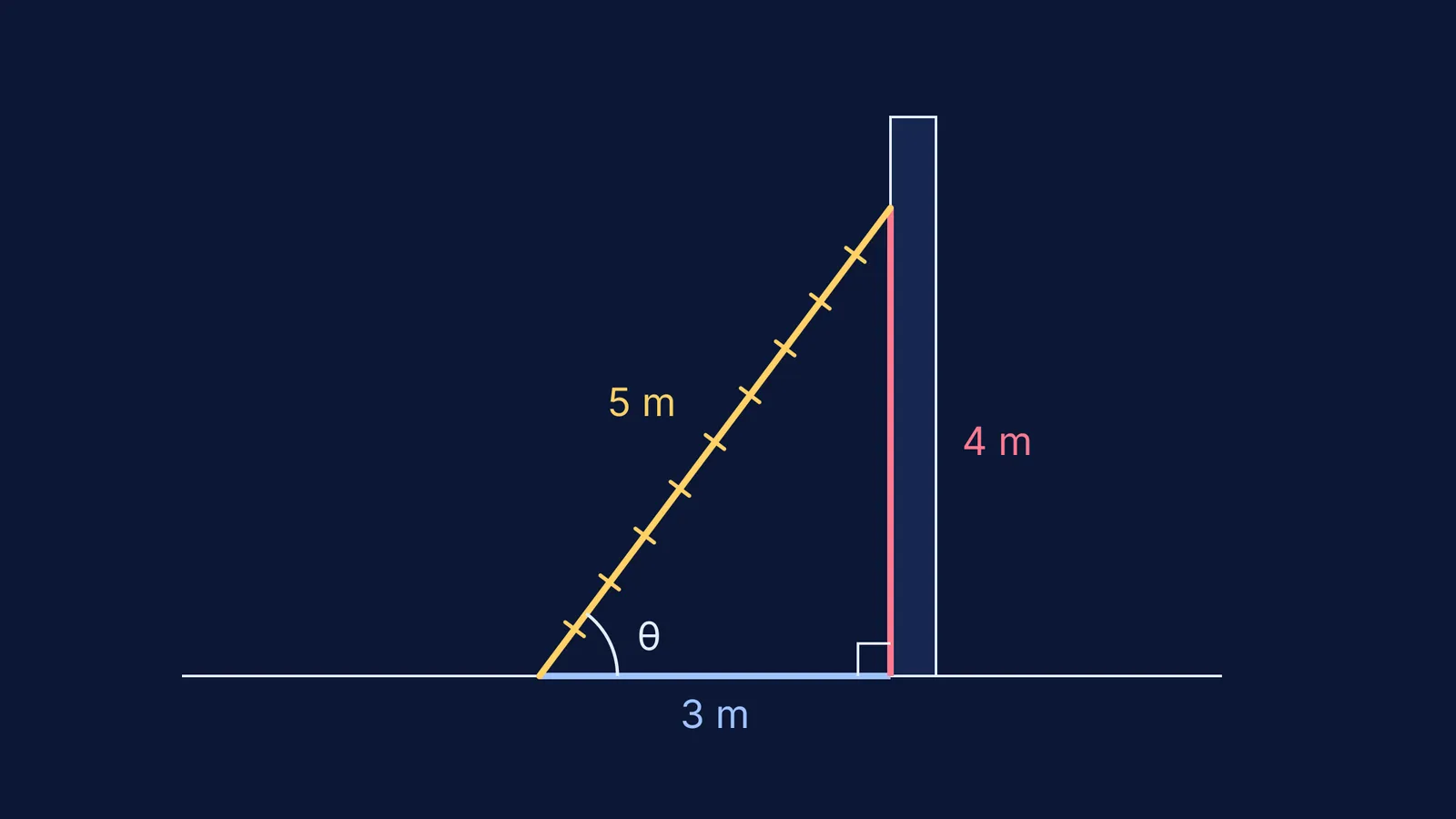
Now make it physical. A 5 m ladder leans against a wall. Its foot is 3 m from the wall, so its top touches the wall 4 m up, because 3² + 4² = 9 + 16 = 25 = 5². Call the angle between the ladder and the ground θ.
The wall height (4 m) is opposite θ.
The ground distance (3 m) is adjacent to θ.
The ladder (5 m) is the hypotenuse.
So sin θ = 4/5, cos θ = 3/5 and tan θ = 4/3. Ask your child what happens if the foot slides closer to the wall. The ladder gets steeper, so sin θ grows and cos θ shrinks, matching NCERT's note that from 0° to 90°, sin A rises from 0 to 1 and cos A falls from 1 to 0.
Now the step that takes the fear out of identities. Square the two ratios and add them: (4/5)² + (3/5)² = 16/25 + 9/25 = 1. That is Pythagoras divided by the hypotenuse squared, which is exactly how NCERT proves sin²A + cos²A = 1 in Section 8.4. The identity is not a new rule to memorise. It is the ladder, rewritten.
In what order should my child practise trigonometry?
Move on only when the current step feels easy:
Name the sides. Mark one angle and label opposite, adjacent and hypotenuse, then switch to the other angle and relabel.
Ratios from three known sides, like the ladder. Use 3-4-5 and 5-12-13 triangles so the numbers stay clean.
One ratio given, find the rest. If sin A = 3/4, draw opposite 3 and hypotenuse 4, find the third side with Pythagoras, then read off the others.
Build the standard-angle table, do not cram it. NCERT gets the 45° values from an isosceles right triangle and the 30° and 60° values from half an equilateral triangle.
Identities last. Start from sin²A + cos²A = 1 and the ladder, then the other identities, then proofs.
Keep sessions short and end on a question your child got right. If a step keeps going wrong, go back one step.
How can I help if I don't remember trigonometry myself?
You do not need to. Keep it calm and concrete.
Ask for a drawing before any formula.
Praise the method ("you labelled the sides first") rather than speed.
Treat a wrong answer as information about which step to revisit. Our piece on a child who is afraid of making mistakes has more on this.
If your child wants help between school and tuition, the Fermi Problem Library has worked problems with a step-by-step solver that explains the reasoning rather than printing an answer. For students who want to go over a single idea again, the Fermi Concept Library gives each mathematics concept its own lesson. There is also a walkthrough on clearing doubts about Class 10 trigonometric ratios with an AI tutor.
If worry about studies is affecting sleep, appetite or school attendance, talk to the school counsellor or a doctor. Tele MANAS, the government's free 24x7 mental health helpline, is on 14416.
Tonight, skip the formula sheet: draw one ladder together and let your child name the sides.


