

On this page
When Class 10 students first meet sine, cosine and tangent, the numbers often go wrong before the calculation even starts. According to a 2024 study in the *Eurasia Journal of Mathematics, Science and Technology Education* (doi.org/10.29333/ejmste/15707), 48.9% of tenth-grade students make data-related errors when applying the Pythagorean theorem because they struggle to correctly interpret the geometric figures.
Students memorise the formulas but apply them to the wrong sides of the triangle. If you ask an AI tutor to drill you on naming the sides before you touch the ratios, you can build a habit that prevents these early mistakes.
Where do Class 10 trigonometric ratio doubts begin?
Most doubts in trigonometric ratios come from a single misunderstanding: treating the "opposite" and "adjacent" sides as fixed labels.
Students often assume that the horizontal side at the bottom of the page is always the base (adjacent), and the vertical side is always the perpendicular (opposite). This is a fixed orientation bias. In reality, these labels are relative to the reference angle you are working with. If a problem asks for sin A and then sin C in the same triangle, the opposite and adjacent sides swap roles. If you do not relabel the triangle for the new angle, every subsequent step will be wrong.
When you move on to some applications of trigonometry (like heights and distances), this error becomes even more costly. A student who places the angle of elevation correctly but mislabels the base and perpendicular will choose the wrong trigonometric ratio entirely. They might calculate the tangent of an angle when the problem actually requires the sine. This one early slip cascades through the entire page of working, resulting in zero marks for an otherwise perfect algebraic calculation.
Why do mnemonics fail without a diagram?
Many Class 10 students rely heavily on memorised rhymes like "SOH CAH TOA" or "Pandit Badri Prasad Har Har Bole". While these memory aids are excellent for recalling the ratios (Sine = Opposite / Hypotenuse, or Perpendicular / Hypotenuse), they are completely blind to the geometry.
A mnemonic cannot tell you which side is the perpendicular. If you skip drawing the diagram and jump straight to the rhyme, you are guessing at the data. This is why teachers and examiners always insist on a clear, labelled sketch alongside every trigonometry answer.
How do you identify the opposite and adjacent sides?
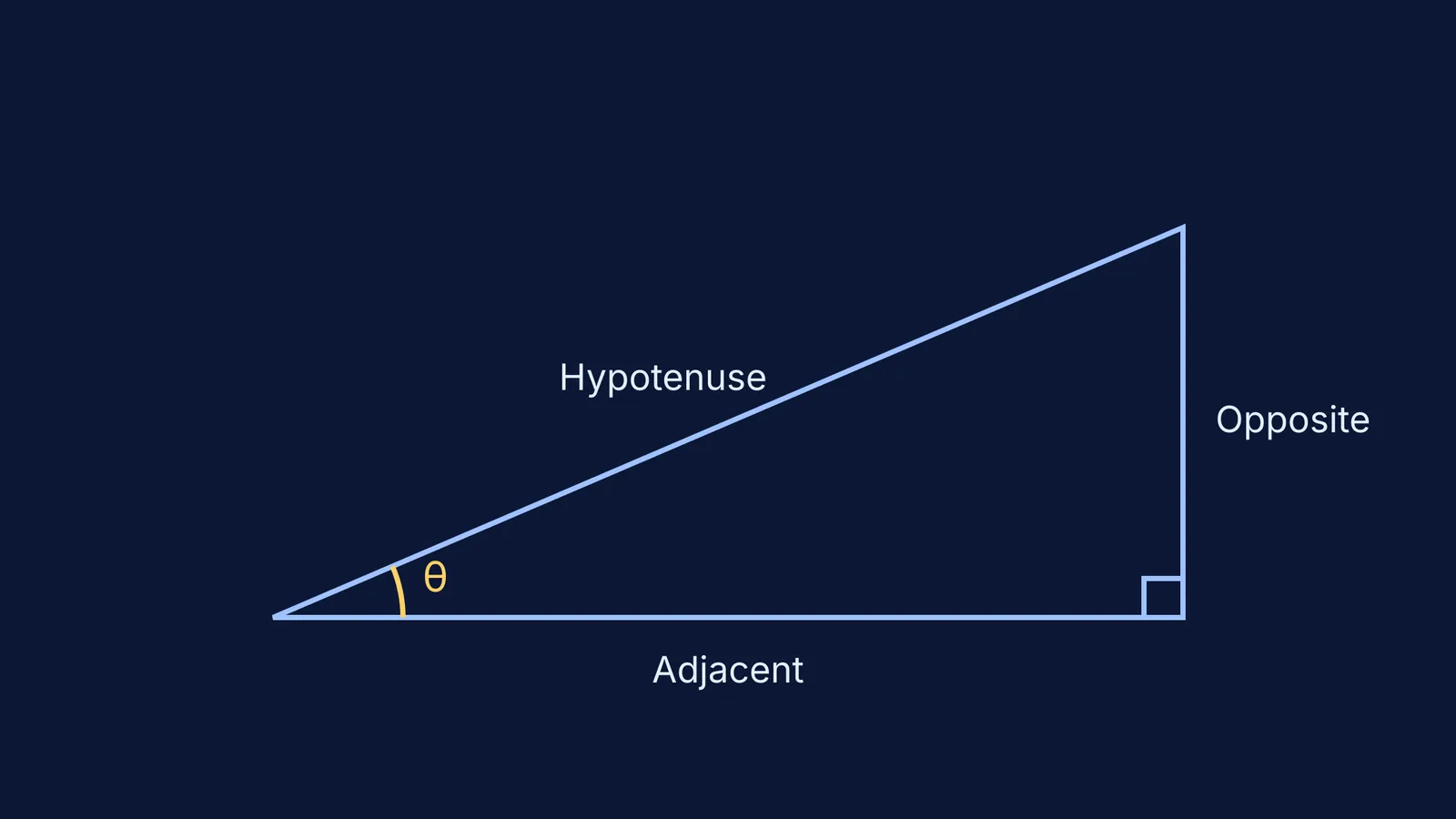
To avoid confusion, do not look at the horizontal or vertical lines. Instead, follow a strict order to label the triangle for the specific angle you are investigating:
Find the hypotenuse first: This is the longest side, always directly across from the 90° right angle. It never changes, no matter which acute angle you pick.
Mark the reference angle: Put your finger on the angle the question asks about (for example, angle θ).
Find the adjacent side: This is the leg that your finger is touching which is not the hypotenuse. The word "adjacent" simply means "next to".
Find the opposite side: This is the leg directly across from your finger. It is the only side of the triangle that does not touch the reference angle.
Once the three sides are locked in, you can safely apply your mnemonics to find the ratios.
How can an AI tutor clear trigonometric ratios class 10 doubts?
When you work through problems on your own, a textbook answer key only tells you if your final fraction is right or wrong. It will not tell you that you swapped the base and the perpendicular on line one.
This is where Fermi's AI tutor can help. Because it teaches rather than just answers, it holds a line of reasoning across a session. When you upload a diagram, you can ask Fermi to test your setup: "Before we solve this, ask me to name the opposite, adjacent and hypotenuse for the angle."
The tutor will draw the figure, wait for your labels, and check your understanding as it goes. If you get it wrong, Fermi will point out why the side you picked is actually touching the angle, guiding you to correct the mistake yourself. You can also explore the Fermi Problem Library, which has worked problems with a step-by-step solver that explains the reasoning behind each label instead of just printing the ratio. By working with the tutor, you sit down to a clear next step instead of staring at a blank page.
A script to use with your AI tutor
To build a robust habit, use this prompt with your AI tutor before every homework session:
"I am practising Class 10 trigonometric ratios. Give me a word problem with a right-angled triangle, but do not solve it. First, ask me to draw the triangle and tell you which sides are the opposite, adjacent and hypotenuse for the angle in the question. Check my labels before we move on to the ratios."
By forcing yourself to state the primary data explicitly, you clear up the geometrical doubts before they ruin the algebra.
If you are looking to brush up on other Class 10 science and maths topics, you might find our guides on concave mirror images for all six object positions, Class 10 or naming carbon compounds in Class 10: prefixes, suffixes, examples useful.


