

On this page
When a Class 10 student firmly closes their bedroom door, hides their notebook, or snaps that they do not want your help with mathematics or science, many parents feel immediate alarm. In an Indian board exam year, parental anxiety often peaks just as adolescent desire for independence surges. It is easy to interpret this refusal as arrogance, laziness, or avoidance of accountability.
Developmental science suggests an entirely different explanation. At age 15 or 16, teenagers are navigating a crucial phase of cognitive individuation. Pushing away a parent's unsolicited assistance is often a healthy bid to establish self-efficacy and intellectual ownership. When parents understand what drives this shift, they can protect both their family relationship and their teenager's academic progress.
Why does a Class 10 child refuse homework help?
In primary school, children frequently welcome a parent sitting beside them to explain long division or check spelling words. By secondary school, students develop advanced metacognition: the ability to monitor and evaluate their own thinking. Direct parental intervention during study time often feels like an implicit declaration that they are incapable of managing their own responsibilities.
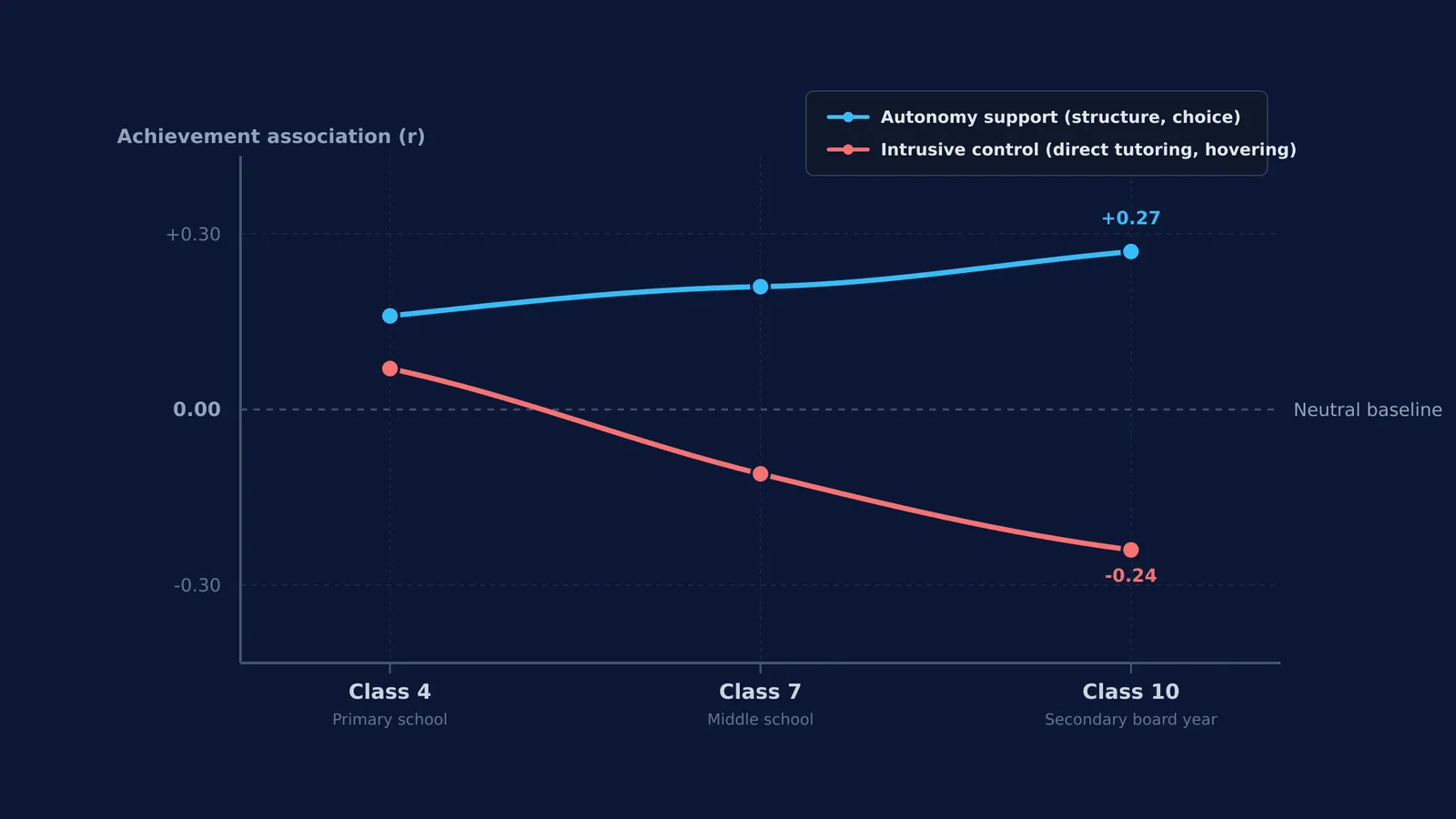
In a landmark research synthesis published in the *Review of Educational Research*, Patall, Cooper, and Robinson (2008) examined 14 training studies and 20 correlational studies across grade bands to understand how home involvement influences achievement. The synthesis revealed that while direct instruction from parents can aid younger pupils, the relationship shifts during adolescence. In secondary school, parent rule-setting and autonomy support—offering structure, encouraging independent study choices, and respecting boundaries—correlate far more positively with academic outcomes than dictating daily execution. Learning to step back is central to autonomy-supportive parenting, which fosters internal motivation rather than compliance driven by anxiety.
What does research say about parental help in high school?
Stepping in to tutor a high schooler frequently backfires. In their comprehensive analysis of longitudinal federal education data spanning three decades, sociologists Keith Robinson and Angel L. Harris published *The Broken Compass* with Harvard University Press (2014). Their analysis revealed that frequent parental help with homework in high school was consistently associated with lower test scores, not higher ones. Secondary curricula—such as Class 10 trigonometry, chemical equations, and circuit laws—often clash with the methods parents learned decades ago, confusing students and sparking emotional friction at home.
Furthermore, intrusive parental supervision can trigger a self-reinforcing downward spiral. In a longitudinal study published in the *Journal of Educational Psychology*, researchers Dumont, Trautwein, Nagy, and Nagengast (2014) investigated reciprocal dynamics between parents and students. They found that when parents observed a teenager struggling or procrastinating, they commonly responded by imposing greater control and surveillance. However, higher parental control directly predicted lower subsequent academic achievement and reduced student effort over time. Controlling involvement undermines a student's intrinsic drive, replacing competence with resentment. Knowing when to help with homework and when to step back prevents parents from inadvertently triggering this cycle.
How can parents stay informed without hovering?
Stepping back from direct tutoring does not mean disengaging from your child's education. The most effective approach treats the parent not as a foreman checking hourly output, but as a supportive consultant who provides reliable infrastructure.
Agree on a weekly review rather than daily inspection. Replace constant evening interruptions with a calm weekly conversation on Sunday to discuss upcoming deadlines, project needs, and how the student feels about their pace.
Equip them with objective study tools. When tricky numerical problems or science derivations stall progress, teenagers often resist parental corrections. The Fermi Problem Library has worked problems with a step-by-step solver that explains the reasoning rather than printing an answer, allowing students to diagnose mistakes independently.
Separate love from academic performance. Board exam pressure can distort family dynamics. As outlined in our guide on how to talk to your teenager about marks, conversations that focus exclusively on scores provoke defensive secrecy. If a teenager experiences overwhelming distress or crippling board exam anxiety, families can connect with certified counsellors through official initiatives like the Ministry of Health's Tele MANAS helpline (toll-free 14416).
Establish a neutral escalation routine. Agree in advance on how your teenager will handle conceptual roadblocks before frustration builds—whether that means listing specific questions for their school teacher the next morning, forming a study circle with peers, or consulting syllabus-aligned reference materials.
What should you say instead of asking to check their work?
Reframing everyday conversations reduces defensiveness and signals that you trust your teenager's growing autonomy.
Instead of: "Show me your notebook so I can see what you got wrong."
Try: "I am in the next room if you get stuck on a tricky physics derivation and want a sounding board. Otherwise, I will leave you to it."
Instead of: "Why are you still on the same chapter? You will never finish the syllabus at this rate."
Try: "How are you feeling about your revision schedule for this week? Let me know if you need any past papers printed or extra reference materials."
Instead of: "Listen to me, this is the exact method I used to score marks."
Try: "Which technique is helping you remember these formulas best?"
Refusing parental help with homework is not a symptom of rebellion; it is a normal step toward academic maturity. When parents respect this boundary, teenagers take genuine ownership of their studies, building the self-directed discipline they need for board examinations and lifelong learning.


