

On this page
Your child will hear the numbers anyway: from coaching batchmates, from Telegram groups, from a relative at a wedding. The question is whether they first hear them from you, calmly and in context, or from someone who uses them to scare.
Should you tell your child how competitive JEE or NEET is?
Yes, in most cases, and better in Class 11 than a month before the exam. A teenager who has chosen a path deserves to know what it looks like, and odds hidden now are found out later.
What matters is the order: numbers briefly, then effort, then options. All numbers sounds like a warning; no numbers sounds like a pep talk your child will not trust.
Pressure is already high for many students. In a survey of 570 Class 11 and 12 students in Udupi, Karnataka, carried out in 2023, 87.0% reported high perceived parental pressure and 86.0% reported high academic stress (Pienyu, Margaret and D'Souza, Journal of Education and Health Promotion, 2024). Your job in this talk is to give information without adding to that load.
What do the real numbers say?
Use official figures and say where they come from, so the talk is about facts rather than rumours.
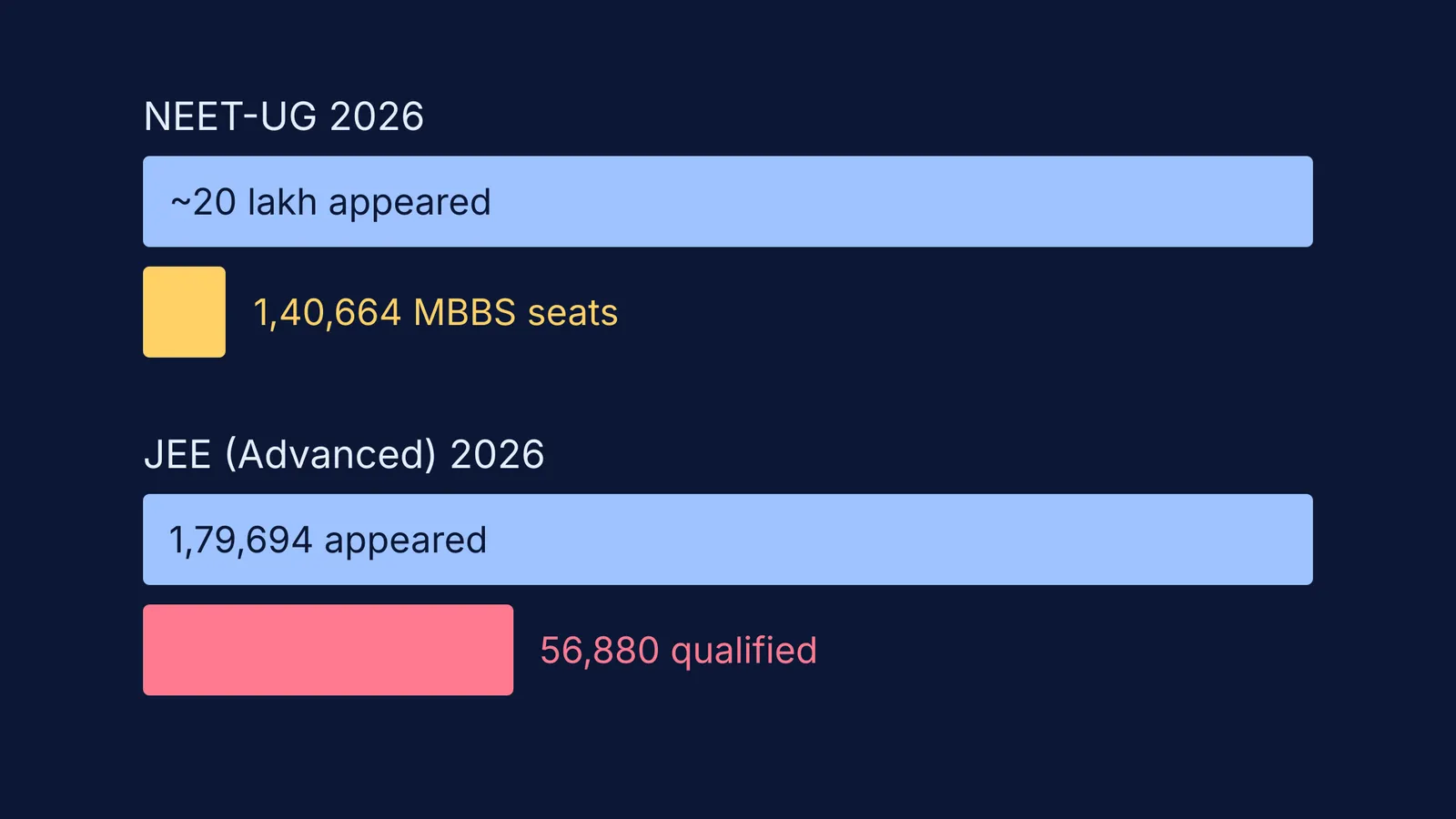
NEET-UG 2026: close to 20 lakh candidates appeared in the re-exam and 11.21 lakh qualified, according to the NTA results reported by ETV Bharat.
MBBS seats: the National Medical Commission's seat matrix lists 1,40,664 MBBS seats for 2026-27, not counting Institutes of National Importance such as AIIMS.
JEE (Advanced) 2026: 1,79,694 candidates appeared in both papers and 56,880 qualified, according to the official press release from IIT Roorkee.
Where JEE ranks lead: JoSAA 2026 allotted seats across 138 institutes, including 23 IITs, IISc Bengaluru, 31 NITs and 26 IIITs.
Say two things out loud. Qualifying NEET is not the same as an MBBS seat; qualified students also go to BDS, AYUSH and allied courses. And the IITs are 23 of 138 JoSAA institutes, not the only good result. If cutoffs and closing ranks confuse your family, read our guide on how cutoffs and closing ranks actually work.
How do you say it without frightening them?
Here is a script you can adapt, using the NTA and NMC figures above. Say it in your own words and your own language.
Open with respect: "You have chosen something hard, and I want you to have the real picture, the same one I have."
Give the numbers once: "About 20 lakh students wrote NEET this year, and there are about 1.4 lakh MBBS seats. So most students who write it do not get MBBS."
Separate odds from worth: "Those numbers are about a crowd. They say nothing about you, and nothing about how much we love you."
Move to effort: "What you control is how you study each week. Let's make that the thing we talk about."
Name the options: "If it doesn't work out this year, here are the routes we would be glad about." Then actually list them.
Hand over the microphone: "What worries you most?" Listen without correcting.
How do you frame odds alongside effort and options?
Try a three-column page, written together and kept somewhere you can both see it.
Odds: the official numbers above, with the source. One line each.
Effort: three things your child controls this month, such as one mock test a week, analysing every wrong answer, and a fixed bedtime.
Options: at least three routes your family would be proud of. For a NEET aspirant, that might be BDS, BSc Nursing or a research-track BSc in biology. For a JEE aspirant, an NIT, a strong state college, or a different field entirely; our piece on why engineering is not the only option after PCM can start that list.
A worked example with a made-up student: Meera, in Class 11, wants MBBS. Odds: the NEET and NMC numbers. Effort: "finish NCERT biology chapters before each coaching test" and "redo every wrong physics question". Options: BDS, BSc Nursing, a BSc in life sciences. When a mock goes badly, the family looks at the effort column, not the odds.
If the effort column feels vague because your child doesn't know where to start, Fermi's AI tutor can work out what they already know and build a plan for the session, so the column holds real next steps.
When is worry more than ordinary nerves?
Some nervousness is normal. If your child stops sleeping or eating well, withdraws from friends, or talks about hopelessness, speak to a doctor or counsellor. Tele MANAS, the Ministry of Health and Family Welfare's free 24x7 helpline, is reachable on 14416 or 1800-891-4416. Our guide on talking to a child who is anxious about entrance results covers the conversation after the exam.
Tonight, try only step one of the script, and listen to what your child says back.


