

On this page
In short
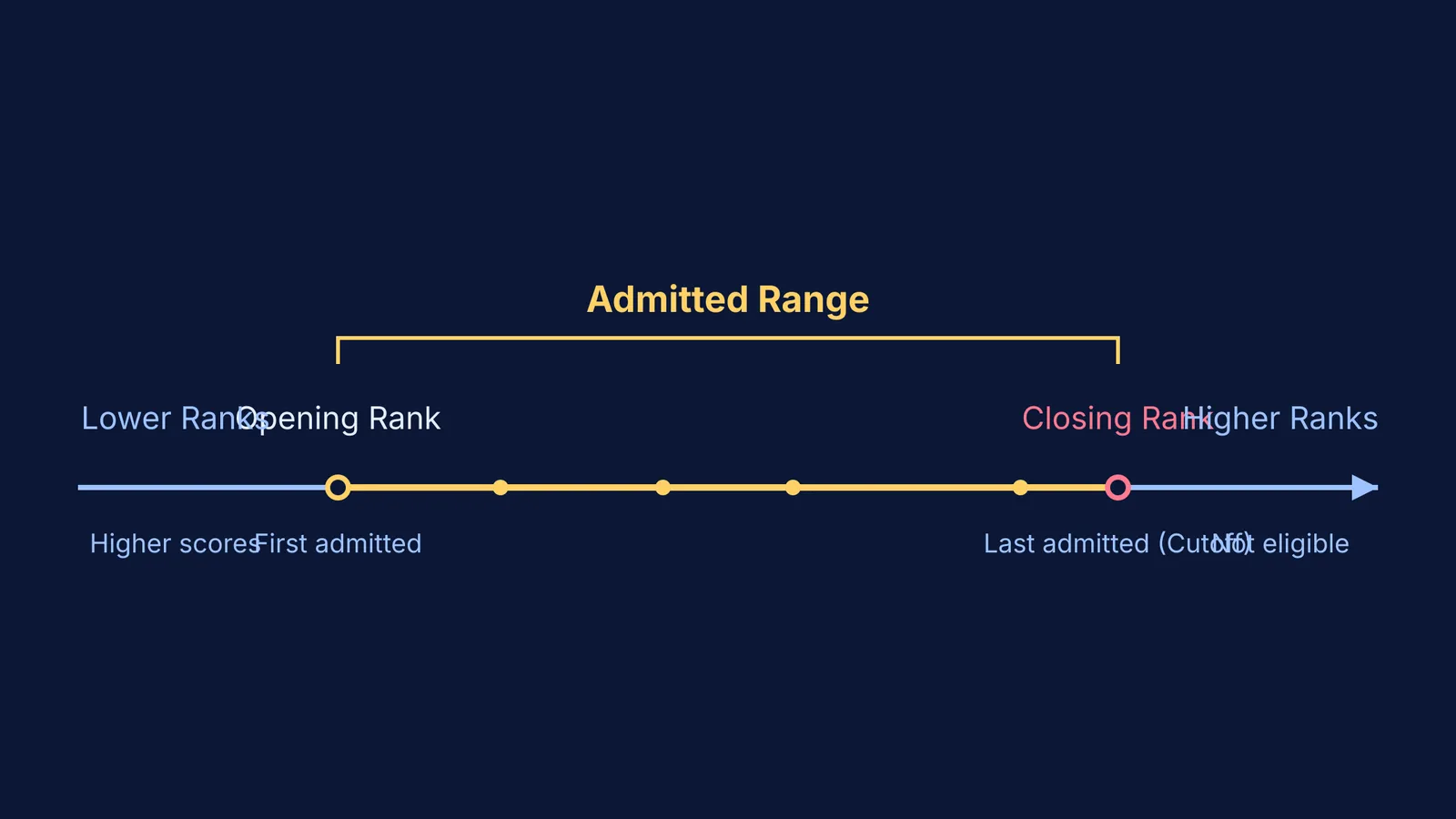
In college admissions, the opening rank is the rank of the first candidate allotted a seat in a specific course and category. The closing rank is the rank of the last candidate admitted, effectively acting as the final cutoff. If your rank is numerically higher than the closing rank, you are generally ineligible for that seat.
During seat allocation for engineering and medical colleges, official bodies like the Joint Seat Allocation Authority (josaa.nic.in) release cutoff data as Opening and Closing Ranks. Understanding these terms helps you predict whether you have a realistic chance of getting into your preferred program.
What is closing rank in counselling?
When a college admits students to a program, it ranks them based on their entrance exam scores. The rank of the first candidate to be allotted a seat is the Opening Rank (OR) josaa.nic.in. The rank of the last candidate to be allotted a seat is the Closing Rank (CR) josaa.nic.in.
The Closing Rank is the most critical number because it acts as the final cutoff boundary. If your rank is numerically higher (which means a lower score) than the closing rank, you are generally ineligible for that seat.
How to use last year's closing ranks?
When planning your choices for counselling, use the previous year's closing ranks as a guide. For example, in the JoSAA 2024 Round 1 seat allotment, the closing rank for Computer Science and Engineering at IIT Bombay for the Open (Gender-Neutral) category was 68 (cutoffs.iitr.ac.in).
If your JEE Advanced rank is 75, gaining admission to that specific seat is highly unlikely, and you should ensure you rank other attainable options higher in your preference list. For state-level exams, you can look up similar seat allotment phases to gauge your chances (see KEA counselling after KCET: option entry, rounds and seat allotment).
What happens during mock allotments?
Before the actual seat allocation begins, portals like JoSAA often conduct mock seat allotments. A mock allotment is a trial run based on the choices submitted by candidates up to a certain deadline. It gives you an early estimate of the seat you might get, but it is not a final guarantee.
During this phase, you can look at the mock closing ranks and adjust your preference list. If your rank is close to the mock closing rank of your preferred program, it is wise to add more safe choices below it to ensure you secure a seat. Mock allotments help you avoid the mistake of filling only ambitious choices and ending up with no seat at all.
Why do cutoffs change every year?
Closing ranks are not fixed; they shift based on the seat matrix (the total number of available seats) and the choices submitted by all candidates that year. If a particular branch like Artificial Intelligence suddenly becomes more popular, its closing rank will become more competitive (a numerically lower rank).
Ranks also change from round to round within the same year. For example, according to josaa.nic.in, JoSAA typically conducts five rounds of counselling for the IITs and NITs. A seat might have a closing rank of 1500 in Round 1, and relax slightly to 1550 by Round 5 if some candidates withdraw to join other colleges. This is why participating in all rounds of counselling is crucial.
If you are waiting for an allotment, understanding how scores compare is just as important as the ranks themselves. You can read more about how JEE Main percentile scores and shift normalisation work and the JEE Advanced qualifying marks: subject and aggregate cut-offs.
How do you build your choice list using closing ranks?
Find the official archives on portals like josaa.nic.in or your state equivalent to find the previous year's data. Look for the opening and closing ranks for the specific program and college.
Filter by your category, as an Open category rank cannot be compared with a reserved category closing rank. Category ranks reflect your position within your specific group.
Sort by the final round to see the true final boundary for admission. The first round is always more competitive than the last.
Build three lists for Ambitious, Realistic, and Safe programs based on how last year's ranks compare to yours. Place your dream colleges at the top, even if their closing ranks are slightly lower than your rank, followed by realistic and safe options.
How Fermi helps you reach your target rank
A closing rank is the target, but getting there takes consistent daily work. If you are struggling to bridge the gap in your mock test scores, Fermi's AI tutor can help.
When you bring a topic, a course, a problem set, or a scanned assignment, Fermi works out what you already know, builds a plan for the session, and teaches through it. It holds a line of reasoning across a whole session, notices where you are stuck, and decides whether to explain, ask, or show. If you need a step-by-step solver that explains the reasoning rather than printing an answer, try the Fermi Problem Library.


